Transfer-Matrix Method
This chapter explains how TMM combines interface reflection, propagation through each layer, and matrix multiplication to obtain multilayer R, T, A, and polarization results.
Chapter Scope
| Level | Physical statement | Simulation consequence |
|---|---|---|
| Refraction law | Angle transformation across interfaces | Internal propagation angles are determined for each layer |
| Fresnel boundary law | Amplitude split at each interface | Polarization-dependent reflection and transmission |
| In-layer phase evolution | Thickness-dependent phase accumulation | Spectral shift of resonances and fringes |
| Matrix chain | Ordered composition across all layers | Final , , , ellipsometry, and depth-resolved quantities |
Snell's Law and Angular Refraction
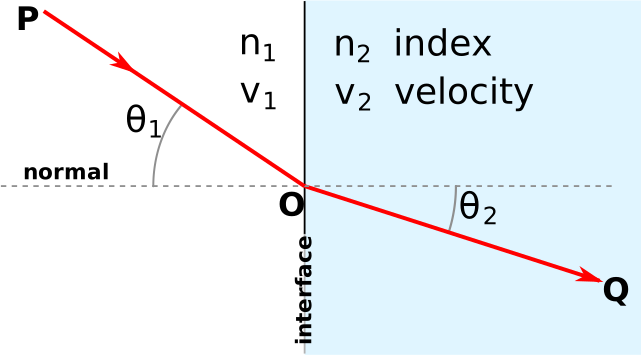
For an interface between media and , the propagation angles satisfy
In multilayers, this relation is applied recursively at every boundary. Therefore, the single input Incident Angle determines the angular state throughout the stack.
Fresnel Equations and Interface Coefficients
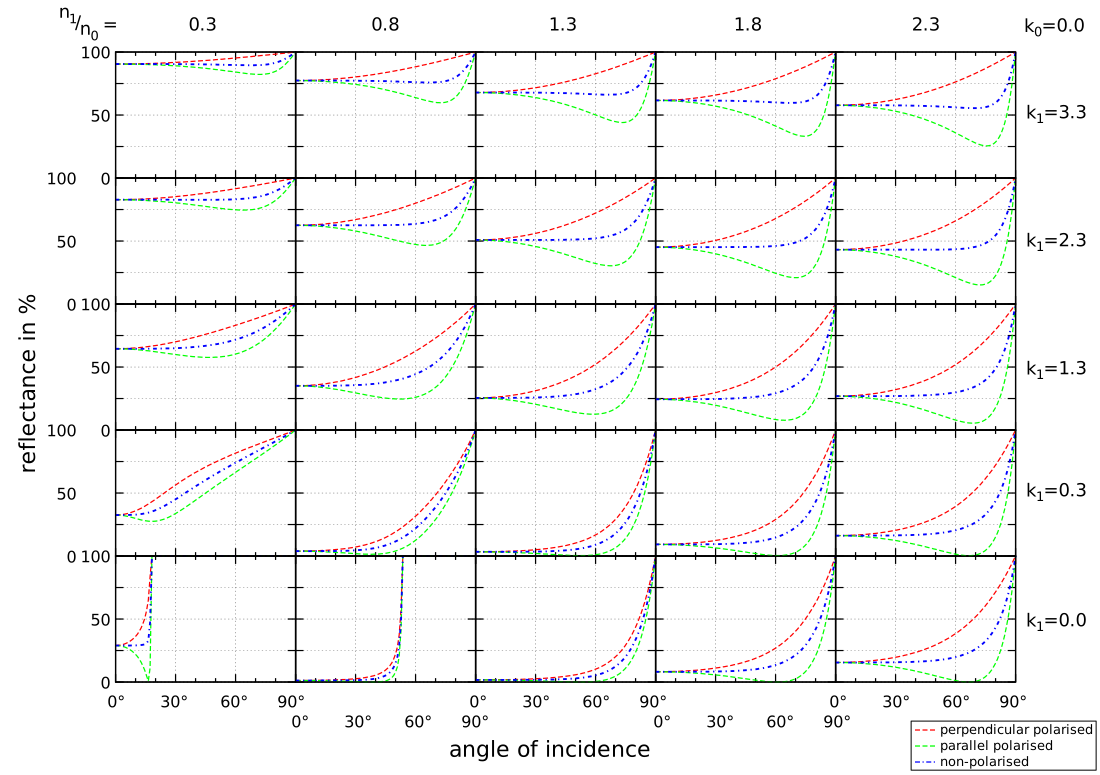
Field continuity at the interface yields amplitude coefficients. For non-magnetic media, a standard angular form is
Power coefficients are derived from amplitudes:
Phase Accumulation Inside a Layer
For a layer of thickness , refractive index , and internal angle , the phase thickness is
This term governs the displacement of interference extrema under thickness or wavelength variation.
Transfer-Matrix Composition for Multilayers
The TMM formulation combines interface and propagation operators:
A commonly used propagation matrix is
The global matrix returns and , then all power and phase observables follow from those amplitudes.
Mapping to App Outputs
| App output | Physical origin | Interpretation focus |
|---|---|---|
Reflection | R = P_ref / P_inc (reflected-to-incident power ratio) | Return-power fraction and stop-band behavior |
Transmission | T = P_tr / P_inc (transmitted-to-incident power ratio with medium/angle scaling) | Through-power fraction and coupling efficiency |
Absorption | 1 - R - T | Net dissipative loss |
Layer Absorption | Absorption decomposition by layer | Dominant loss layer localization |
Ellipsometry | rho = r_p / r_s = tan(Psi) * exp(iDelta) | Polarization phase and amplitude contrast |
Depth Distribution | Spatial field solution | Field maxima, nodes, and absorption hotspots |
External References
- Fresnel equations (RP Photonics)
- Fresnel equations (Wikipedia)
- Snell's law (Wikipedia)
- Transfer-matrix method (optics) (Wikipedia)
Next
Continue with Optical Concepts and Structure Configuration. For the assumptions this derivation relies on and where real samples break them, see Limits of the TMM Model.