Depth Detector Analysis
This page covers Normalized Poynting Vector, Absorption Density, Electric Field, and Refractive Index. This detector group is used for in-layer position analysis. System-level results belong to Basic Optical Results. Layer-level absorption attribution belongs to RTA and Layer Absorption Analysis.
Relevant result pages:
Prerequisites
| Condition | Current requirement |
|---|---|
| Detector activation | Enable the required detector in Optics > Depth Distribution |
| Coherence | Normalized Poynting Vector, Absorption Density, and Electric Field require a fully coherent stack |
| Depth Resolution | Set after enabling depth detectors; controls the number of depth samples |
| Analysis entry | Run and Run Sweep |
| Direct optimization | Depth quantities are not direct optimization targets in the current implementation |
Detector Roles
| Detector | Main information | Primary use |
|---|---|---|
Normalized Poynting Vector | normalized energy flow along depth | energy transport and interface-to-interface flow change |
Absorption Density | local dissipation strength | absorption location and parasitic-loss location |
Electric Field | spatial distribution of field magnitude or phase | standing-wave nodes, field enhancement, interface-mode localization |
Refractive Index | depth-expanded refractive-index background | comparison against layer boundaries and heatmap zones |
Application Scope
| Scenario | Primary results | Recommended sweeps |
|---|---|---|
| Parasitic-absorption localization | Absorption Density, Layer Absorption | wavelength window, thickness |
| Cavity field enhancement | Electric Field | wavelength window, thickness, incidentAngle |
| Interface modes, defect modes, cavity modes | Electric Field, Normalized Poynting Vector | wavelength window, incidentAngle, pRatio |
| Standing-wave node and antinode inspection | Electric Field | wavelength window, thickness |
| Post-optimization validation | depth detectors + R / T / A | optimize first, then inspect local behavior |
Baseline Model
Structure
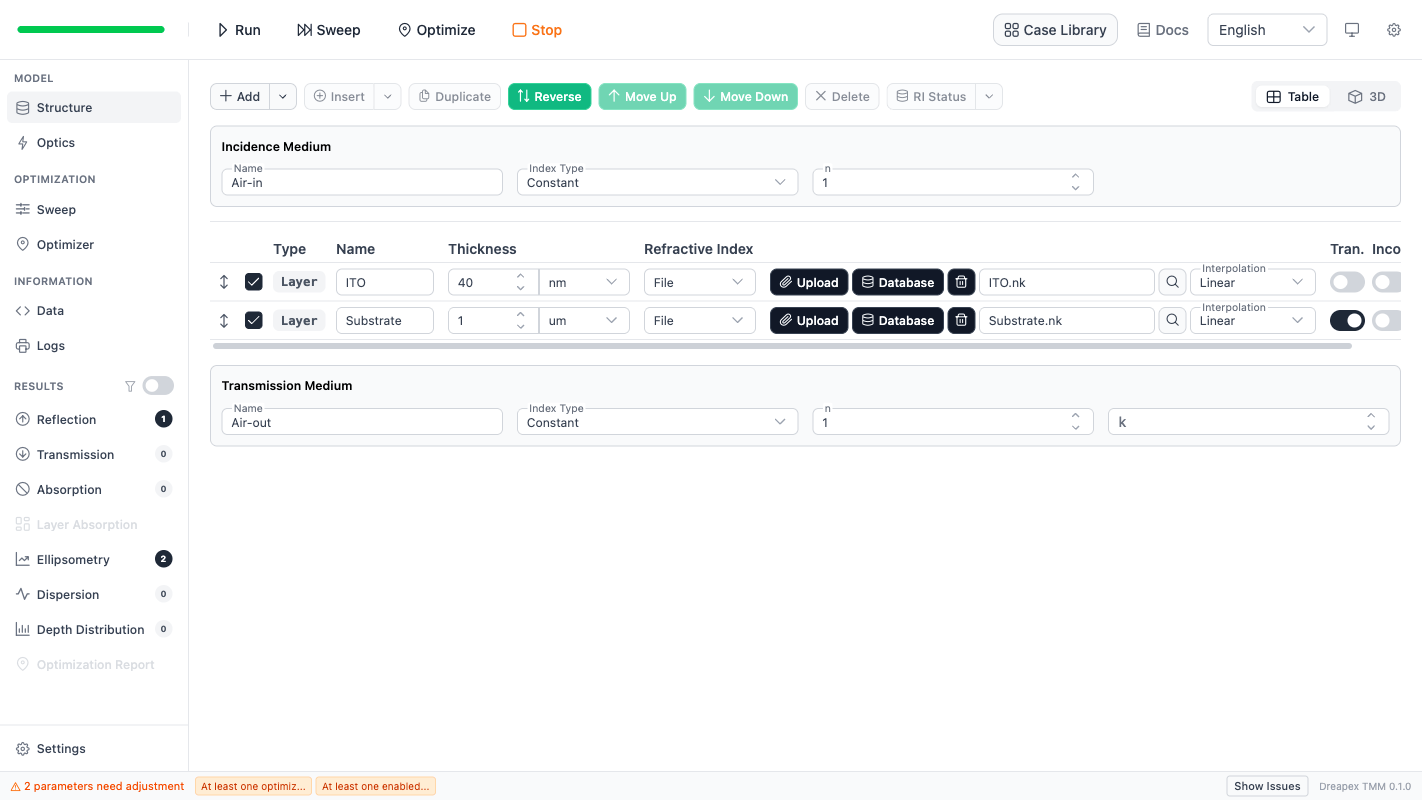
This example keeps the same ITO 40 nm + Substrate 1 um stack. As in the ellipsometry section, the full stack remains coherent to make in-layer field distributions available.
Single-Wavelength Optical Parameters
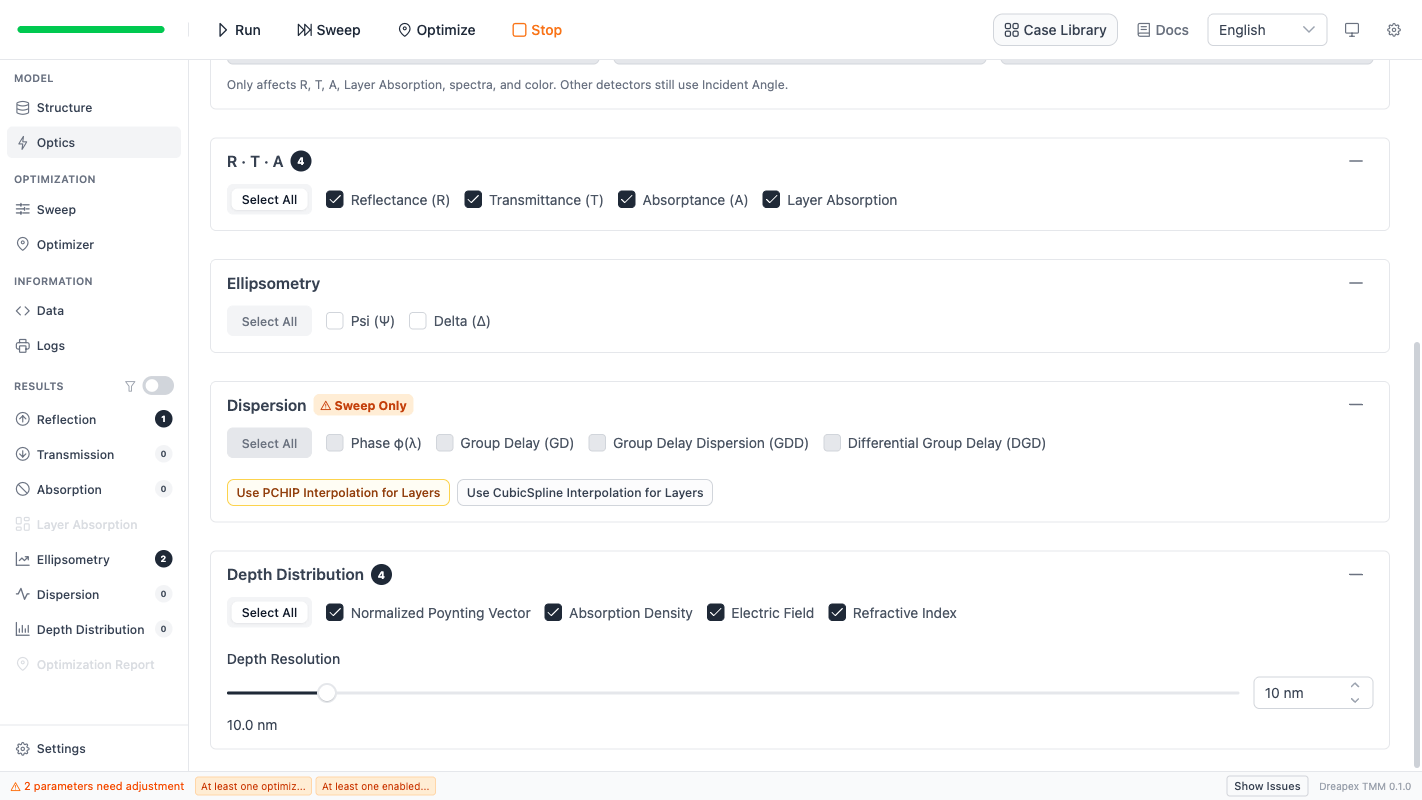
| Item | Setting |
|---|---|
| Wavelength Sampling | Single |
| Wavelength | 550 nm |
| Incident Angle | 0° |
| pRatio | 0.5 |
| Base detectors | Reflectance, Layer Absorption |
| Depth detectors | Normalized Poynting Vector, Absorption Density, Electric Field, Refractive Index |
| Depth Resolution | 10 nm |
Wavelength-Sweep Optical Parameters
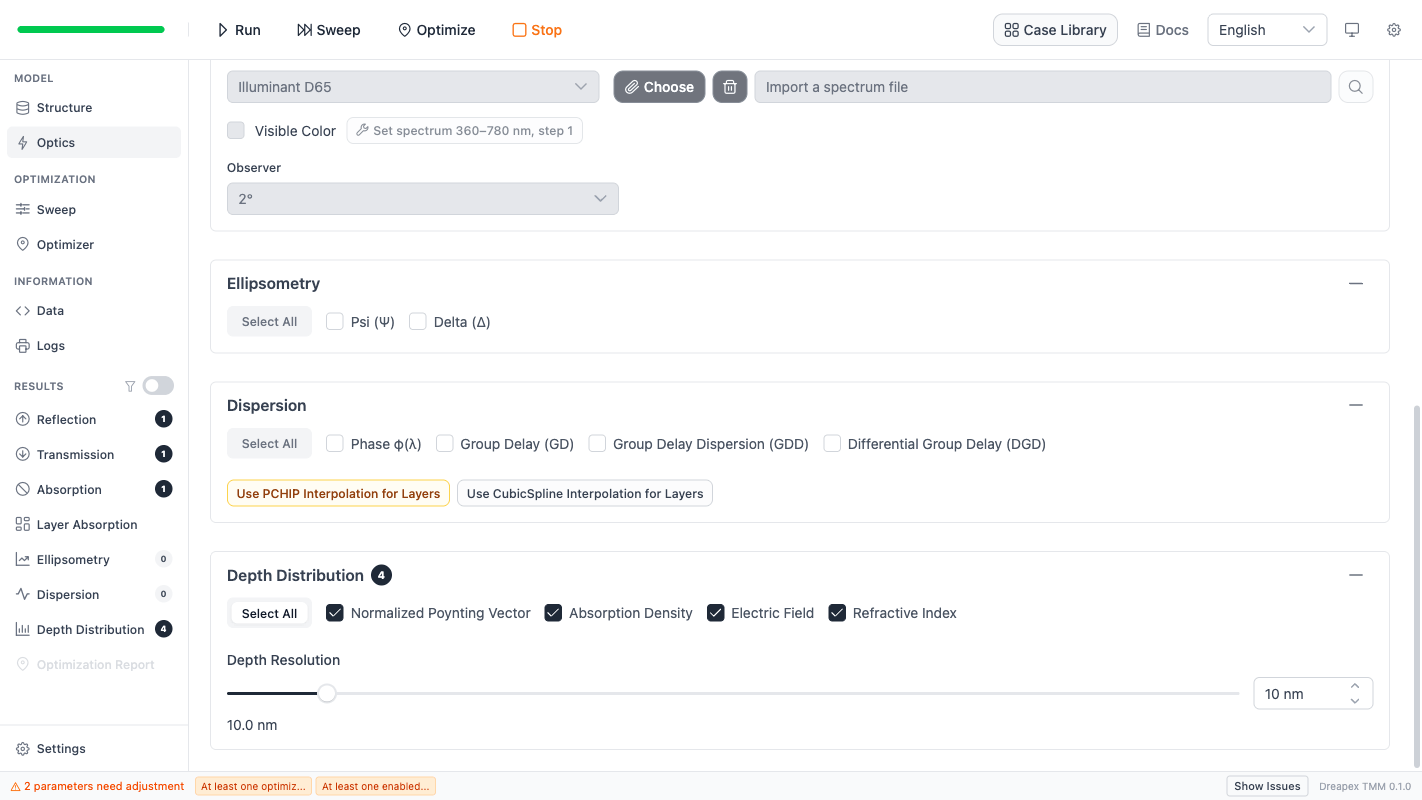
| Item | Setting |
|---|---|
| Wavelength Sampling | Sweep |
| Wavelength range | 400-900 nm |
| Step | 20 nm |
| Incident Angle | 0° |
| pRatio | 0.5 |
| Depth Resolution | 10 nm |
Single Run
Electric Field Line Chart
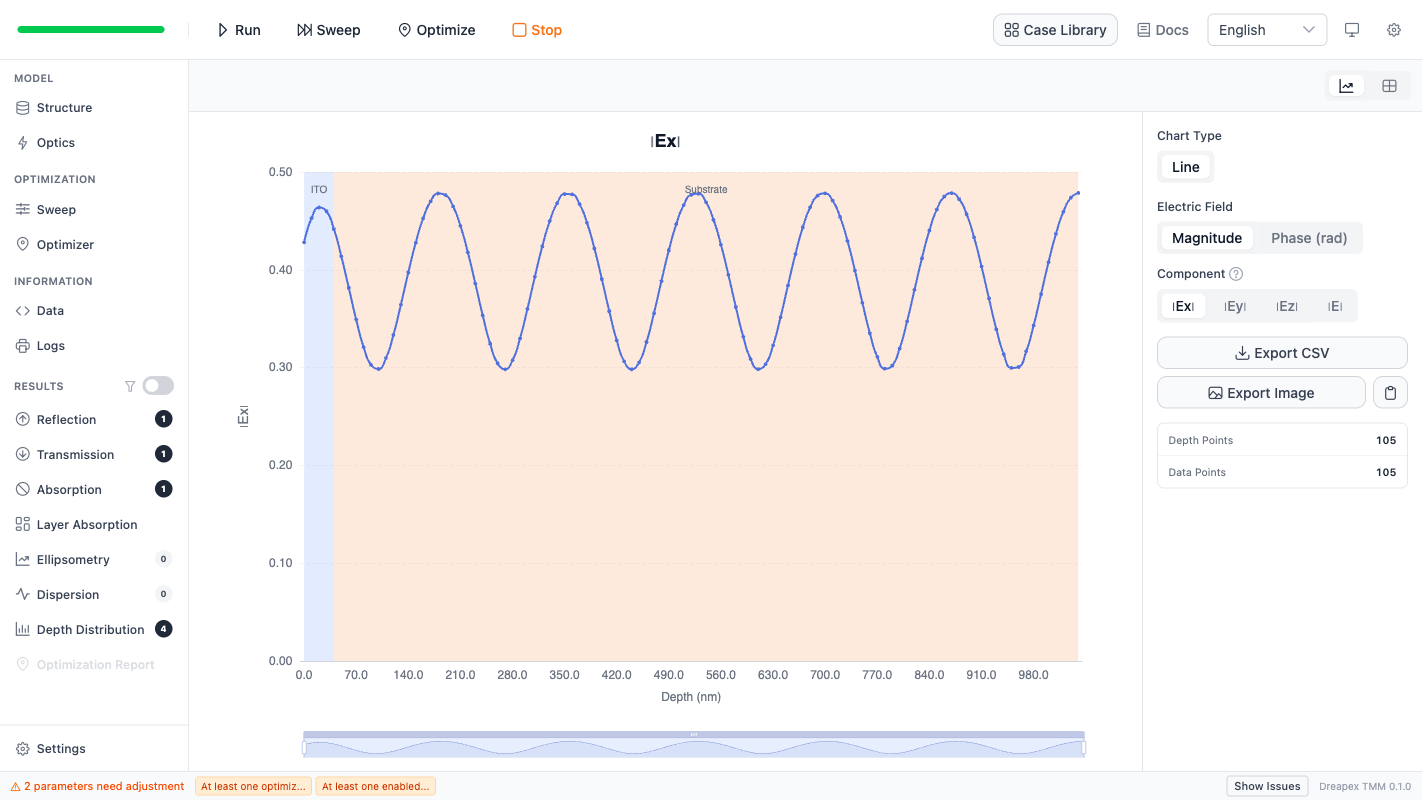
This figure corresponds to a single wavelength with no Sweep parameter. The horizontal axis is depth, and the shaded regions mark layer boundaries. It is used to read:
- node and antinode positions
- whether the target layer sits in a high-field region
- whether local enhancement appears near an interface
In this example, the ITO layer is thin and the main oscillation sits in the substrate region. This is a good baseline for deciding whether thickness sweeps are necessary.
Normalized Poynting Vector Line Chart
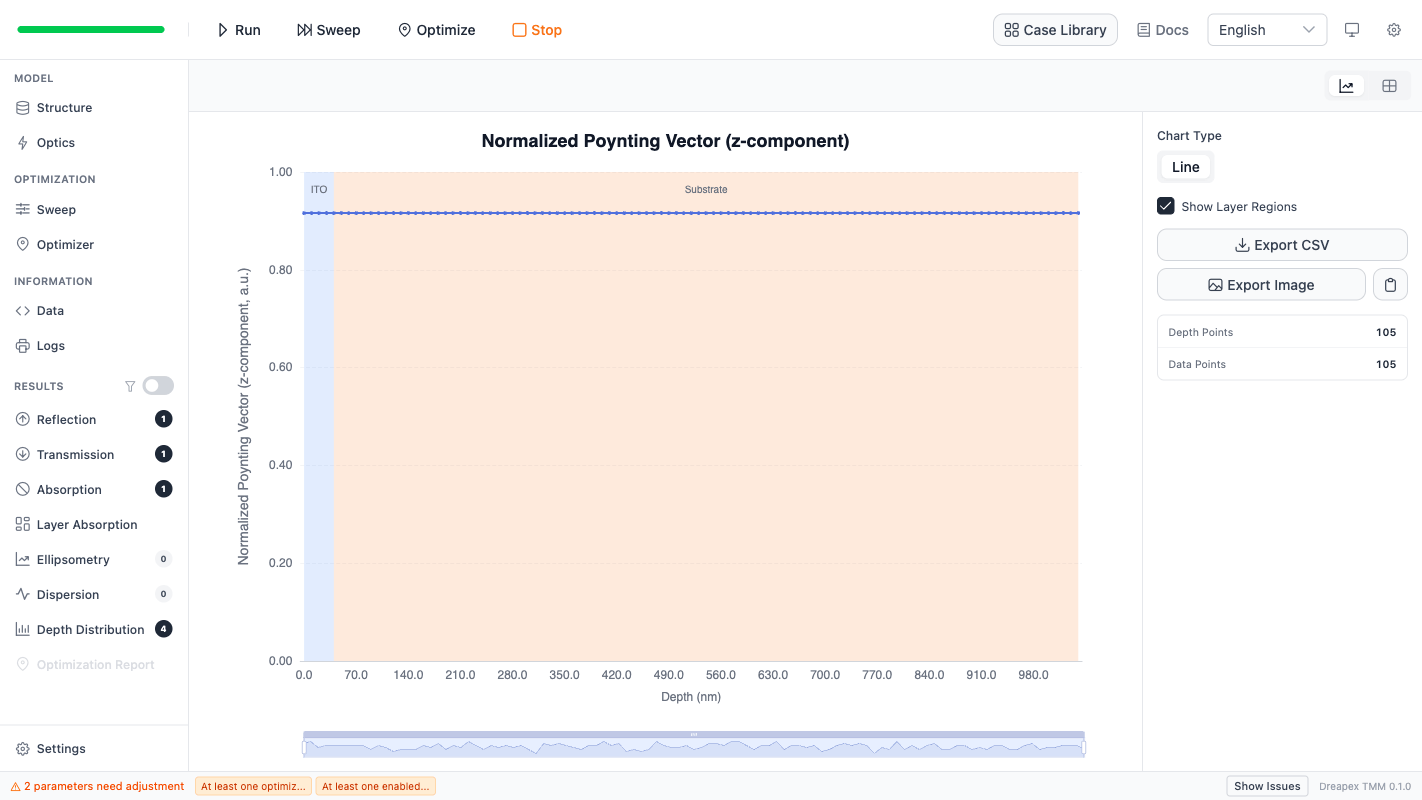
This chart shows that normalized energy flow stays nearly flat along depth for each thickness, with different thickness values shifting the overall level. It is used to read:
- whether energy transport remains smooth across the stack
- whether some thickness values introduce extra flow loss
Normalized Poynting Vector is most useful together with Absorption Density. By itself it does not locate where absorption happens.
One-Parameter Sweep
Sweep Setup
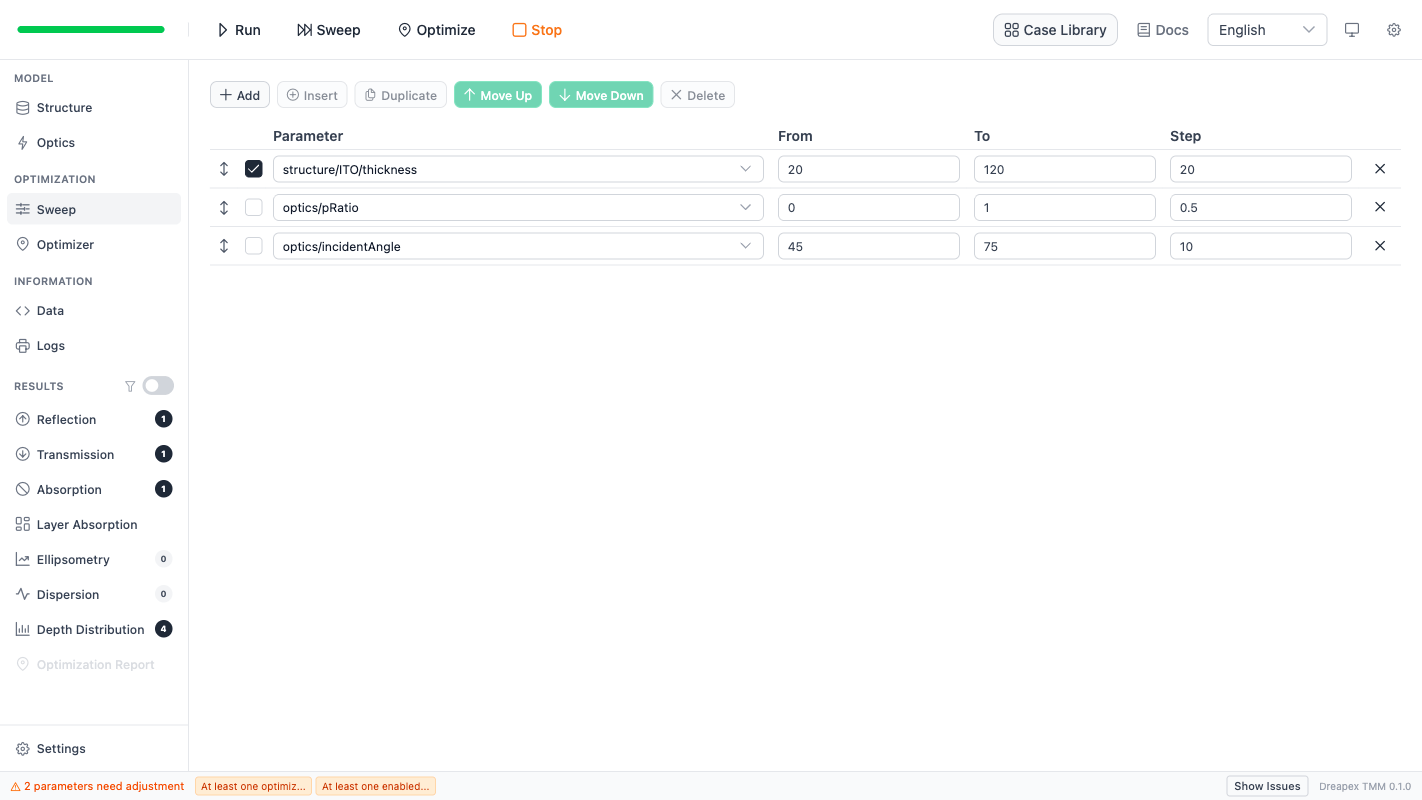
| Parameter | From | To | Step |
|---|---|---|---|
structure/ITO/thickness | 20 | 120 | 20 |
Electric Field Heatmap
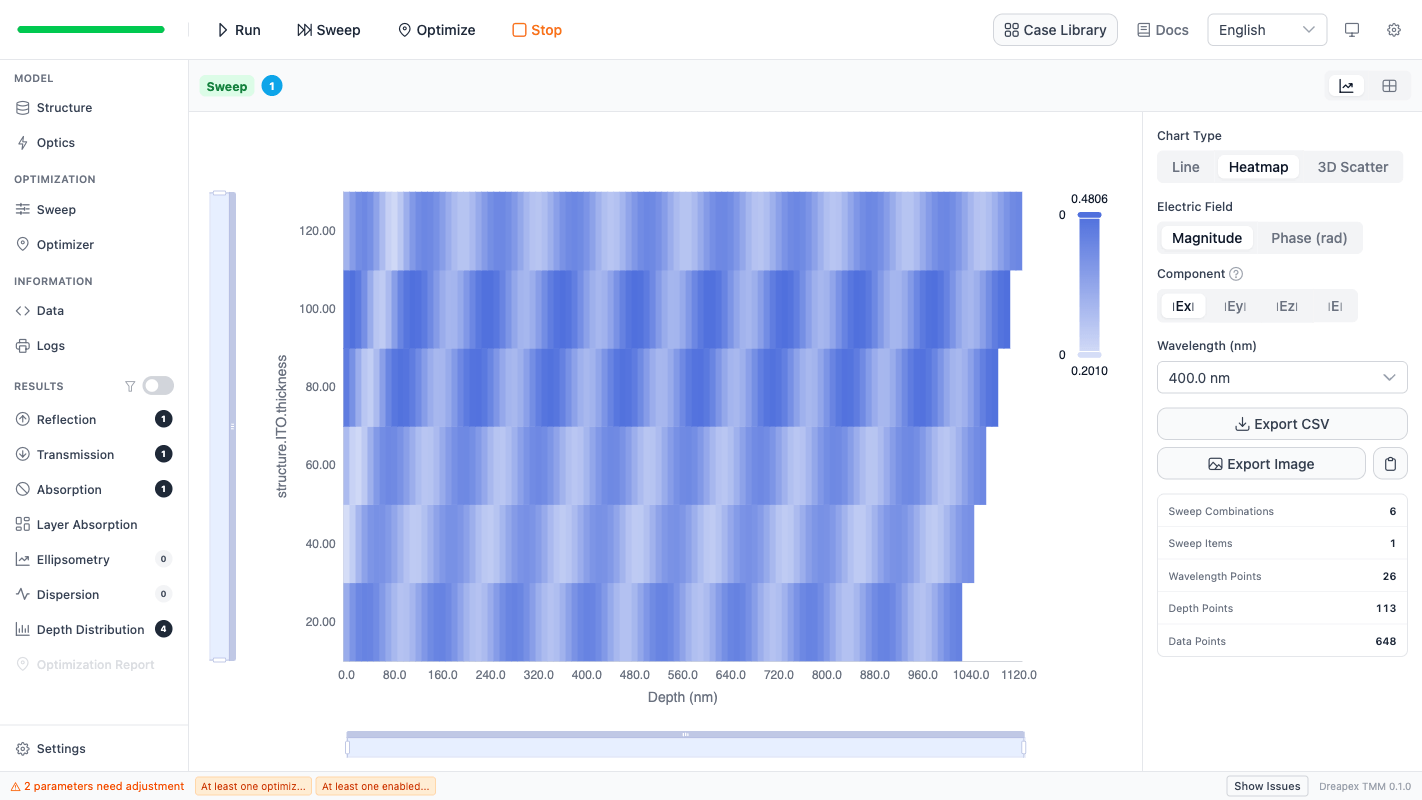
This chart is fixed at 560 nm. The horizontal axis is depth and the vertical axis is ITO thickness. It is used to read:
- whether nodes and antinodes shift with thickness
- whether the high-field region moves into the target layer
- which thickness ranges produce a more stable spatial distribution
The heatmap is the primary depth view for one-parameter sweeps. It is better than a line chart for comparing multiple stacks.
Electric Field 3D Scatter
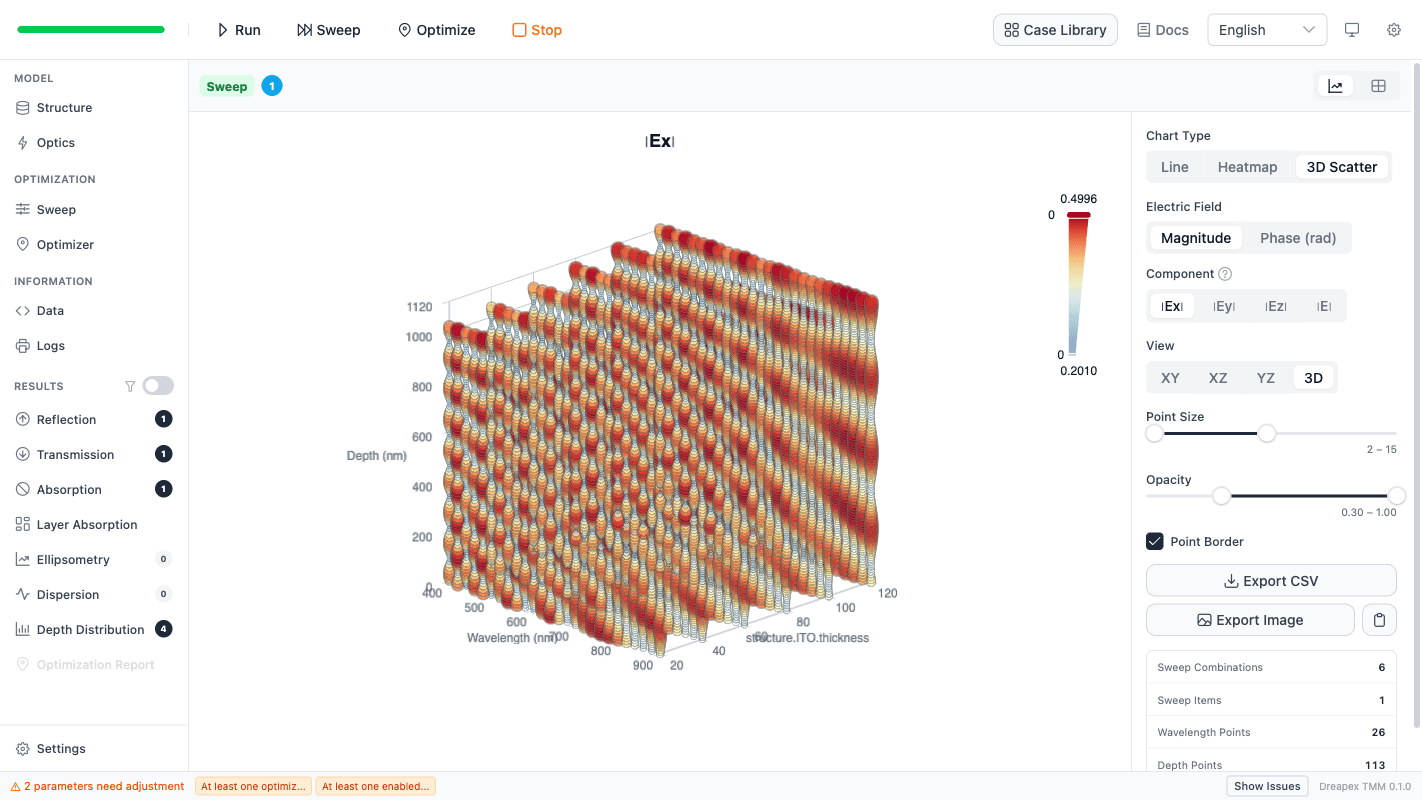
This chart keeps wavelength, depth, and ITO thickness as axes. It is used to read:
- whether field enhancement persists along a wavelength-thickness trajectory
- whether extrema are isolated hot spots or continuous ridges
- whether resonance locations shift systematically with thickness
The 3D scatter is a trend-inspection tool. Exact positions should still be checked in line or heatmap views.
Absorption Density Heatmap
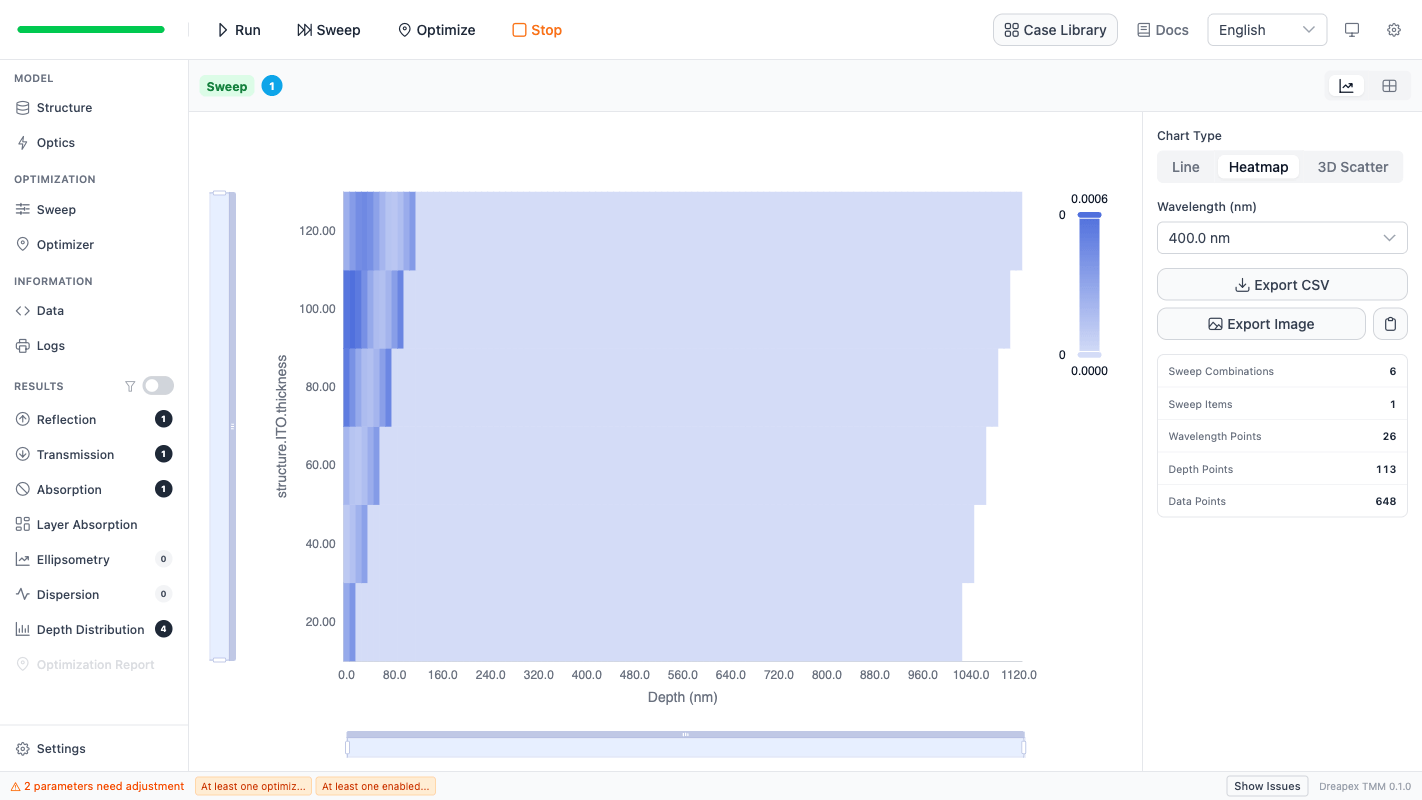
In this baseline stack the local absorption density is near zero, so the map is close to a uniform background. This figure is still useful because it establishes two rules:
Absorption Densityonly becomes visually strong when the stack contains significant local dissipation- a nearly uniform map should trigger a back-check in
AbsorptanceandLayer Absorption, not an automatic assumption of error
A flat depth heatmap can simply mean that the baseline structure has weak local loss in the current band.
Relation to Layer Absorption
| Results page | Resolution level | Primary role |
|---|---|---|
Layer Absorption | by layer | identify which layer absorbs |
Absorption Density | inside a layer | identify where inside that layer absorption occurs |
Electric Field | field distribution | check whether absorption overlaps with a high-field region |
Recommended order:
- Use
Absorptanceto confirm that significant total absorption exists. - Use
Layer Absorptionto identify the layer of interest. - Use
Absorption DensityandElectric Fieldto locate the in-layer position and the field-enhancement region.
Recommended Sweep Order
| Goal | Recommended order |
|---|---|
| Locate local absorption | Layer Absorption → Absorption Density heatmap → Electric Field |
| Inspect interface or cavity modes | Reflectance or spectral results → Electric Field heatmap → Electric Field 3D scatter |
| Post-optimization validation | Optimization Report → R / T / A → depth results |
Relation to the Optimizer
| Item | Current status |
|---|---|
| direct optimization on depth quantities | Not supported |
| recommended use | physical validation after optimization |
Depth detectors belong after the optimizer in the current workflow. First use R / T / A to identify candidate structures. Then use depth results to validate whether the local physical picture is acceptable.
Conclusion Boundaries
- Depth detectors apply to internal field analysis in one-dimensional layered stacks.
- The current results must not be used to explain lateral patterns, scattering structures, or general 2D / 3D mode problems.
Refractive Indexis primarily a structural background view, not a standalone performance metric.
Case Study Entry
For full structures and workflows, see Case Studies. Future cases will cover parasitic-absorption localization, interface modes, cavity-enhanced absorption, and post-optimization depth validation.
Next Step
The current Analysis chapter now covers the three main detector groups. Continue with Case Studies for full application workflows.