RTA and Layer Absorption Analysis
This guide combines R/T/A and Layer Absorption with Sweep and Optimizer for structural analysis. Use it to compare parameter changes, locate layer-level losses, and verify optimization results.
Information Scope
| Result quantity | Output level | Main information |
|---|---|---|
Reflectance | System level | Reflection level, band-edge position, angular drift |
Transmittance | System level | Transmission level, passbands, window efficiency |
Absorptance | System level | Total absorption, total loss budget |
Layer Absorption | Layer level | Layer-by-layer absorption allocation, parasitic-loss location |
Reflection / Transmission / Absorption Spectrum | Spectral level | Band shape, spectral shaping, color precursor information |
Reflection / Transmission / Absorption Color | Visible-color level | Visual output under the current illumination setting |
Application Scope
| Scenario | Primary results | Typical sweeps | Direct optimization availability |
|---|---|---|---|
| Anti-reflection and high-transmission coatings | R, T | thickness, incidentAngle, surroundings.n | Yes |
| High reflectors and DBRs | R, T | thickness, repeatCount, incidentAngle, pRatio | Yes |
| Long-pass, short-pass, band-pass, and notch filters | R, T | thickness, repeatCount, incidentAngle | Yes |
| Beam splitters and dichroic splitters | R, T | thickness, incidentAngle, pRatio | Yes |
| Transparent conductive films | T, A, Layer Absorption | thickness, material k, incidentAngle | Yes |
| Front-optics analysis for solar cells | R, A, Layer Absorption | thickness, material k, incidentAngle | Partial. R / T / A only |
| Ultrathin absorbing interference coatings | R, A, Layer Absorption | thickness, wavelength window, incidentAngle | Partial. R / T / A only |
| Color films and decorative coatings | spectral results, color results | thickness, incidentAngle, pRatio | No |
Baseline Model
Structure
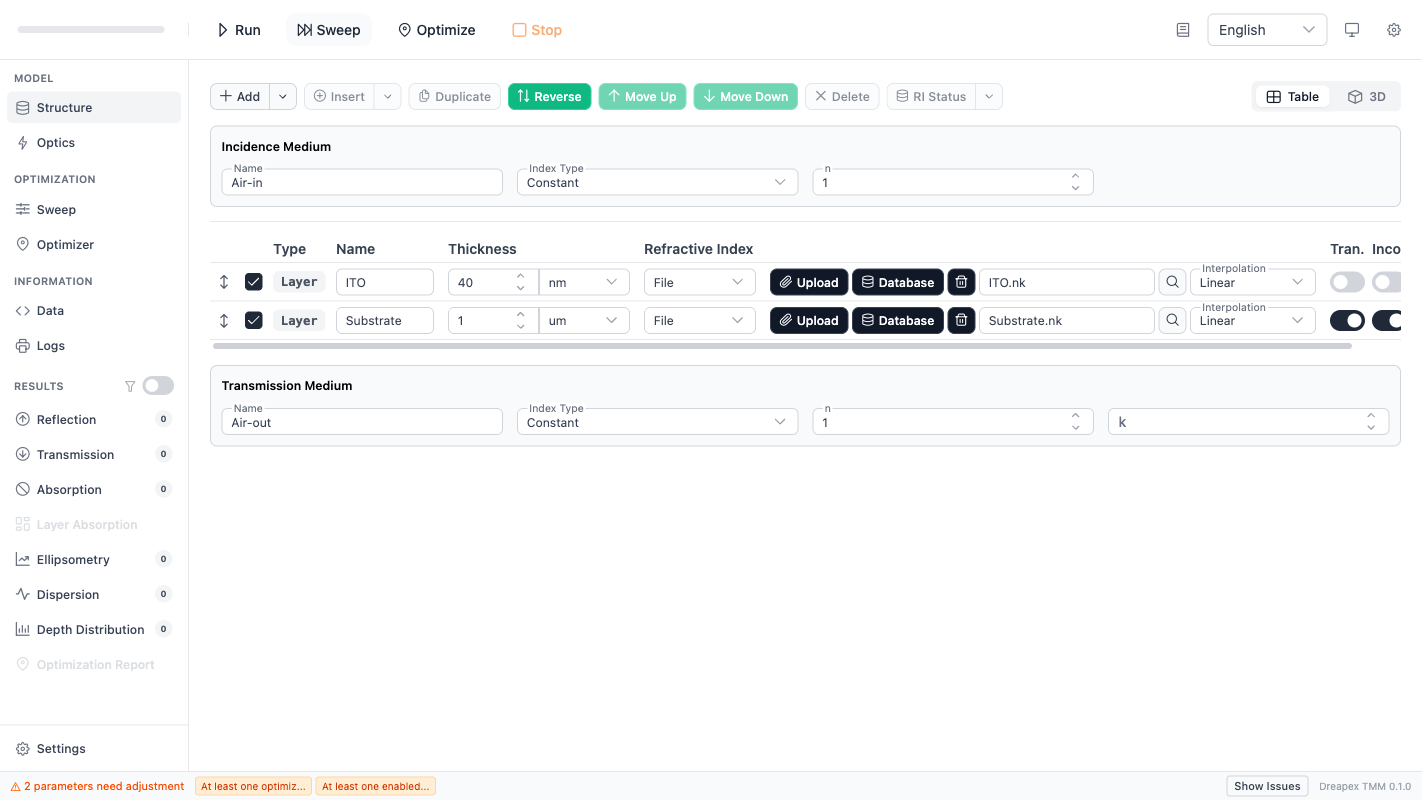
| Item | Setting |
|---|---|
| Incidence medium | Air-in, n = 1 |
| First layer | ITO, 40 nm, Index Type = File, file ITO.nk |
| Second layer | Substrate, 1 um, Index Type = File, file Substrate.nk |
| Transmission medium | Air-out, n = 1 |
Optical Parameters
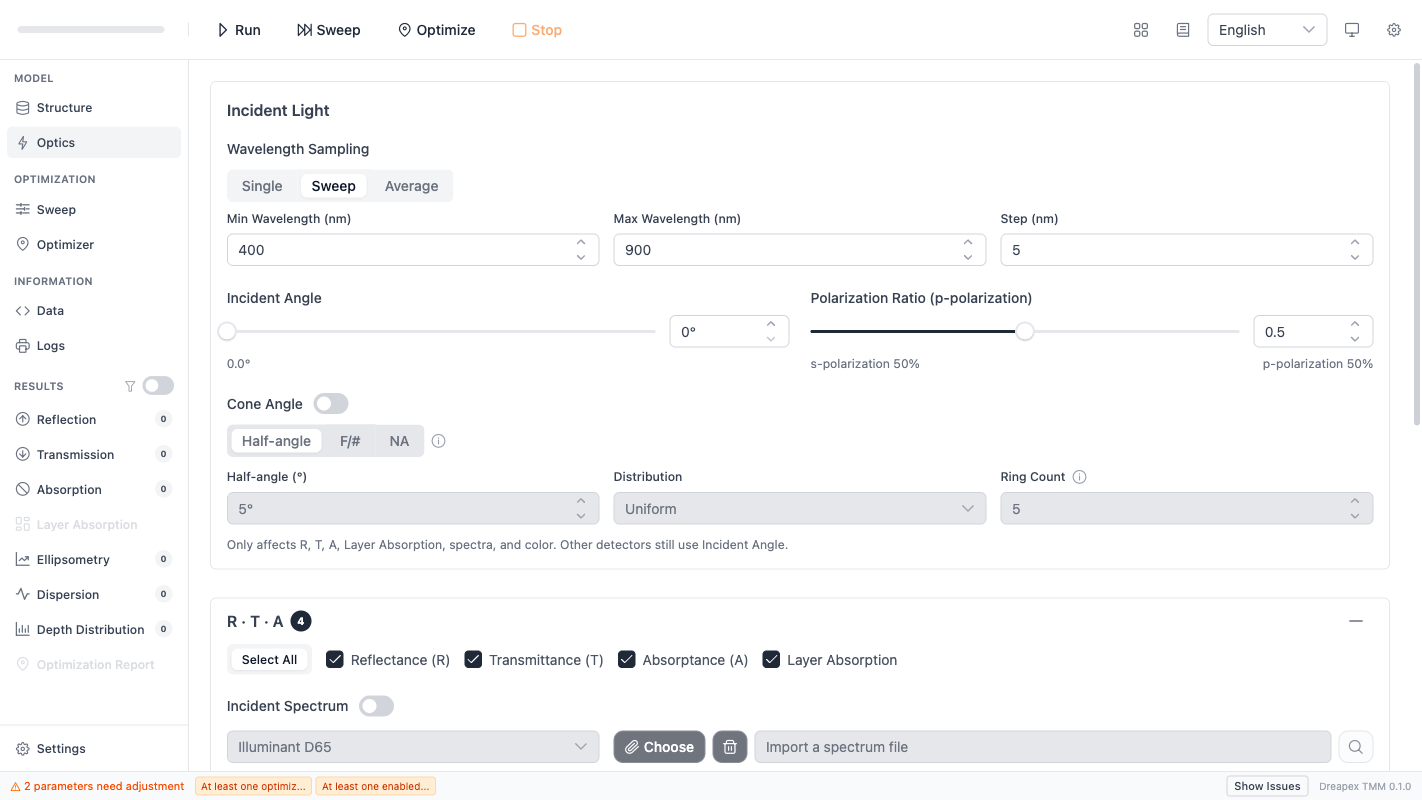
| Item | Setting |
|---|---|
| Wavelength Sampling | Sweep |
| Wavelength range | 400-900 nm |
| Step | 10 nm |
| Incident Angle | 0° |
| pRatio | 0.5 |
| Detectors | Reflectance, Transmittance, Absorptance, Layer Absorption |
This setup is the minimum baseline for explaining thickness sweeps, angle sweeps, and one-variable optimization.
One-Parameter Sweep
Sweep Setup
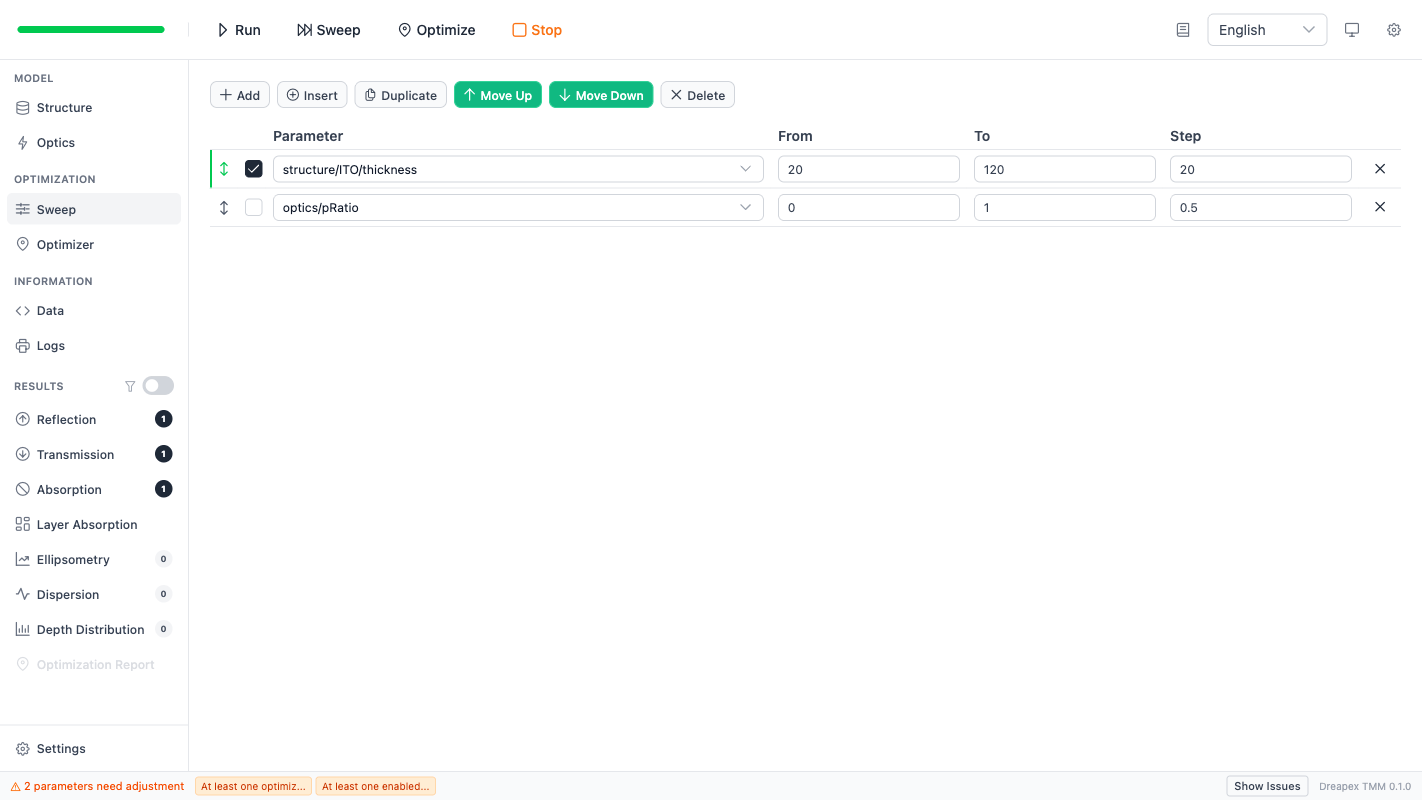
| Parameter | From | To | Step |
|---|---|---|---|
structure/ITO/thickness | 20 | 120 | 20 |
Reflectance Line Chart
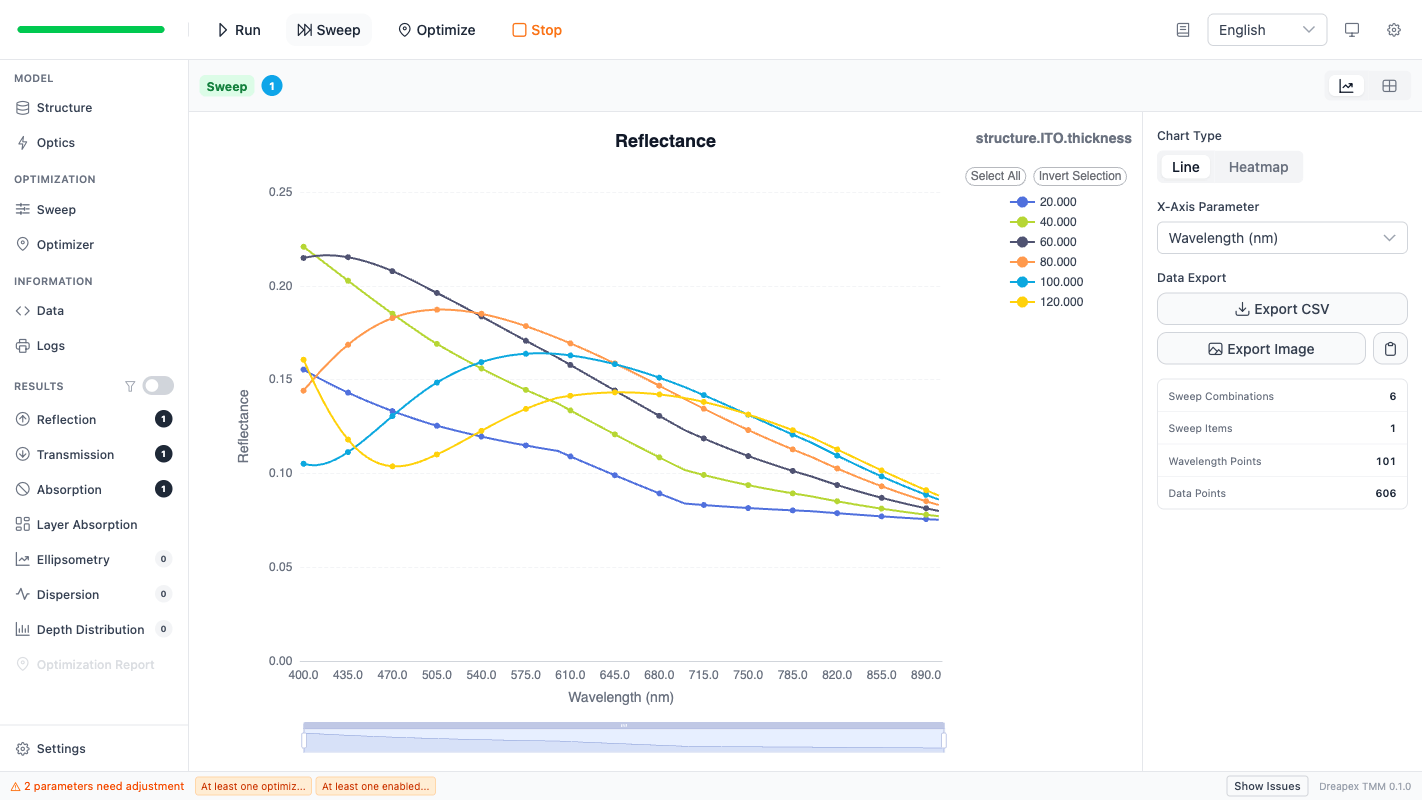
This chart keeps the full wavelength axis. Each curve corresponds to one thickness value. It is the primary chart for:
- band-shift reading
- overall reflectance reduction
- spectral crossings inside the target range
One-parameter line charts are the first screen for deciding whether a variable is physically effective. If all curves nearly overlap, the current variable is not a productive sweep target.
Reflectance Heatmap
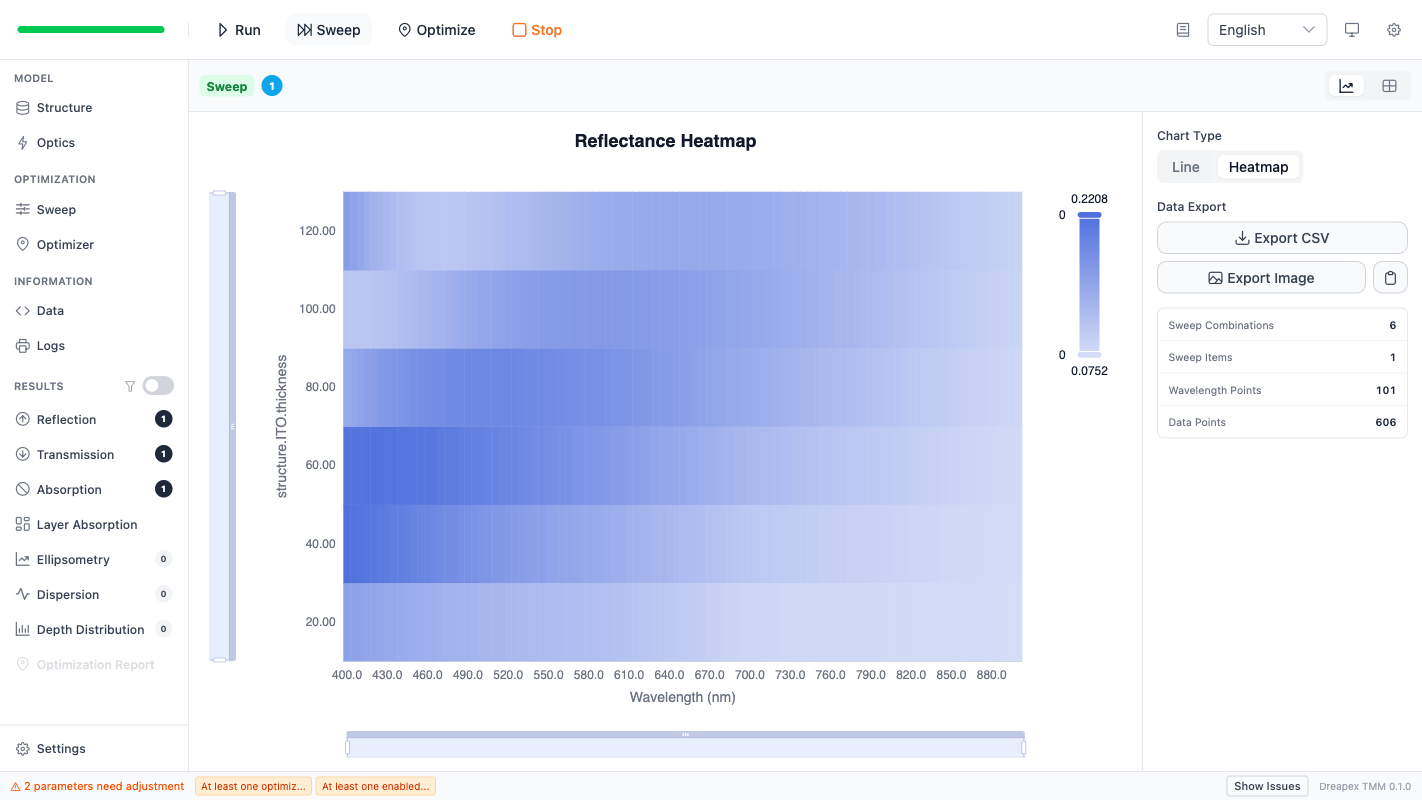
The same data in Heatmap mode turns wavelength and thickness into a two-dimensional map. This view is used to read:
- low-reflectance windows
- slope of the reflectance valley versus thickness
- regions with smooth versus sensitive behavior
The line chart is better for local curve shape. The heatmap is better for continuous operating windows.
Layer Absorption Heatmap
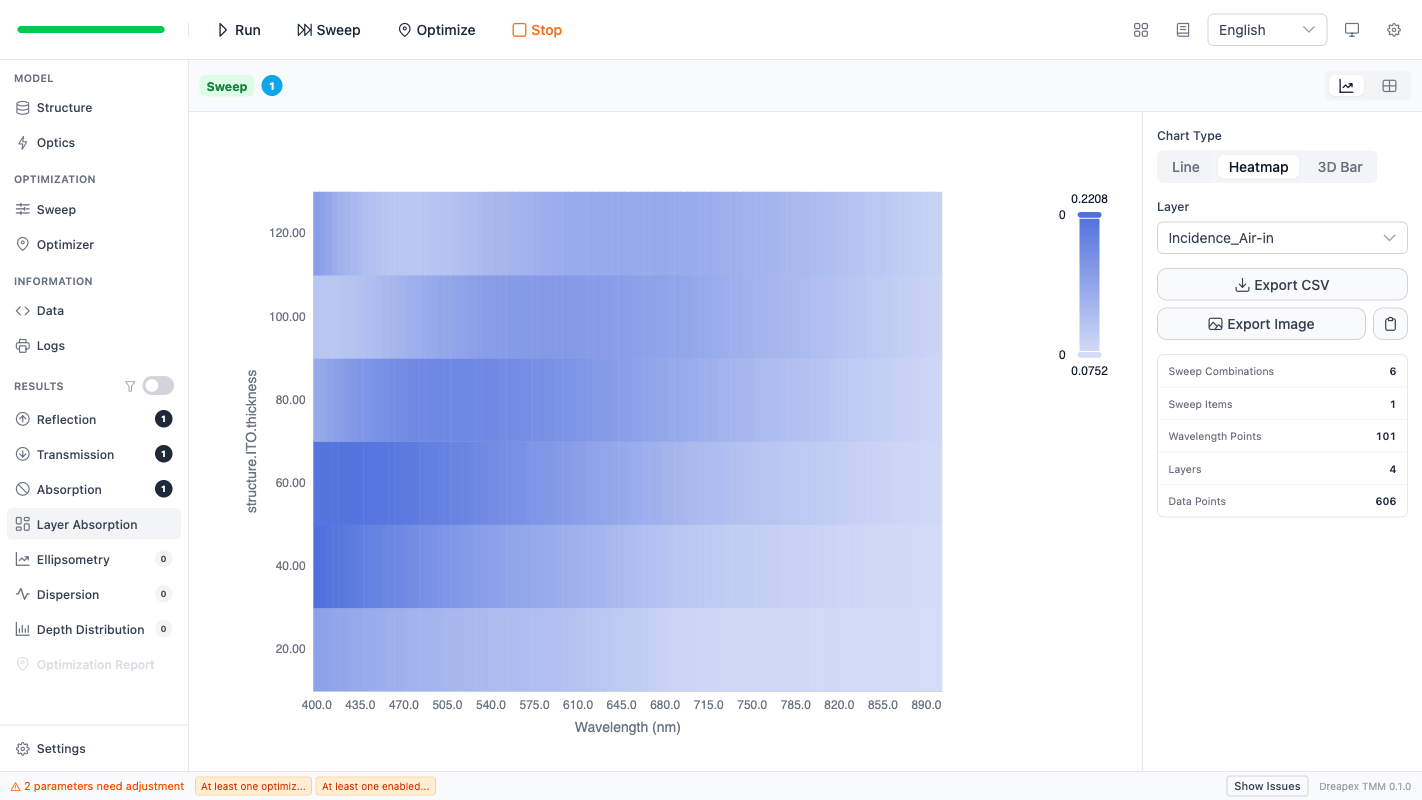
This figure is filtered to the ITO layer. Short wavelengths show stronger absorption. The absorption level rises with increasing thickness and becomes weak at longer wavelengths. This chart answers two questions:
- whether total absorption is concentrated in the intended layer
- whether added thickness increases loss inside a specific layer
If Absorptance rises while Layer Absorption does not concentrate in the intended layer, the next checks are material file, stack order, and substrate setup.
Two-Parameter Sweep
Sweep Setup
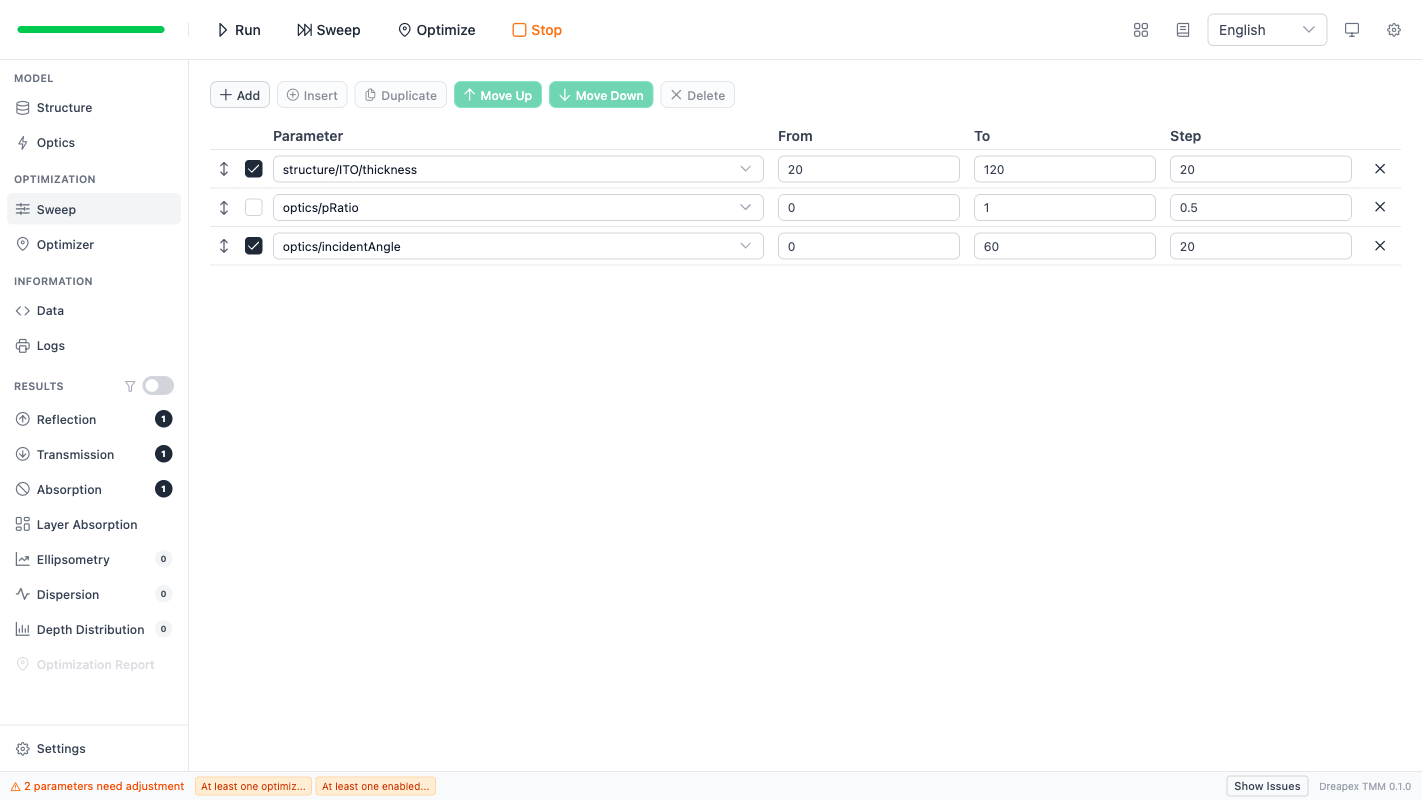
| Parameter | From | To | Step |
|---|---|---|---|
structure/ITO/thickness | 20 | 120 | 20 |
optics/incidentAngle | 0 | 60 | 20 |
Two-parameter sweeps are the primary tool for design windows and angular stability.
Reflectance Heatmap
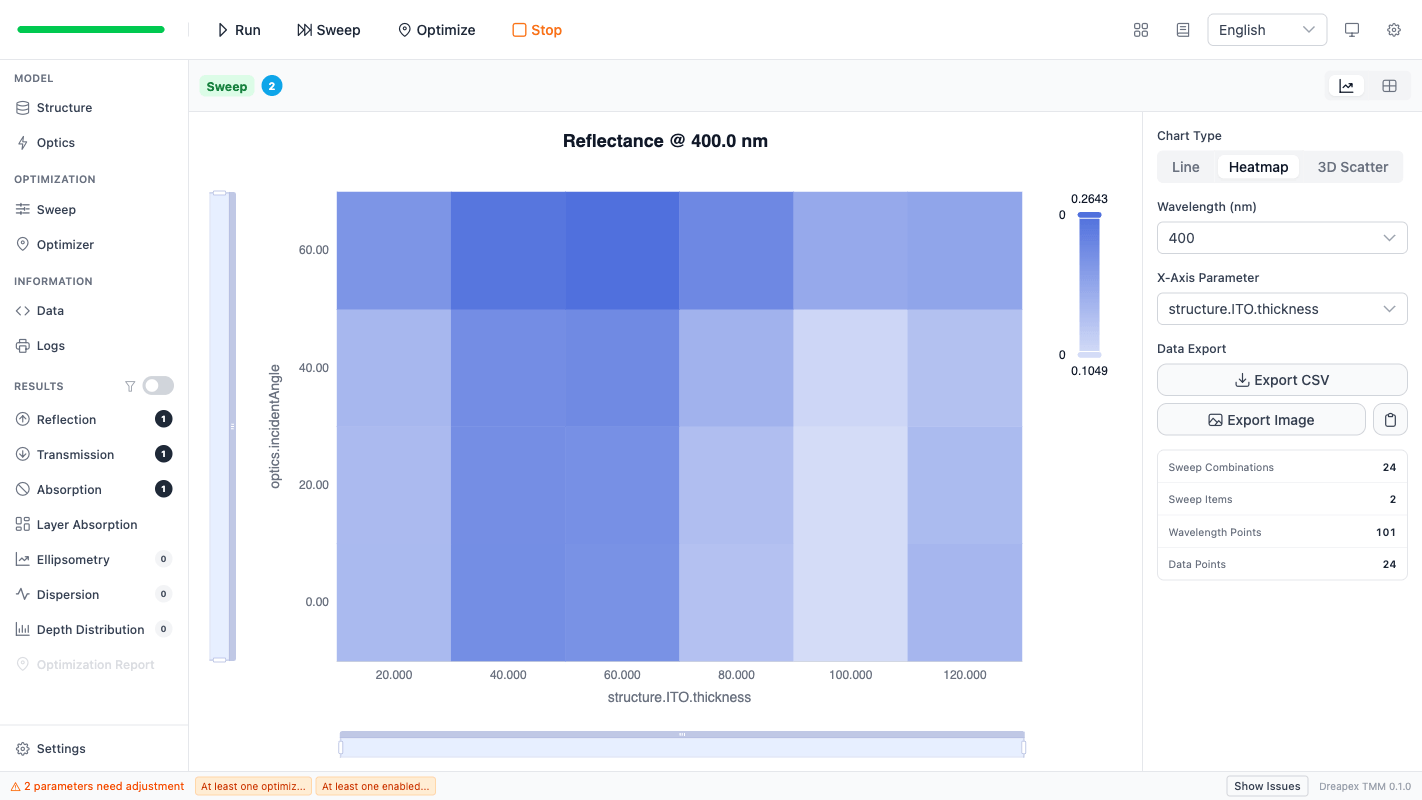
This chart is fixed at 560 nm. The horizontal axis is ITO thickness and the vertical axis is incidentAngle. It is used to read:
- which thickness range stays low in reflection across multiple angles
- how the low-reflectance region drifts with angle
- whether the optimum is broad or narrow
For wide-angle anti-reflection or large-field filters, this chart is the primary result page.
Reflectance 3D Scatter
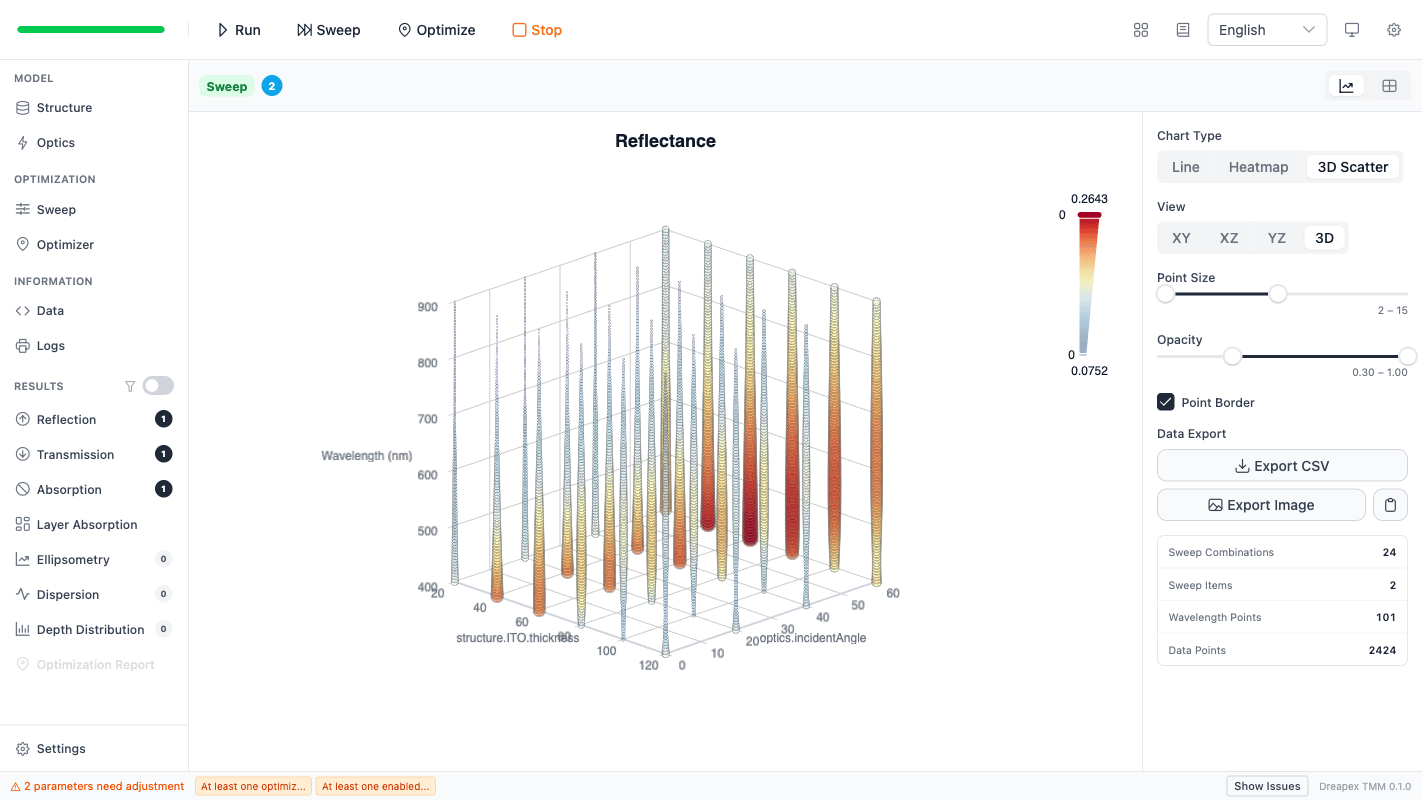
This chart keeps wavelength, thickness, and incidentAngle as axes and uses color for the result value. It is used to read:
- coupling between thickness and angle
- whether one thickness works only in a narrow spectral region
- whether minima lie on a continuous trajectory
The 3D scatter is a trend view. Accurate reading should still use heatmaps, tables, or exported data.
Optimization Workflow
Optimizer Setup
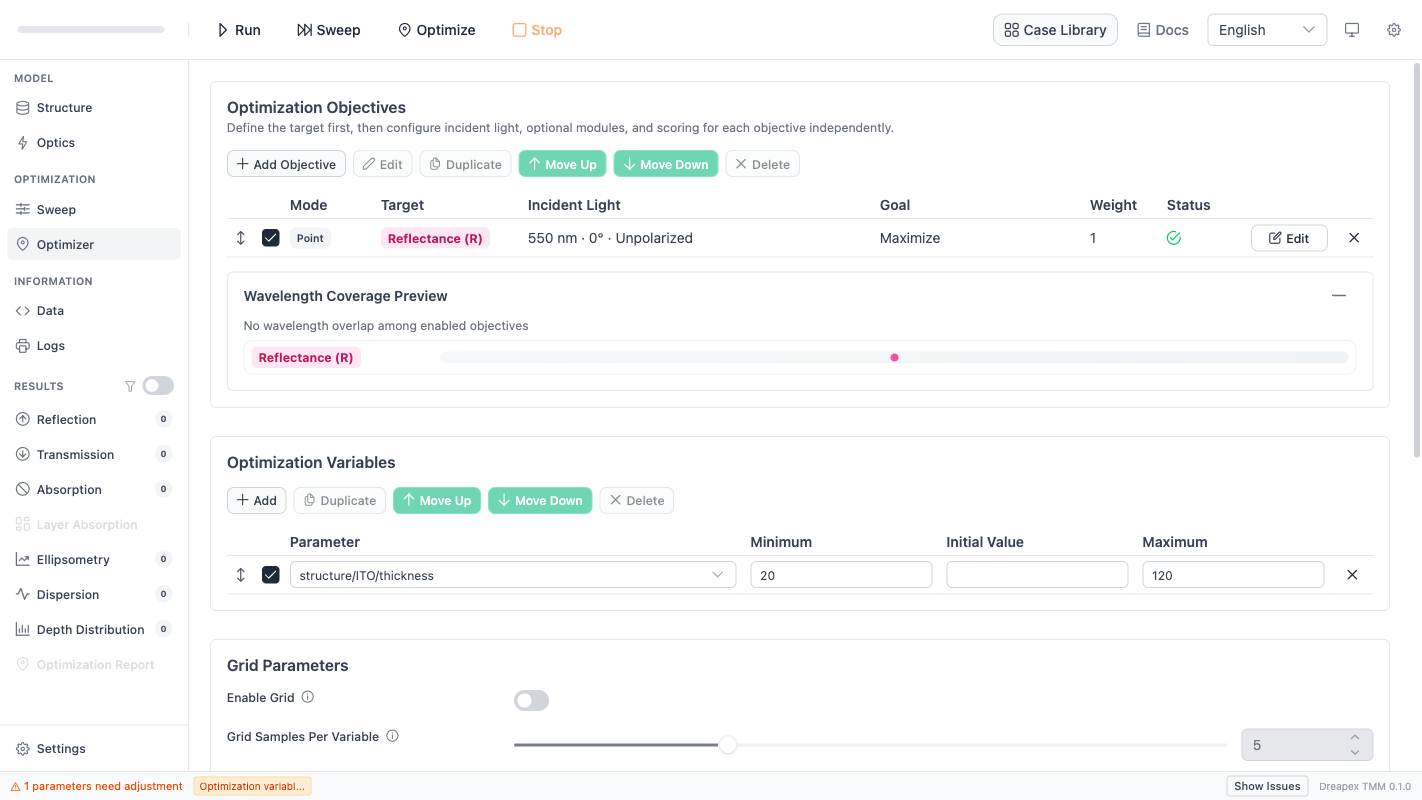
This example uses the following configuration:
| Category | Setting |
|---|---|
| Mode | Point |
| Target | Reflectance (R) |
| Direction | Maximize |
| Wavelength | 550 nm |
| Angle | 0° |
| pRatio | 0.5 (Unpolarized) |
| Weight | 1 |
| Variable | structure/ITO/thickness |
| Variable Range | 20-120 nm |
| Initial Value | 70 nm |
| Algorithm | TRF |
| Max Evaluations | 24 |
This setup corresponds to a one-variable optimization problem that maximizes reflectance at a single design wavelength.
Optimization Report
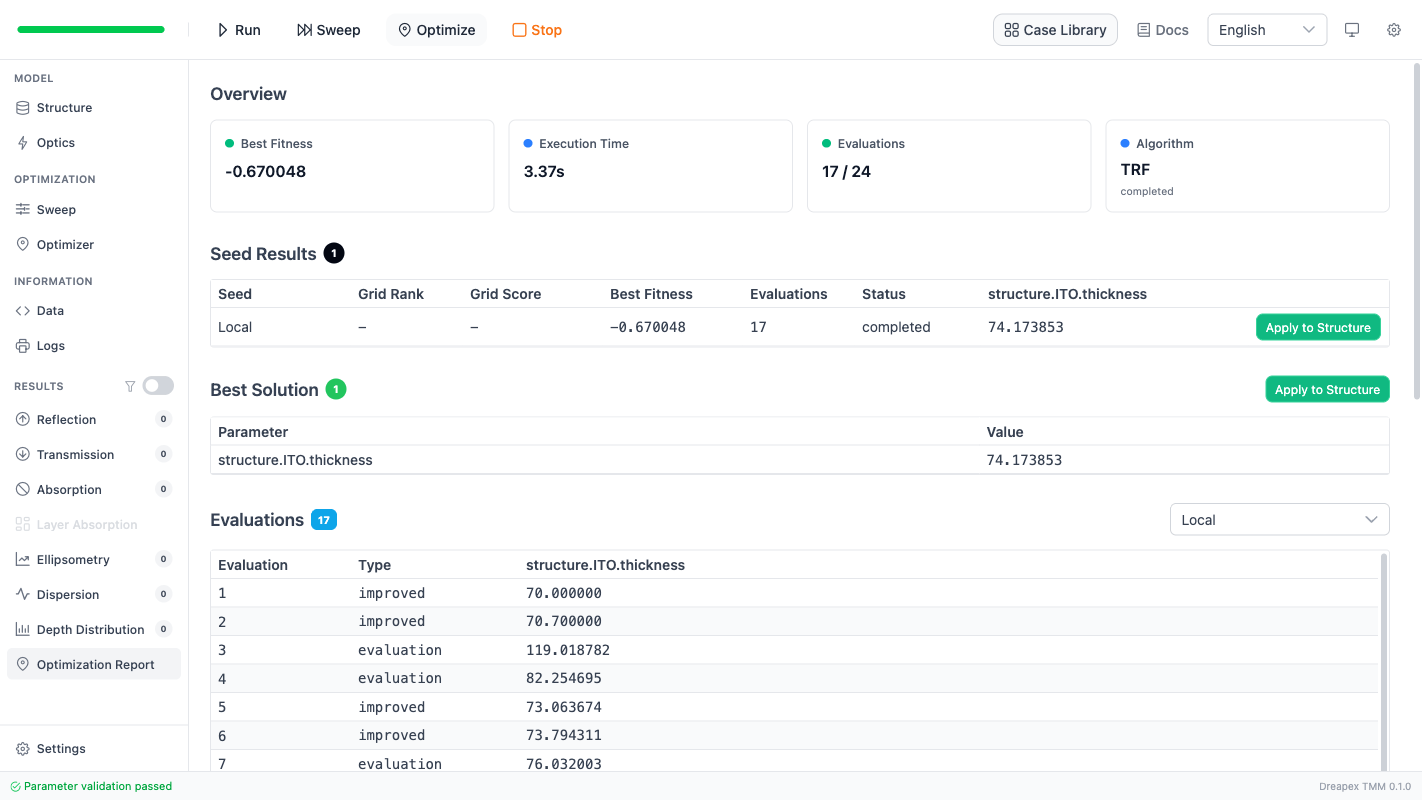
The report exposes:
Overview(Best Fitness, Execution Time, Evaluations, Algorithm status)Seed ResultsBest SolutionEvaluations(search history)Apply to Structure
In this example the TRF algorithm converges in 17 of 24 allowed evaluations (~3.4 s) and returns structure.ITO.thickness = 74.17 nm with fitness -0.670. The evaluations history shows the solver exploring the full 20–120 nm range before settling near 74 nm.
Post-Optimization Back-Check
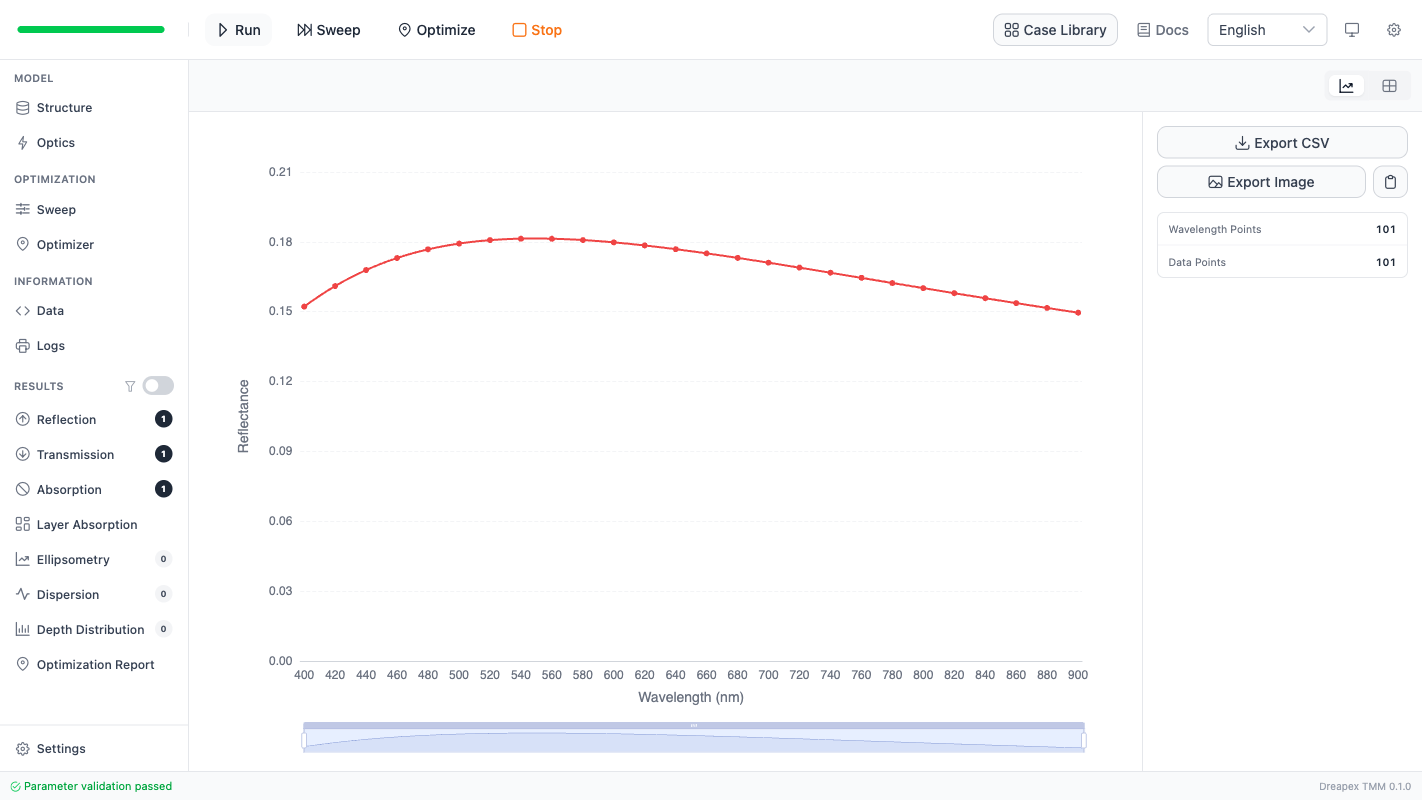
The optimizer output does not replace result validation. After applying the best solution, return to Reflectance, Transmittance, Absorptance, and Layer Absorption to confirm:
- reflectance reaches its expected maximum near the design wavelength
- transmission and absorptance remain physically consistent (
R + T + A ≈ 1) - the peak position matches the targeted wavelength
- loss is not unexpectedly concentrated in a non-target layer
Recommended Sweep and Validation Order
| Problem | Recommended order |
|---|---|
| Reflection too high | Reflectance line chart → Reflectance heatmap → two-parameter heatmap → Optimizer |
| Transmission too low | Transmittance line chart → Absorptance → Layer Absorption → Optimizer |
| Absorption location unclear | Absorptance → Layer Absorption → Depth Detector Analysis |
| Color shift | spectral results → color results → thickness/angle sweeps |
Directly Optimizable Targets and Variables
| Item | Current support |
|---|---|
R / T / A targets | Supported |
structure variable group | Supported |
surroundings variable group | Supported |
| color-result targets | Not exposed as direct targets |
Layer Absorption targets | Not exposed as direct targets |
optics variable group | Not exposed as direct optimization variables in the current UI |
Conclusion Boundaries
R / T / AandLayer Absorptionsupport thin-film design, filter design, front-optics analysis, and layer-level loss attribution.- Solar-cell content is limited to front-optics reflection, transmission, and absorption analysis. It must not be extended to
EQE,IQE,Jsc, or device efficiency. - Color results depend on the incident spectrum and visible-color settings. They are not intrinsic material colors.
Case Study Entry
For full application workflows, see Case Studies. Future cases will cover anti-reflection, high-reflectors and DBRs, filters, beam splitters, solar-cell front optics, and color films.
Next Step
If the problem moves to polarization response, thickness sensitivity, or angular sensitivity, continue with Ellipsometry Analysis. If the problem moves to in-layer position, local absorption, or field enhancement, continue with Depth Detector Analysis.