DreapexTMMCloud Version

Thin-Film OpticalSimulation Platform

Reflection, Transmission, Absorption, and Emission.

For optical coatings, filters, OLED, photodetectors, photovoltaics, and more...

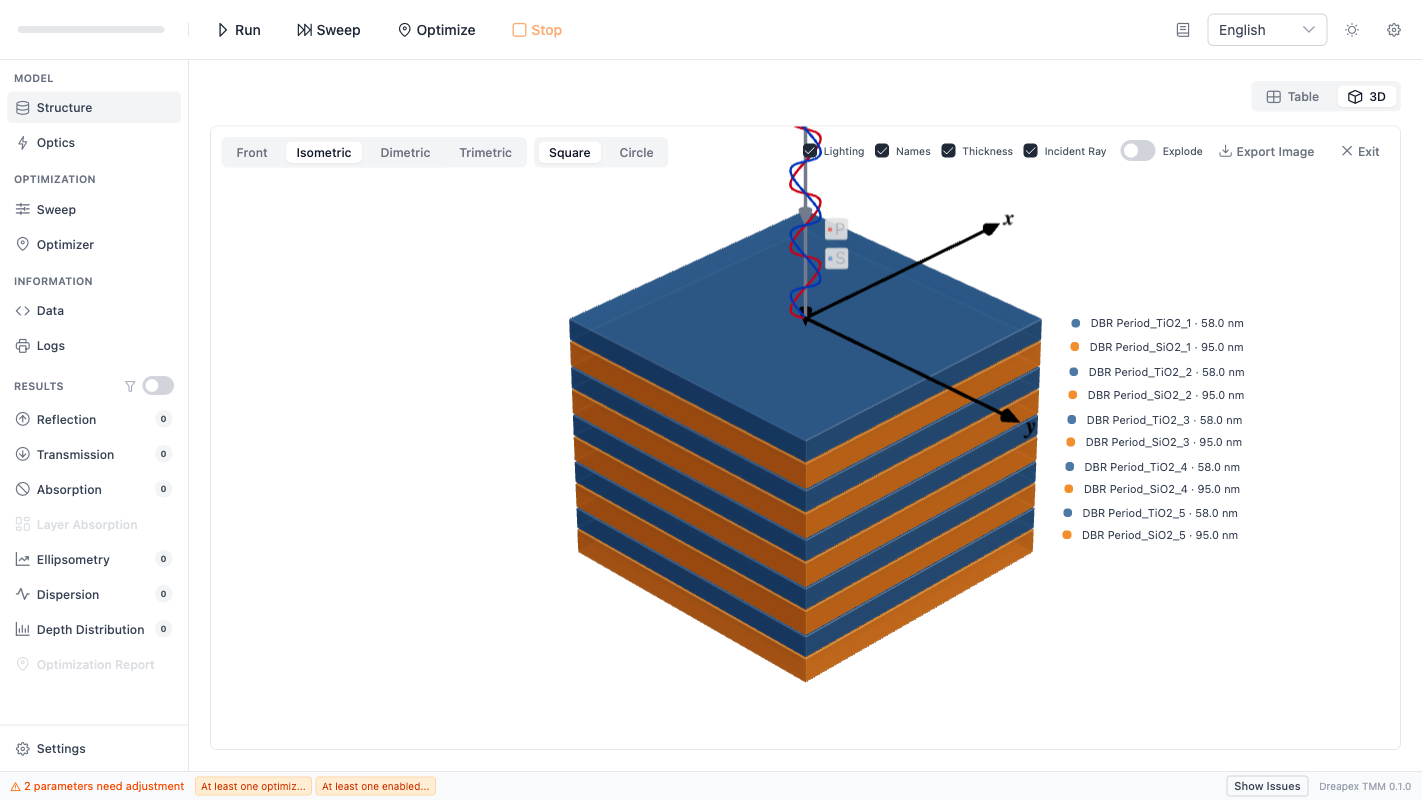
3D multilayer structure in Dreapex TMM
3D multilayer structureStructure

Why Choose Dreapex TMM

01

Comprehensive Simulation

Simulate thin-film optics and OLED emission. Combine detectors to output comprehensive results in one run.

detector types
17
simulation results
30+
02

Easy to Learn

No installation. Cases, materials, and docs are built in. Build models and inspect results in one workspace.

Dreapex TMM modeling workspace
03

Fast Computation

Sweep parameter combinations in parallel, then optimize toward a target.

04

AI Services and Open Data

AI handles modeling through reporting. Export JSON and CSV without format lock-in.

Thin-Film Application Scenarios

Reflection, absorption, emission, color, and dispersion analysis.

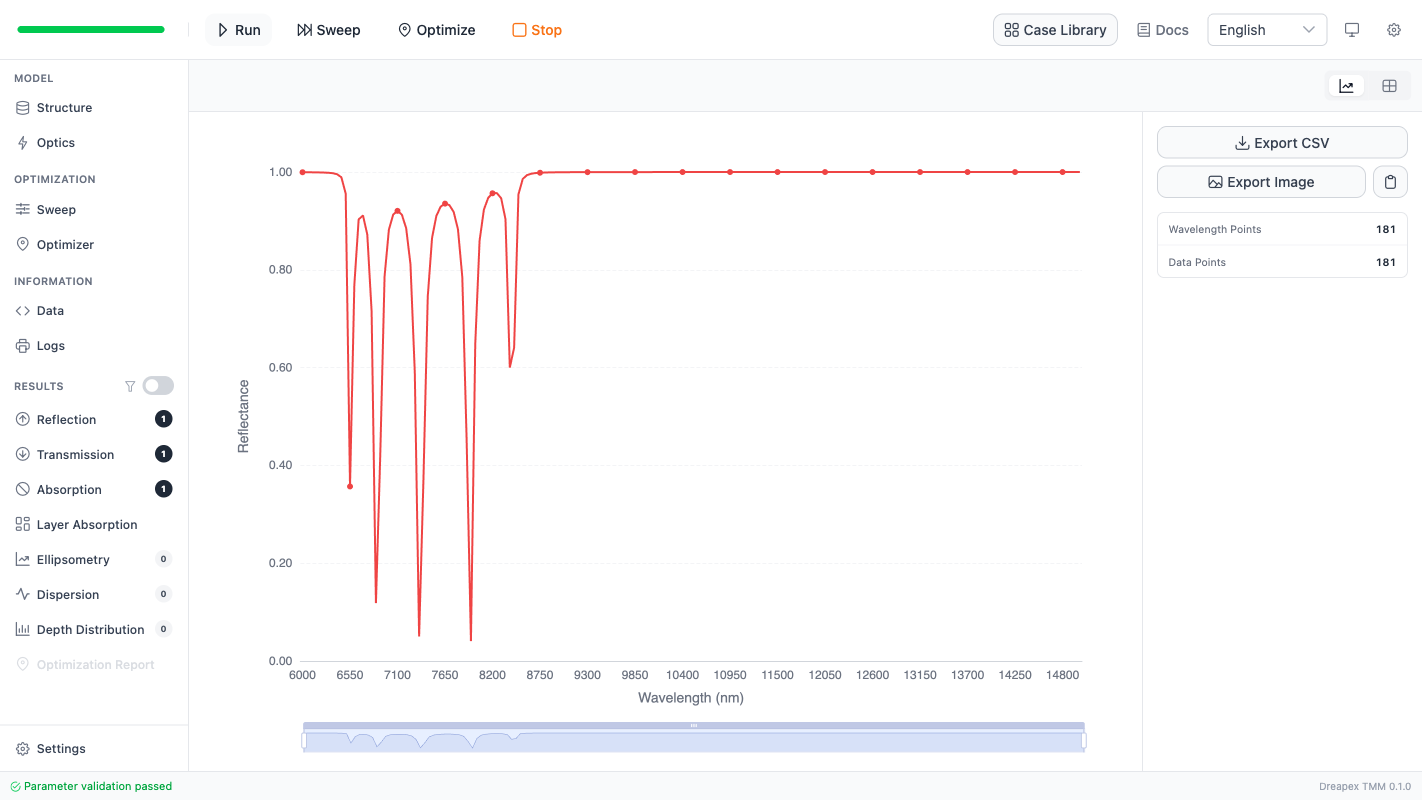
Reflectance spectrum of an omnidirectional DBR at a high incidence angle

DBRs & Optical Filters

Reflection / Transmission / Angle / Polarization

View DBR Case

From Layer Stack to Design

Build. Sweep. Decide.

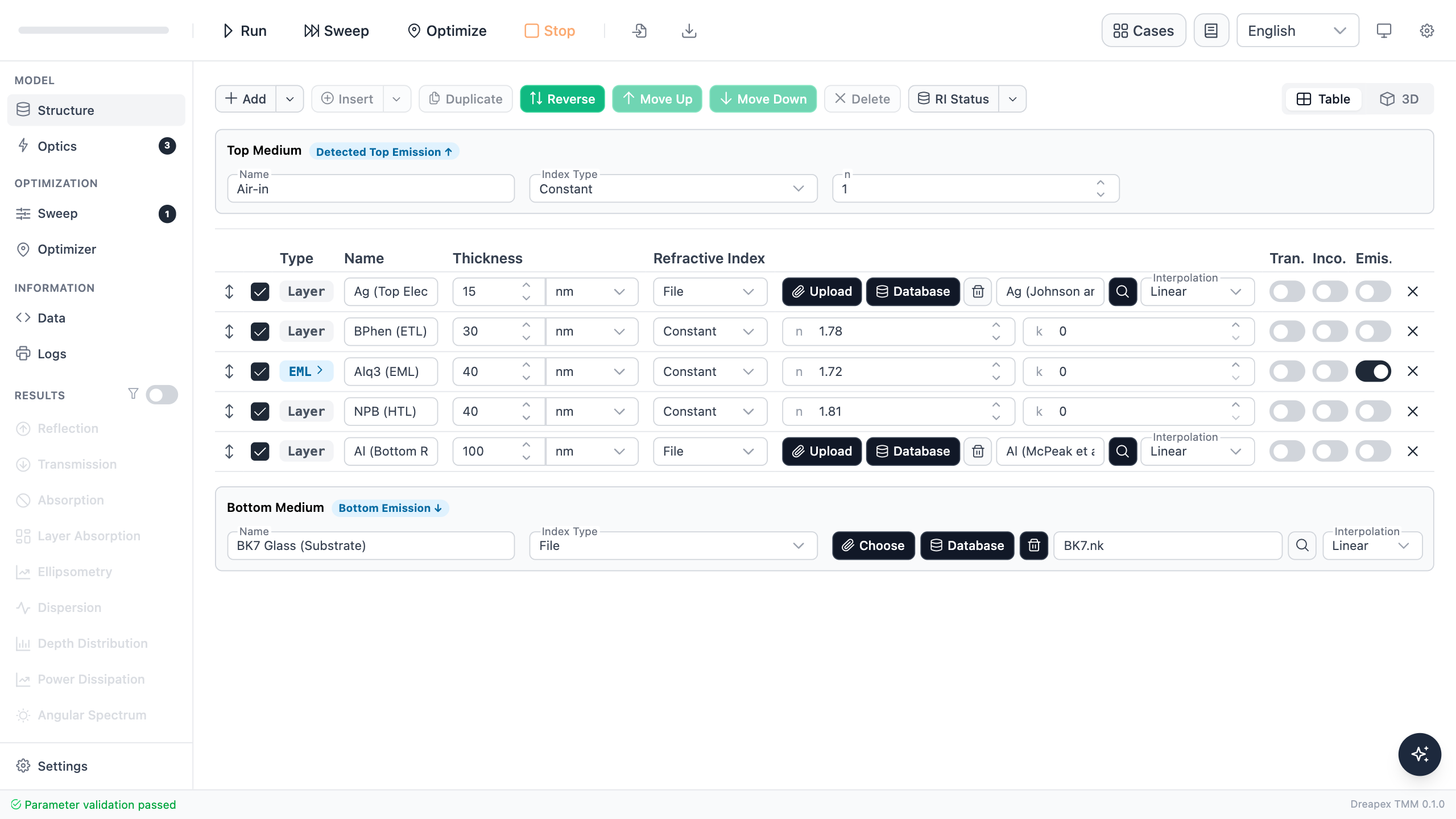
OLED structure page with an emissive layer
Build the Layer StackDefine materials, layer order, thickness & surrounding media.

Compare Results with Published Papers

Reproduce published structures, parameters & figures step by step.

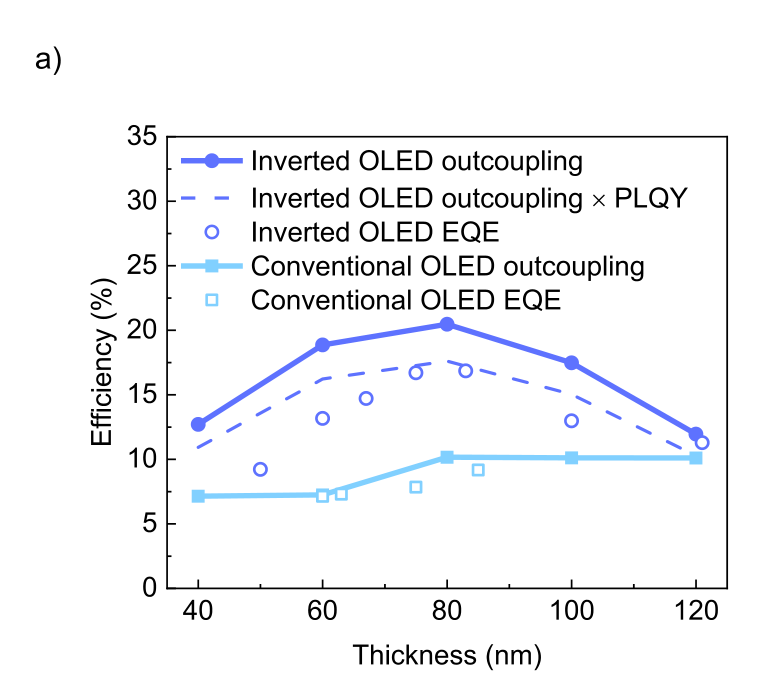
Paper figure01
Outcoupling efficiency of regular versus inverted devices published by Tan et al.
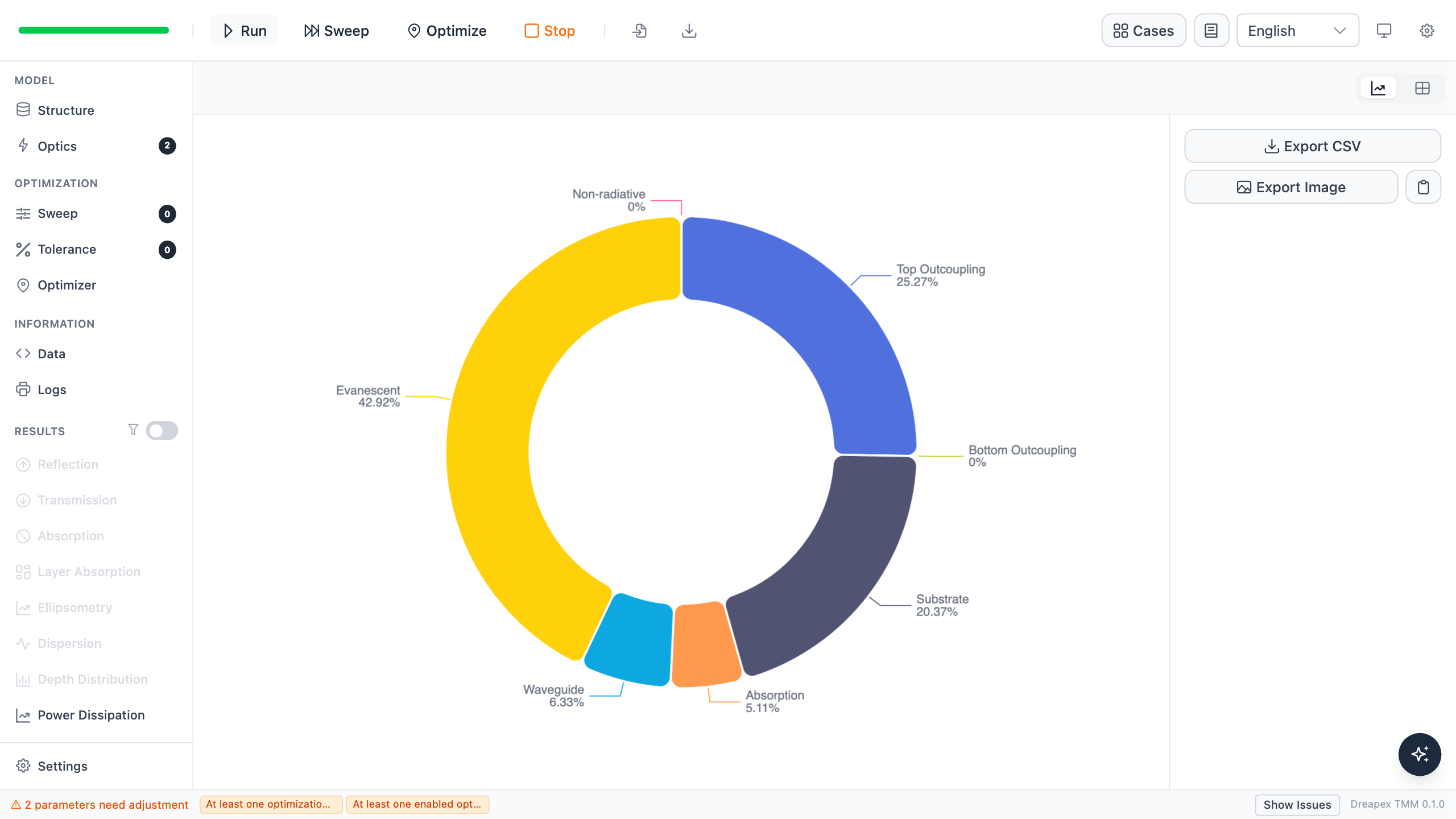
Dreapex TMM02
Optical power channel partition of the inverted device computed by Dreapex TMM

Mode Suppression in an Inverted OLED

Tan et al., Nature Communications 15, 4142 (2024)

View Case

AI Assistant Accelerates Thin-Film Design

Describe the target. Build, sweep, optimize, and analyze the result.

Explore AI Assistant
AI Assistant Online
You

Sweep 0°, 45°, and 80°; calculate average DBR reflectance over 10-15 µm.

Dreapex AI

Understood. I’ll build the DBR, sweep three angles, and summarize reflectance across the target band.

01Build

Create the DBR layer stack.

02Sweep

Run angle and wavelength combinations.

03Read

Aggregate R(λ, θ) results.

04Conclude

Average reflectance over 10-15 µm is approximately 0.99

Connect simulation capabilities through MCP

Open the DBR Model

View the spectrum and study how thickness moves the reflection peak.

Copyright © 2026 Dreapex