Introduction
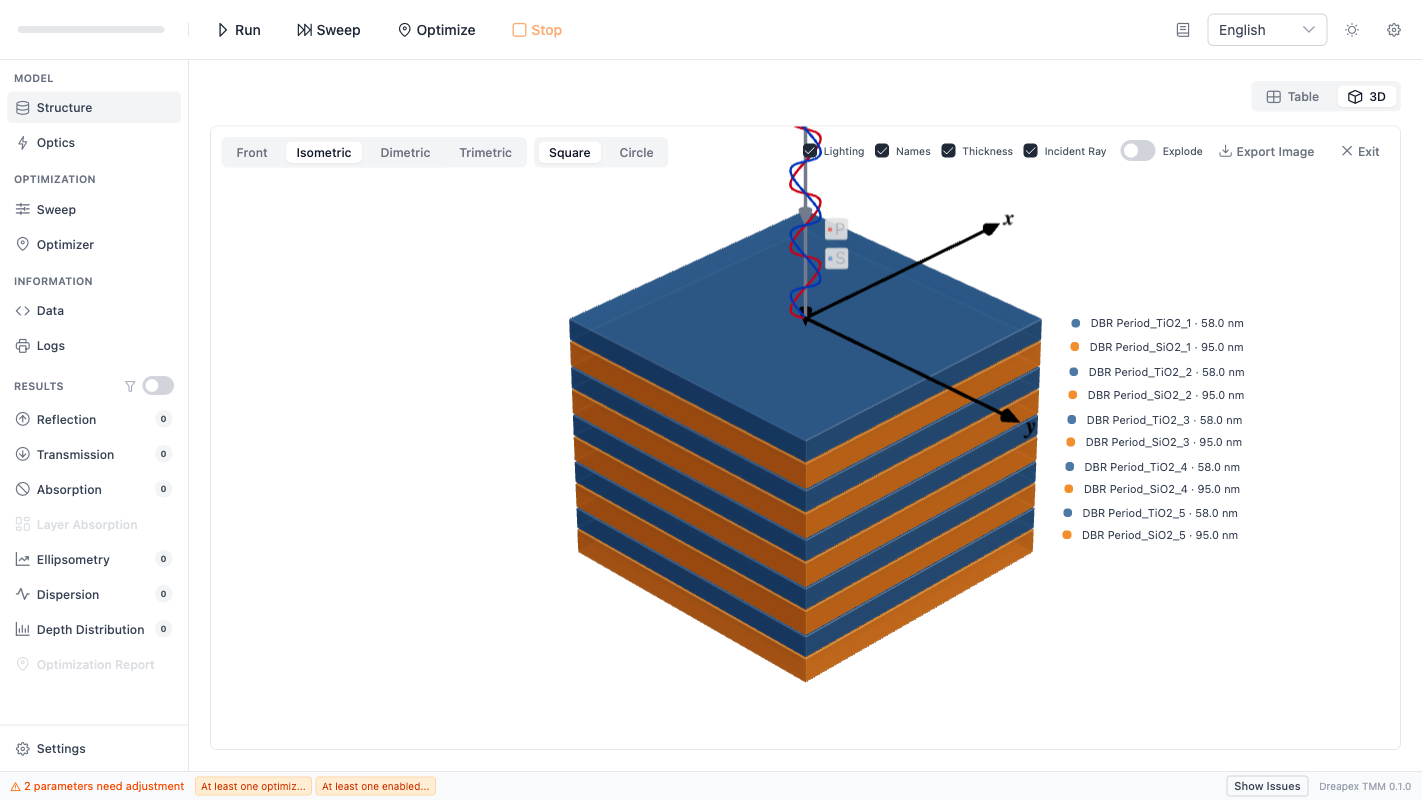
Dreapex TMM is an optical simulation platform
for planar multilayer structures. It calculates two physical processes:
- External light propagating through multilayers (optical coatings, filters, photodetectors, photovoltaics, and related devices).
- Emission from light-emitting layers inside multilayers (OLEDs, QLEDs, PeLEDs, and related devices).
Open Dreapex TMM (https://tmm.dreapex.com) in your browser, click a built-in case in Cases, and start simulating.
Four Core Application Areas
Optical Coatings and Filters
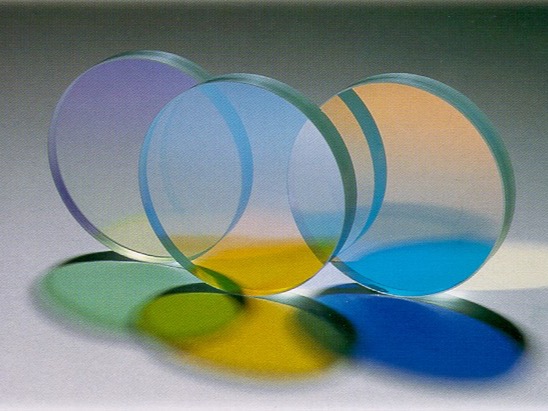
Antireflection coatings, high reflectors, beamsplitters, bandpass filters, and narrowband filters: compare reflection, transmission, and absorption across wavelength, angle, and polarization to verify passbands, stopbands, and cut-off edges. More scenarios.
Photovoltaic and Photodetector Devices
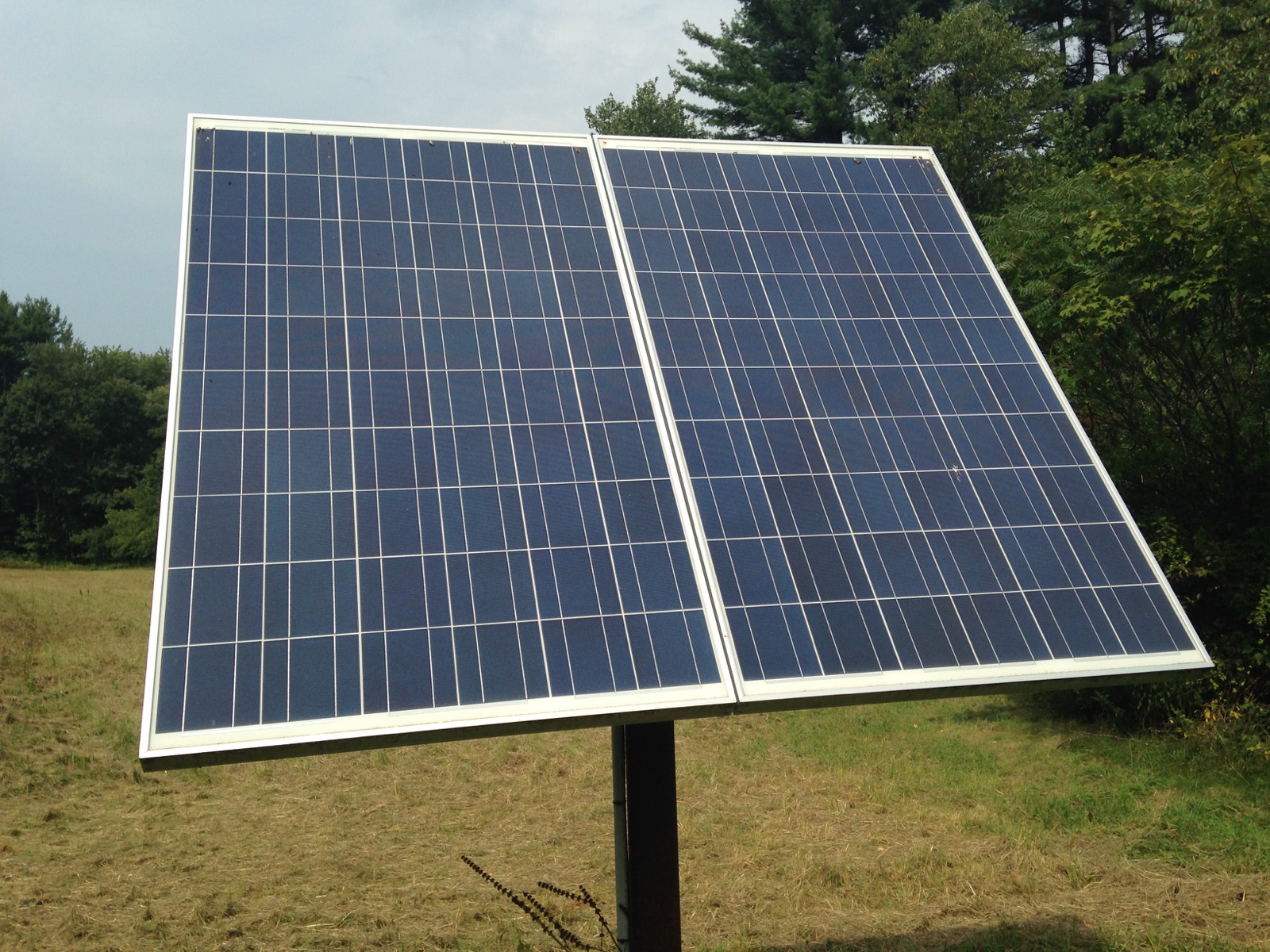
Solar cells, photodiodes, and multilayer detectors: calculate layer absorption, electric field, energy flow, and absorption density to separate active-layer contribution from parasitic loss. More scenarios.
OLED, QLED, and PeLED Devices
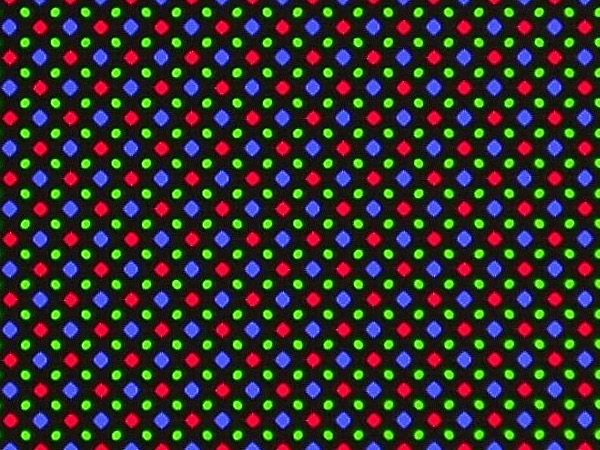
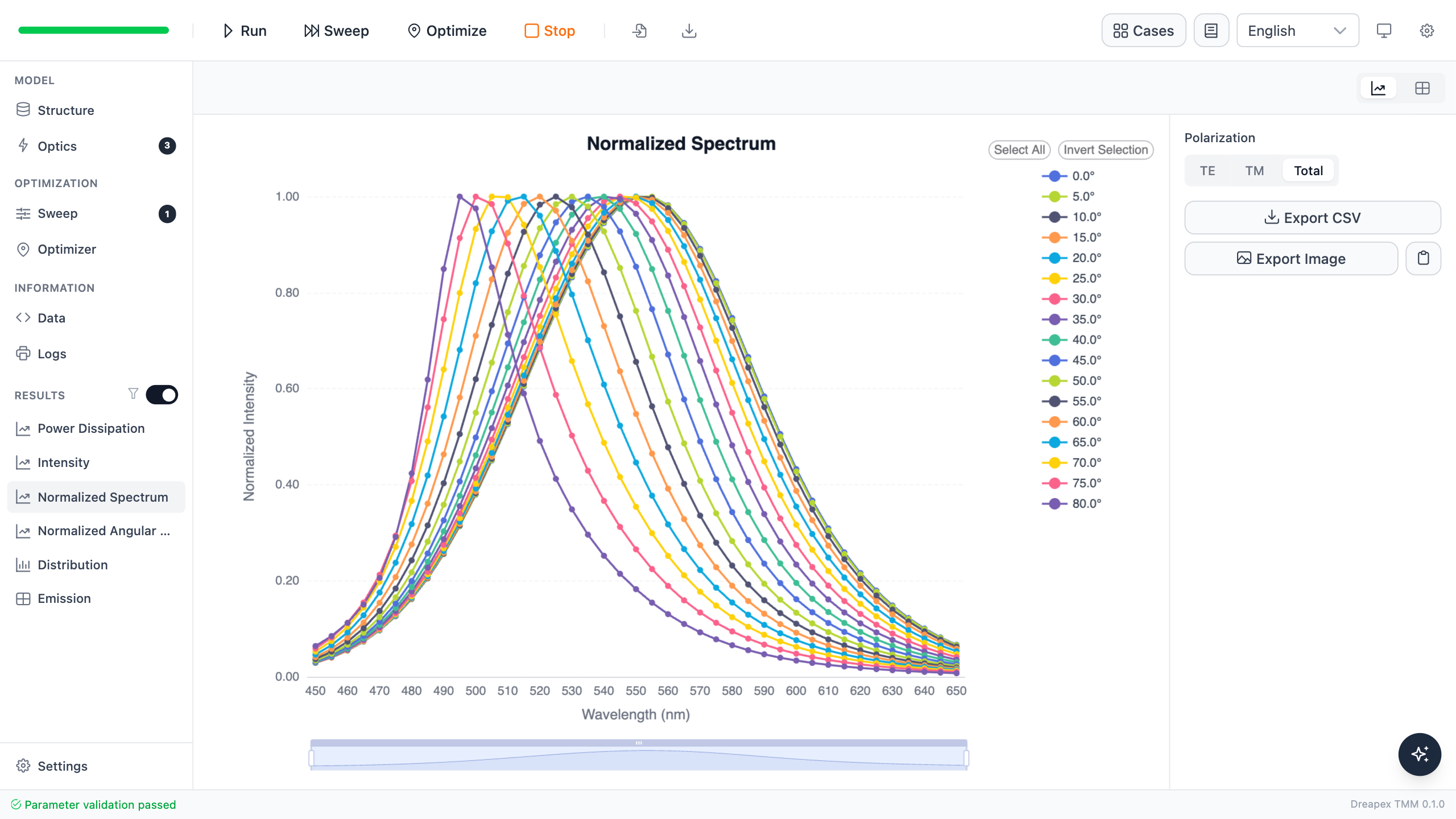
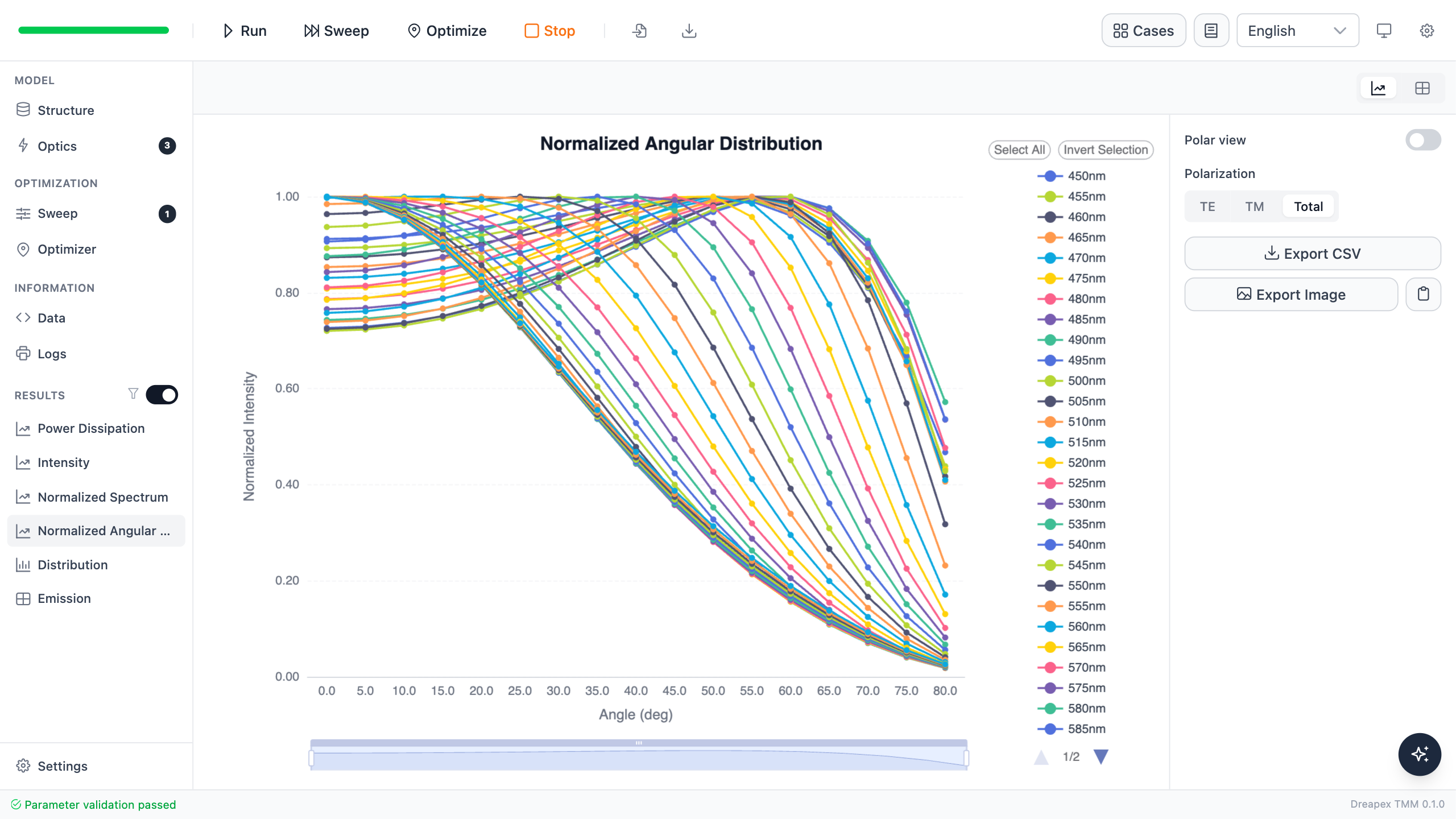
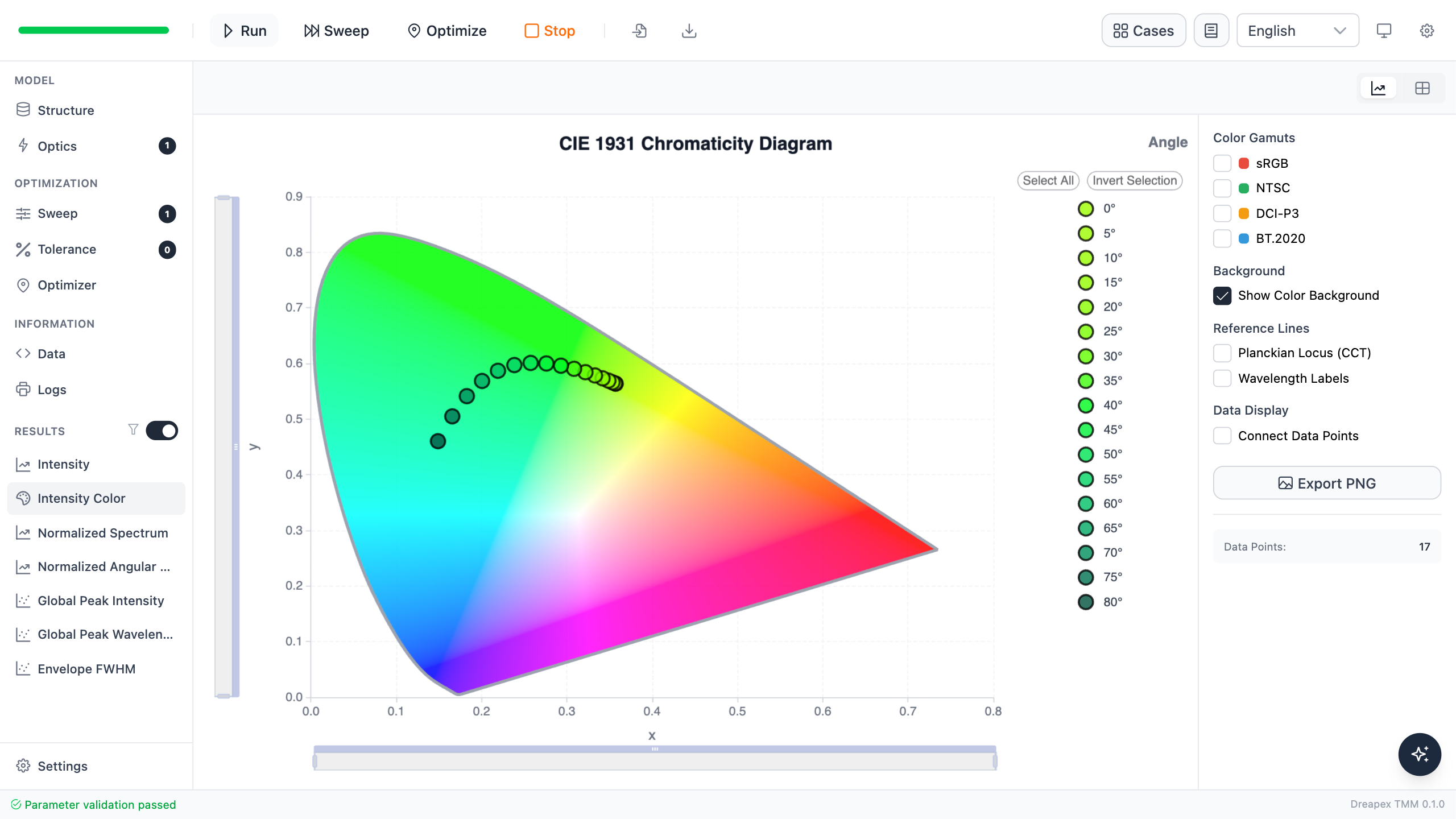
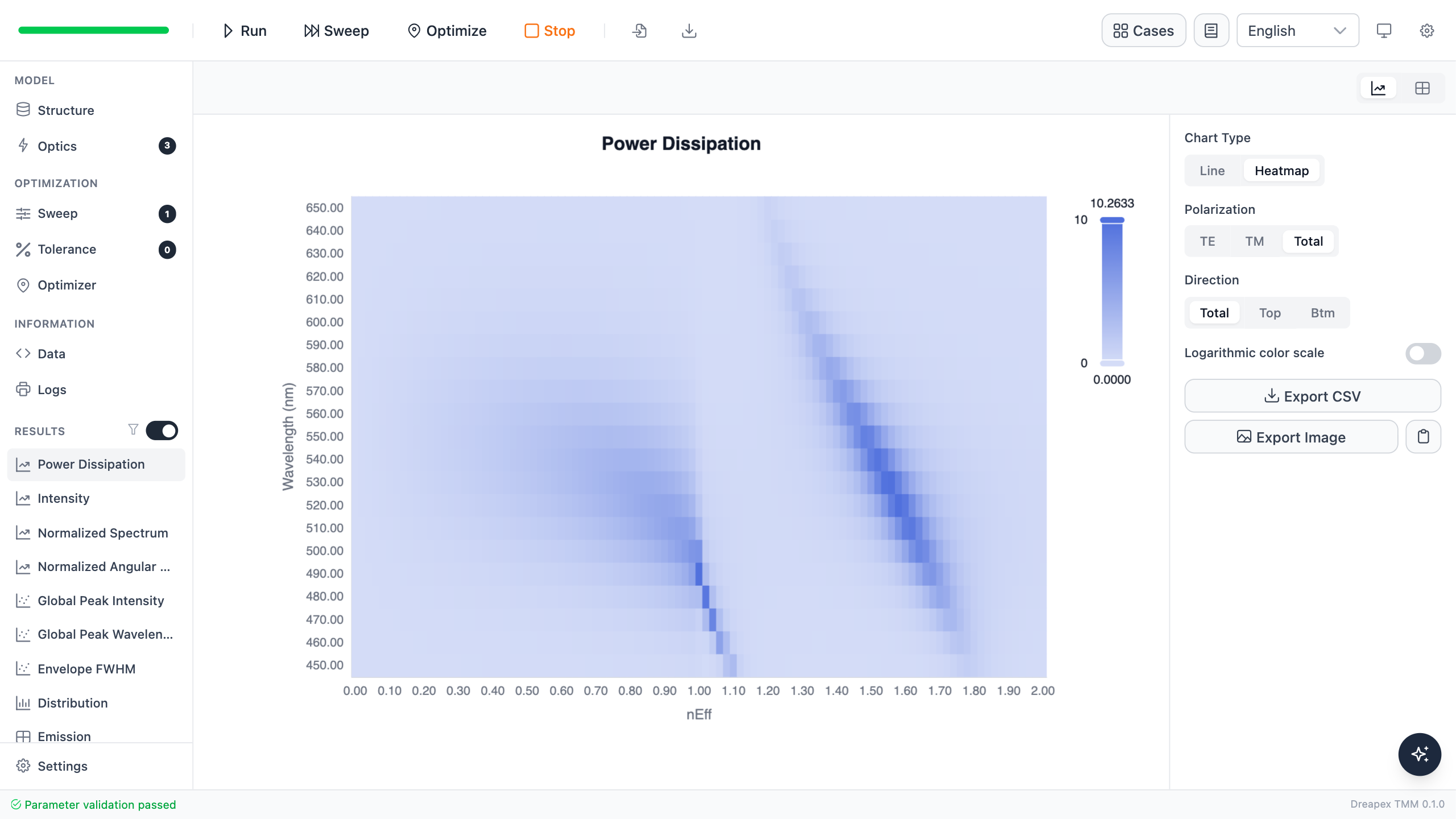
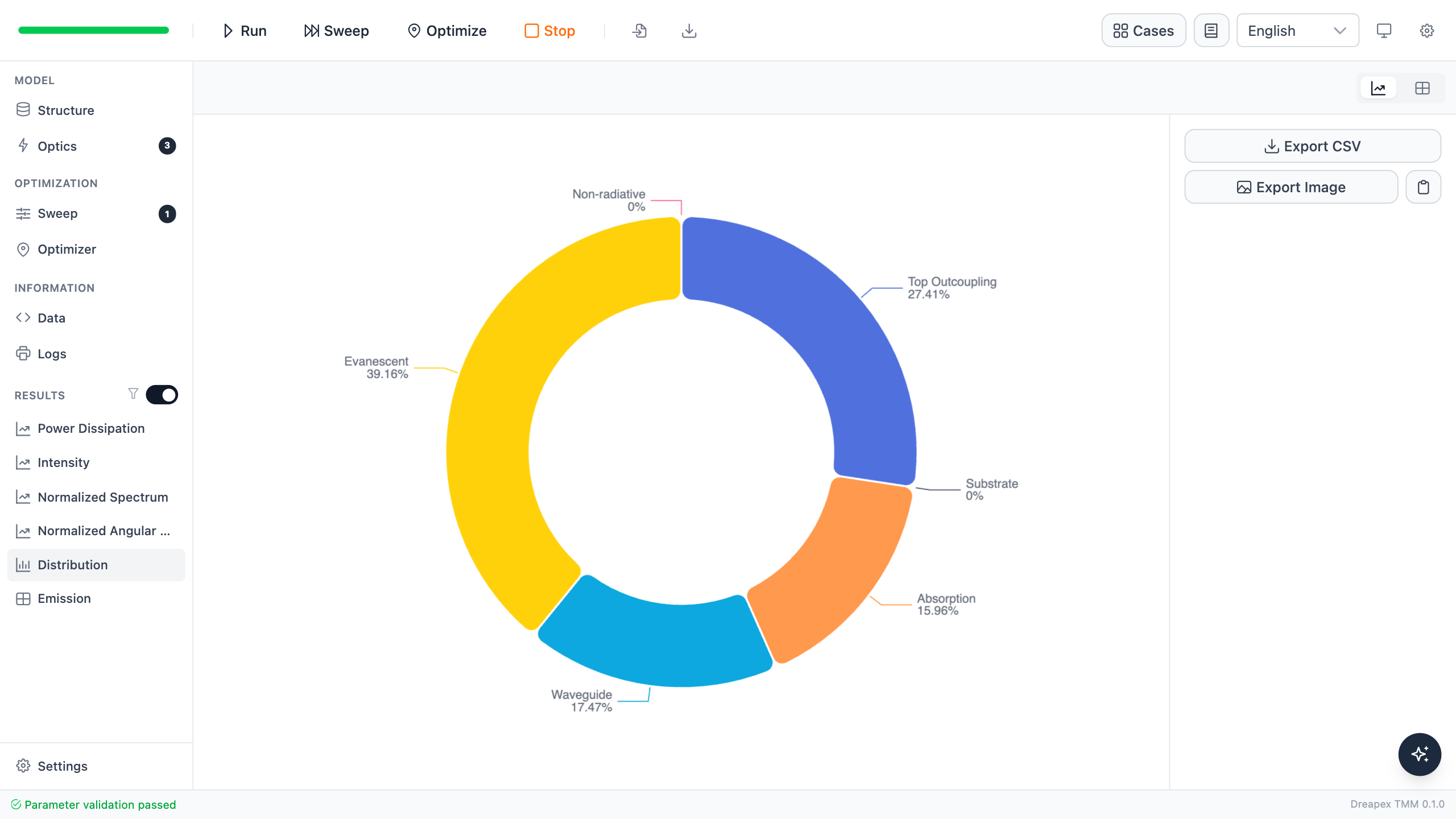
Bottom- and top-emitting OLEDs, QLEDs, and PeLEDs: calculate emission spectra, angular distributions, viewing-angle color shift, and power channels to locate waveguide, surface-plasmon, absorption, and non-radiative losses. More scenarios.
Thin-Film Metrology and Optical Sensing
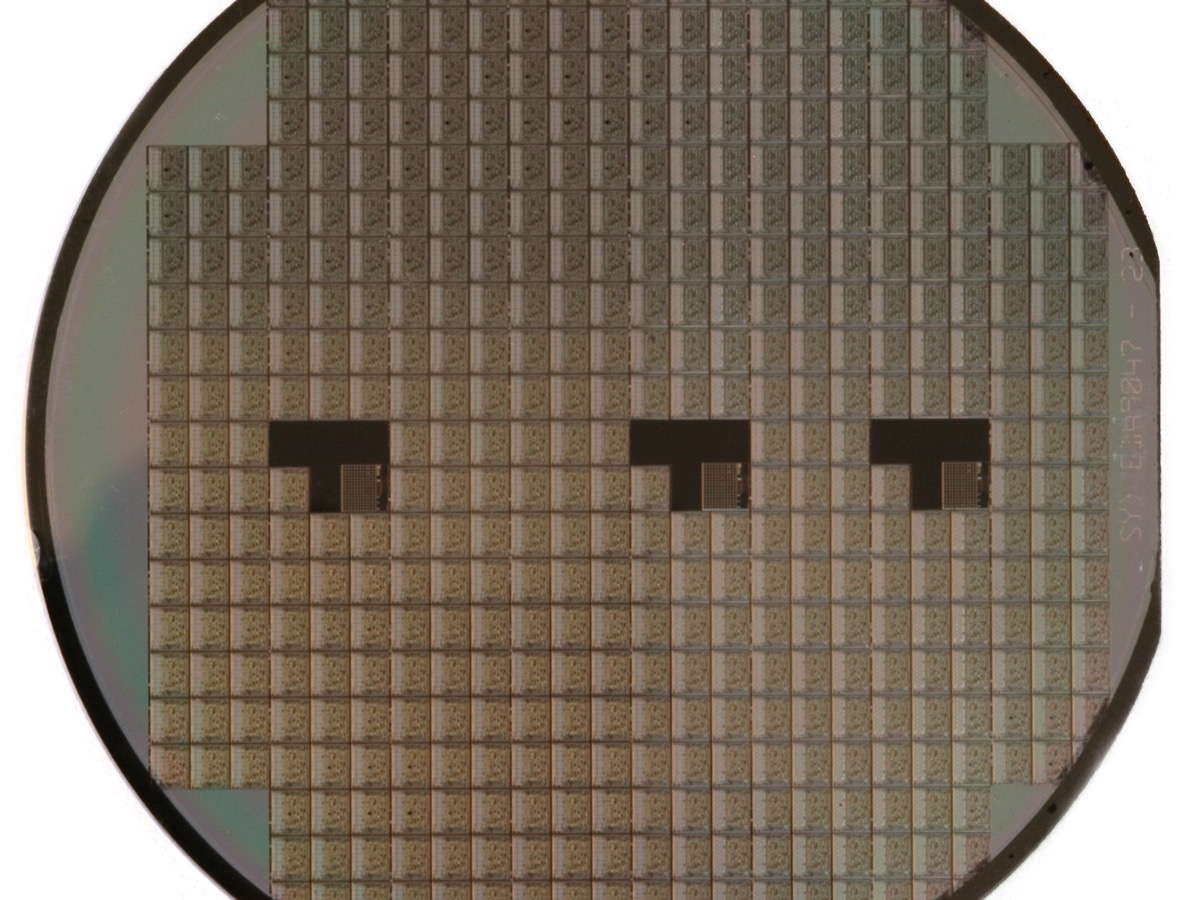
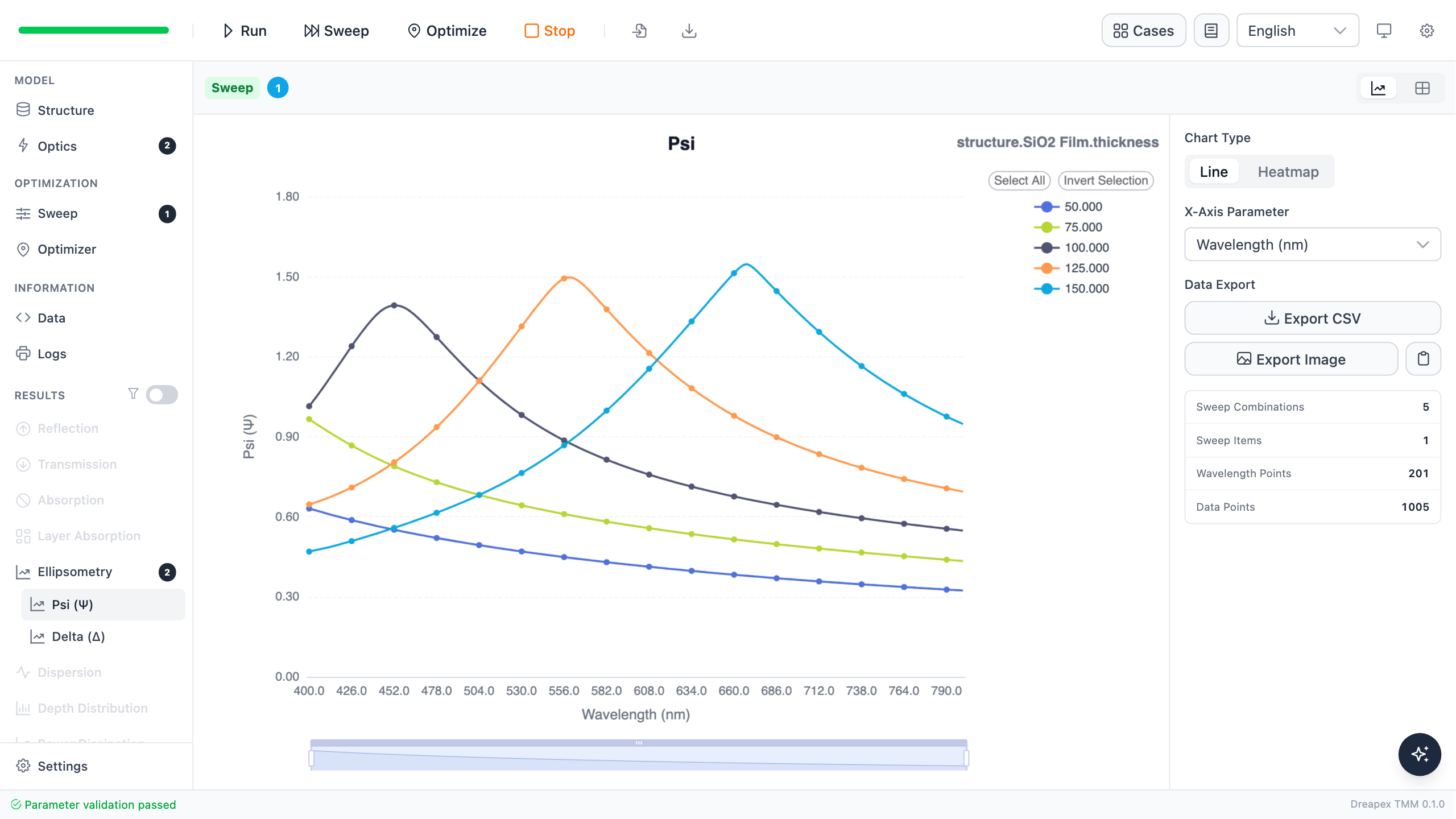
Ellipsometry, film-thickness retrieval, and resonant sensors: calculate Ψ, Δ, and resonance wavelength to evaluate changes in thickness, material properties, or ambient refractive index. More scenarios.
Simulation Result Examples
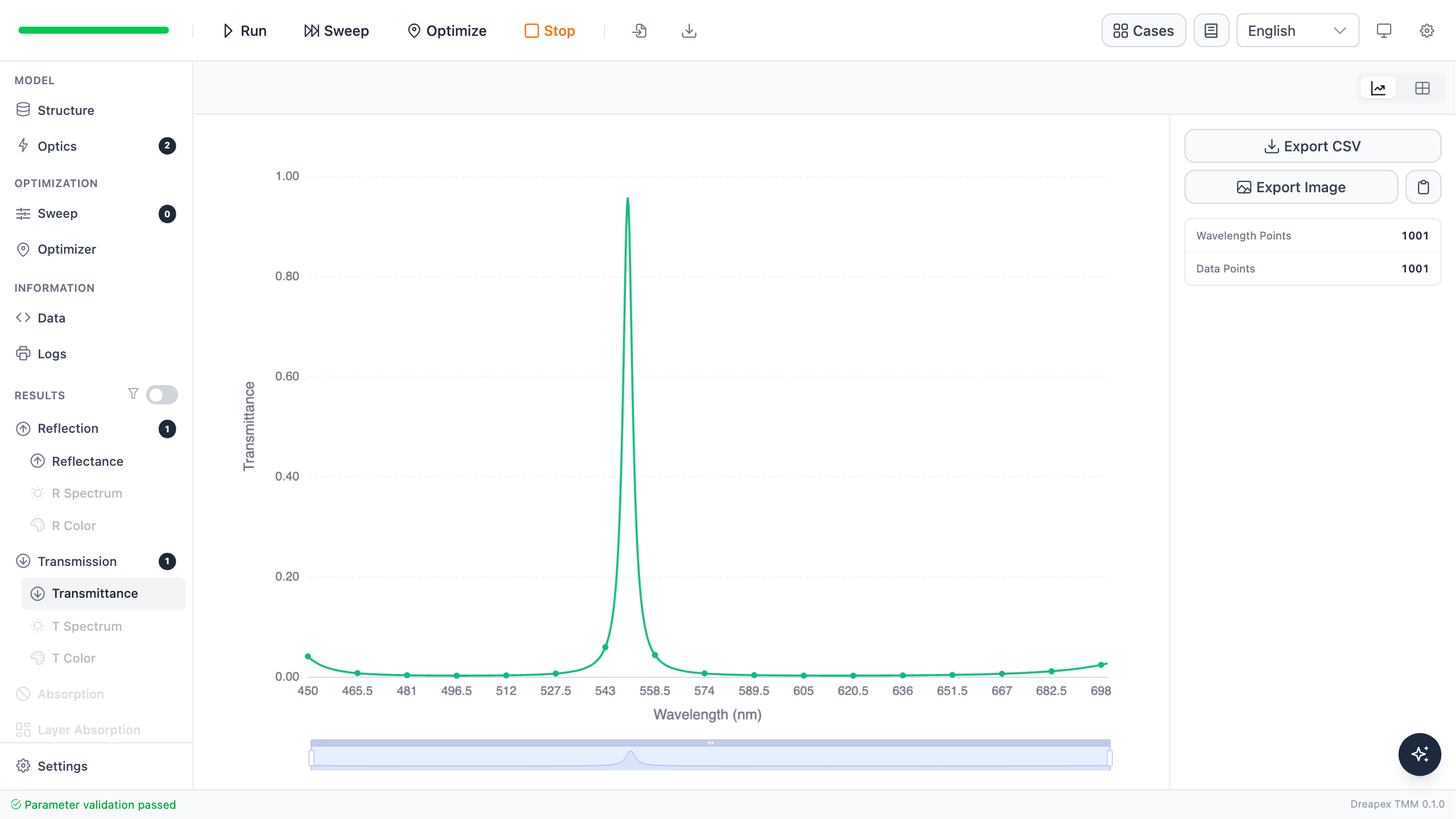
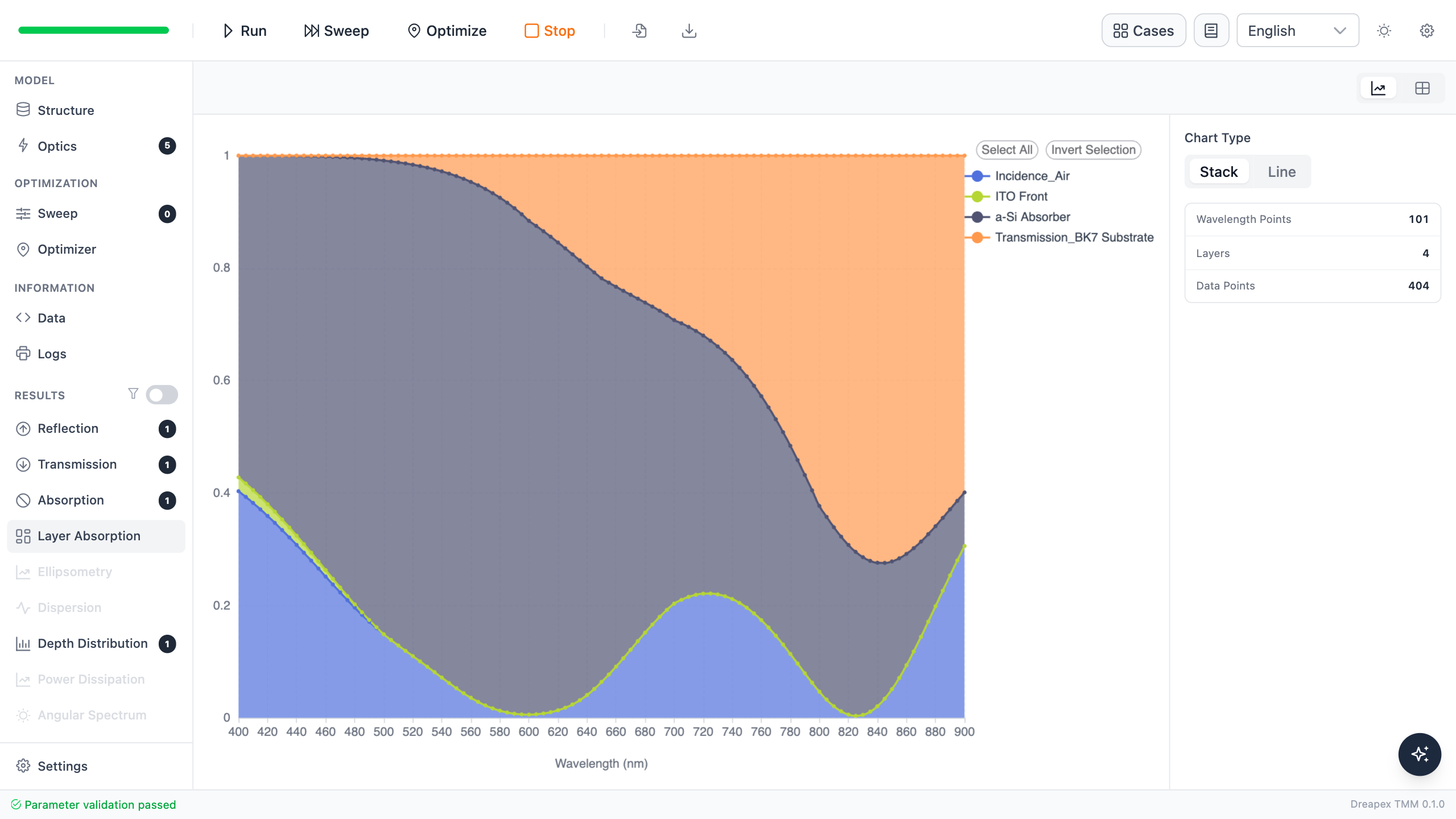
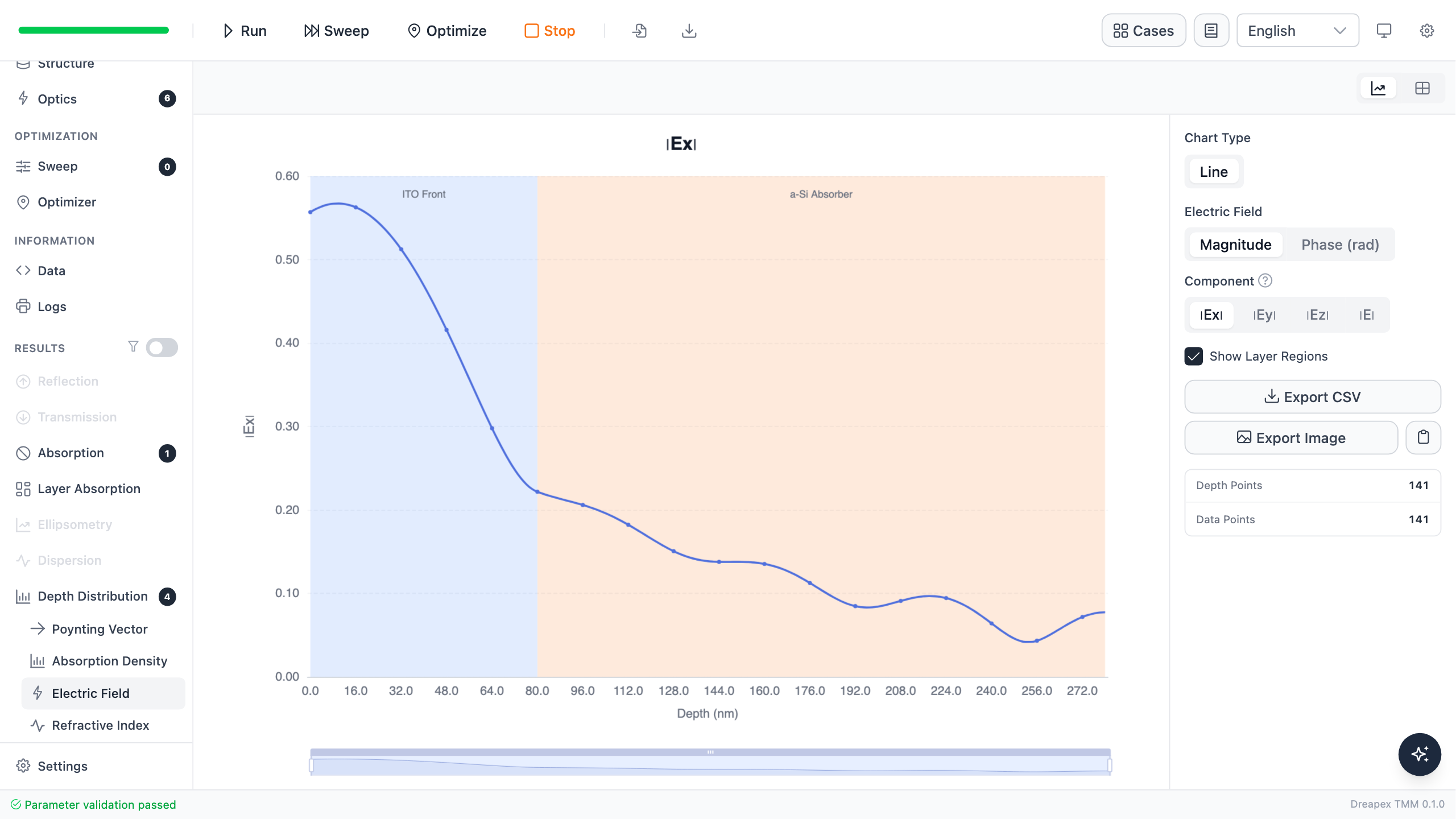
Propagation Results
Emission Results
Sweep and Optimization
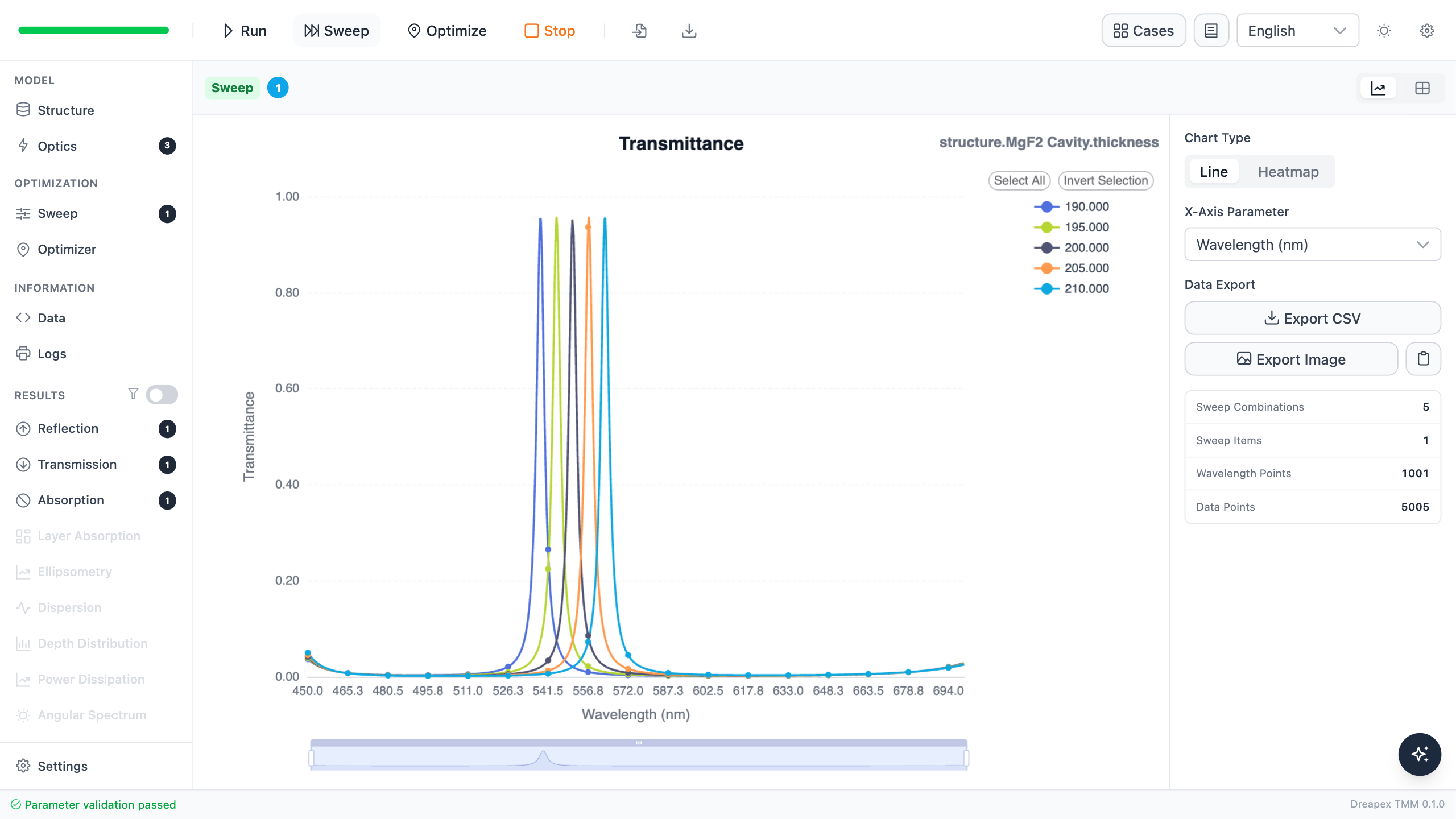
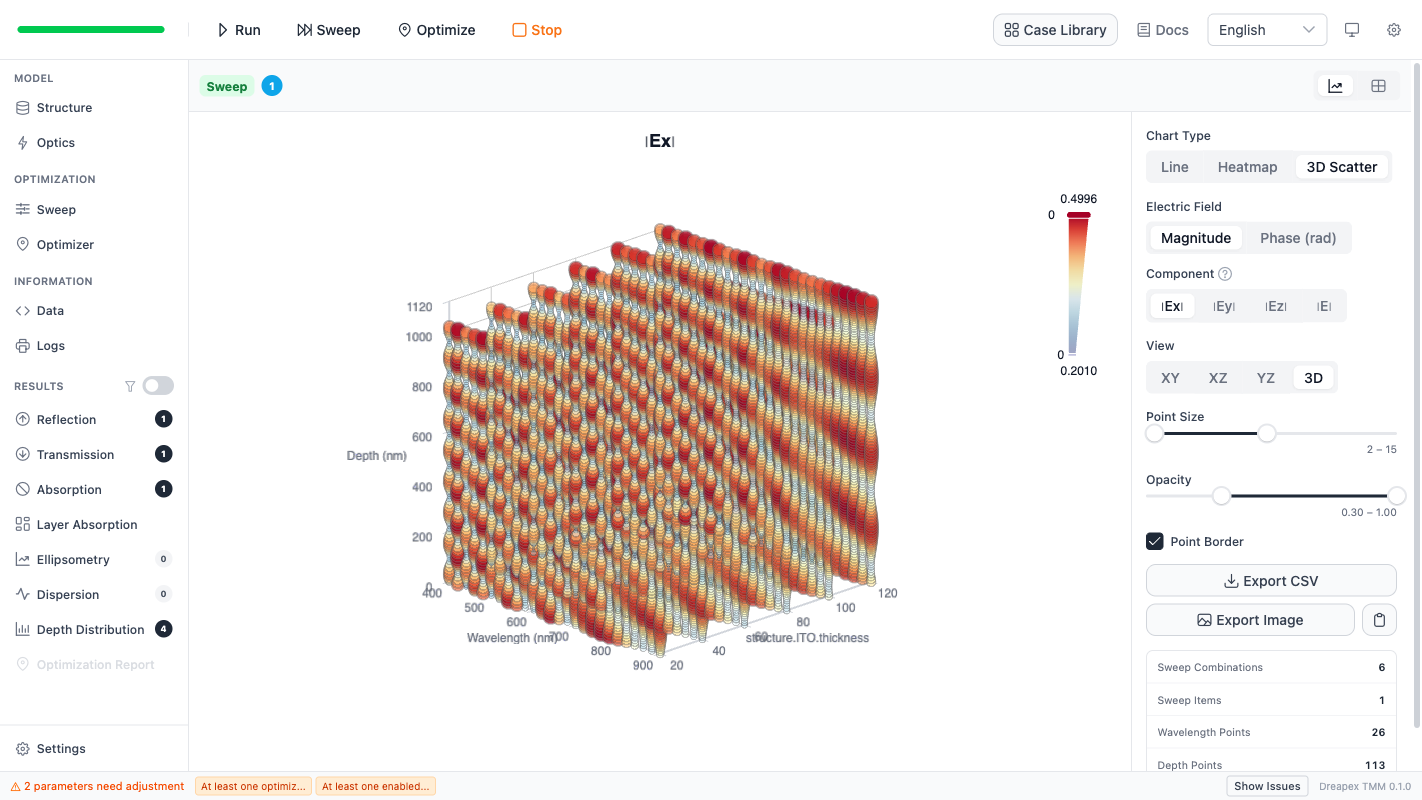
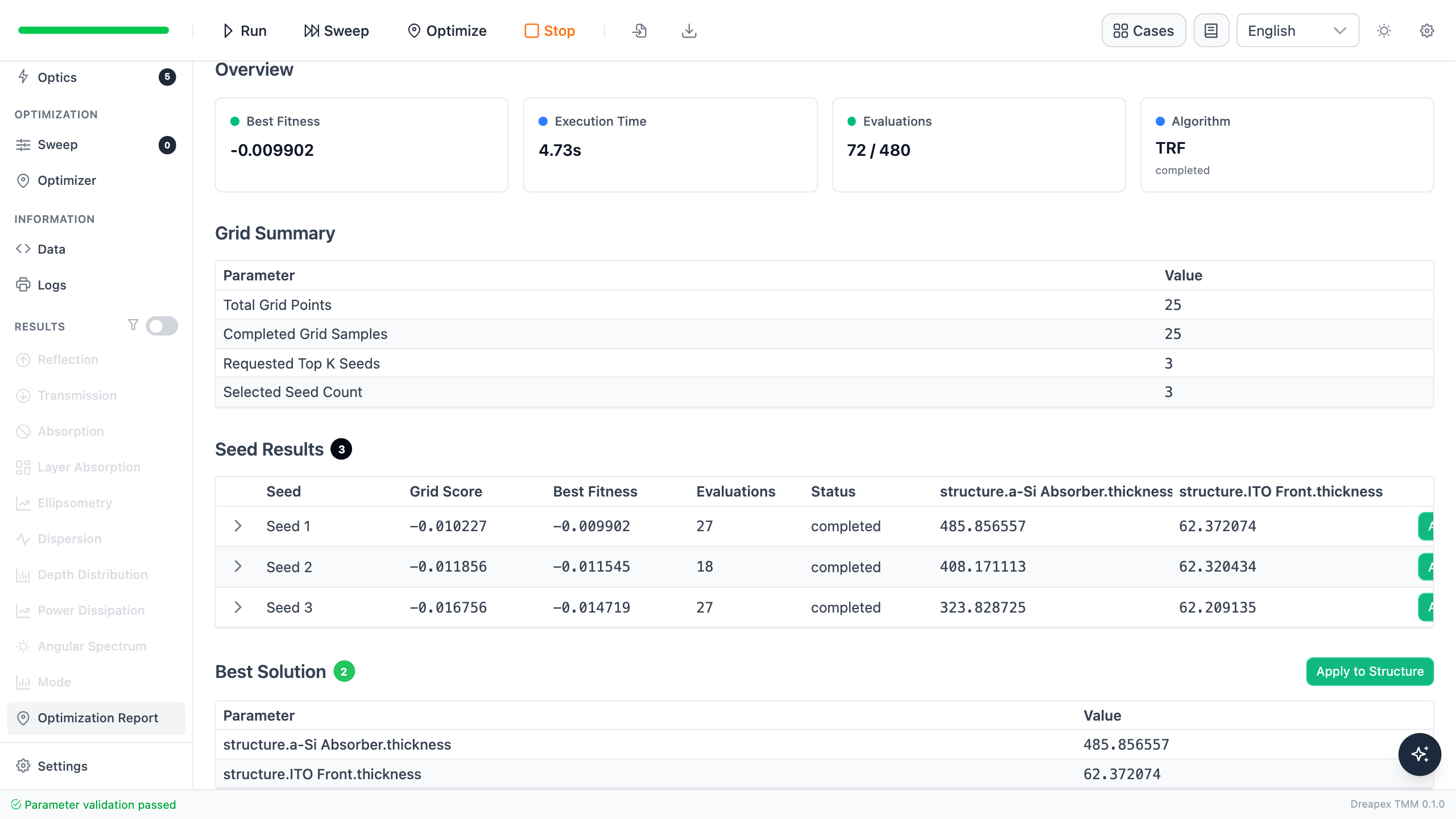
Sweeps show how results change with a parameter; optimization finds the best design for a specified target.
Parameter Sweep
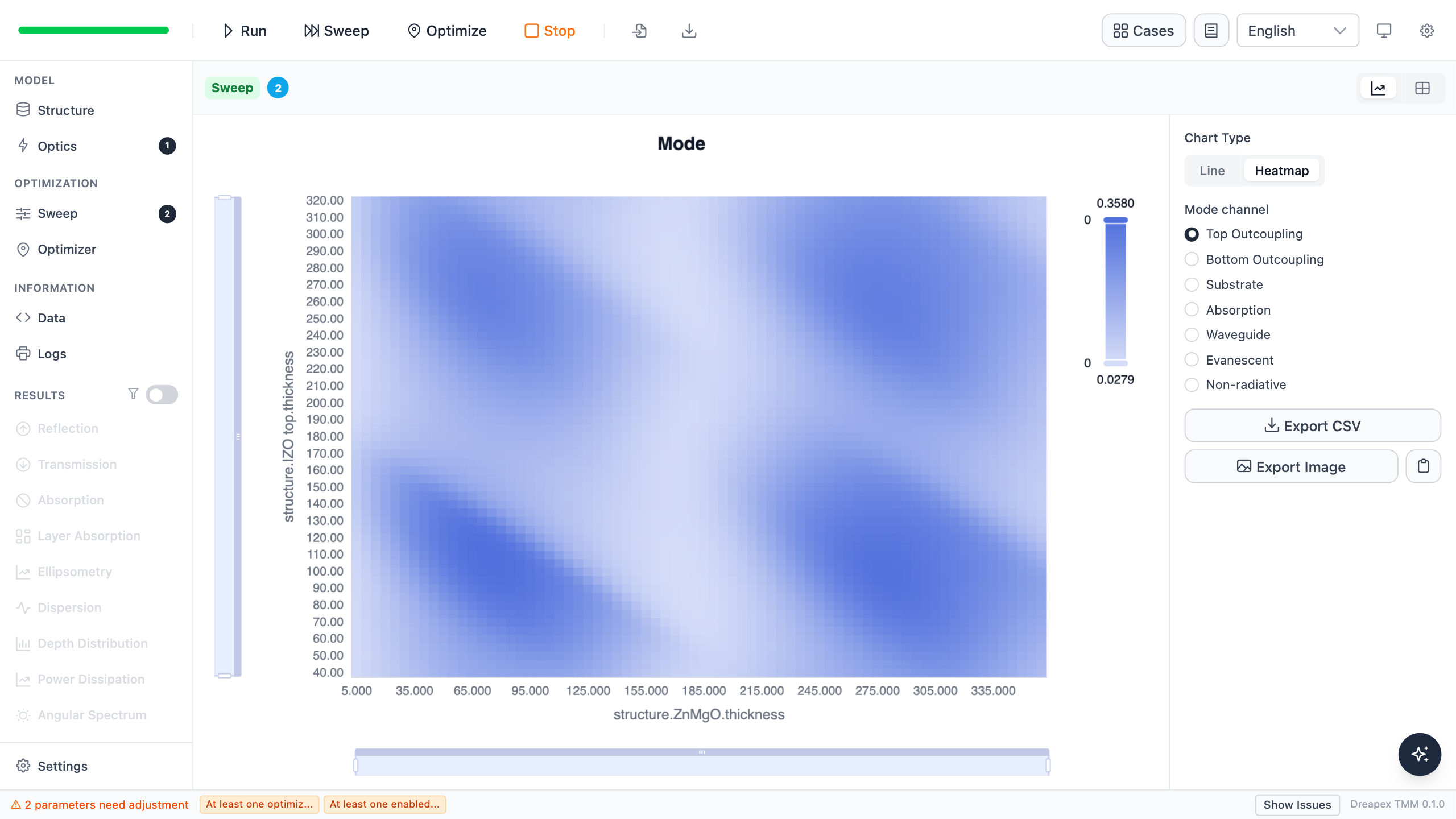
Target-Driven Optimization
Why Choose Dreapex TMM
Comprehensive Simulation
- Combine 17 detector types and obtain a complete analysis in one run.
- More than 30 simulation results cover thin-film optics and OLED emission.
- Verified against industry references and reproduced in published research case studies.
Intensity and Mode, sweep the electron-transport-layer thickness once, and every thickness returns its spectrum and its seven channel fractions at the same time, ready to compare in one set of data. Add Power Dissipation and it comes from that same single run. See Tandem QLED Cavity Optimization for the full procedure.| Simulation type | Light source | Applicable devices | Supported results |
|---|---|---|---|
| Propagation | External incident plane wave | Optical coatings, filters, absorbers, photovoltaics, photodetectors, metrology, and sensing devices | R / T / A and layer absorption; reflection / transmission / absorption spectra and CIE color; swept-color L*a*b*, C*ab, h_ab, and ΔE00; Ψ / Δ; reflection / transmission Phase, GD, GDD, and DGD; depth-resolved electric field, refractive index, normalized Poynting vector, and absorption density |
| Emission | Dipoles inside an emitting layer | Planar OLED, QLED, PeLED, and related emissive devices | Power dissipation; raw / normalized emission spectra and angular distributions; CIE emission color; peak intensity, peak wavelength, and envelope FWHM; top outcoupling, bottom outcoupling, substrate, waveguide, evanescent, absorption, and non-radiative channels; Purcell factor, decay-rate enhancement, effective quantum efficiency, and lifetime |
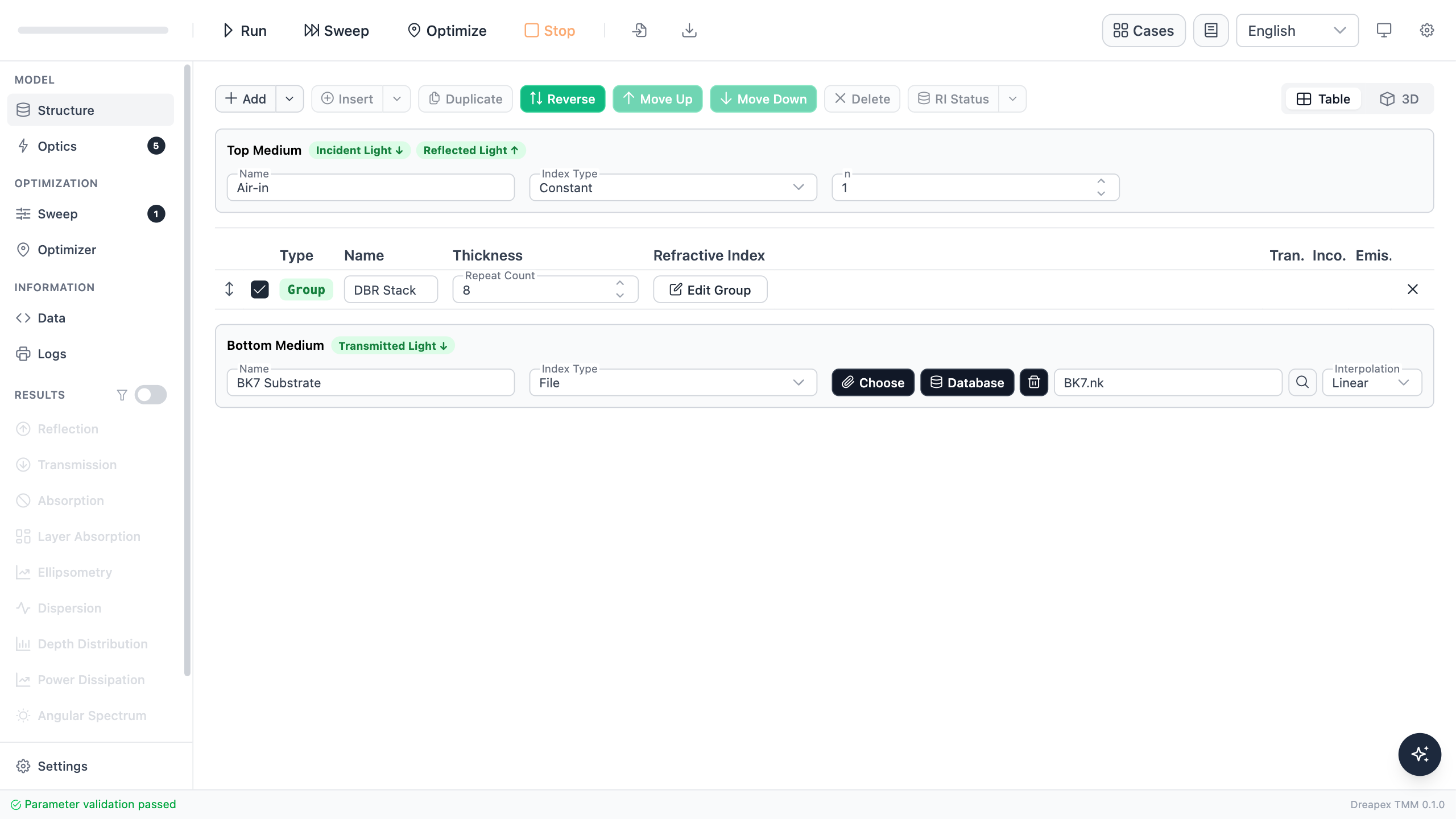
Easy to Learn
- No installation. Open the cloud platform and start.
- A clear workflow replaces cluttered pop-up windows; build the model and inspect results in one workspace.
- Real-time parameter validation reduces interrupted runs and keeps work moving.
- A built-in refractive-index database and case library accelerate model setup.
- Multilingual documentation takes you from the first simulation to advanced analysis.
Fast Computation
- High-speed cloud computing keeps local machines responsive and cool.
- Parallel sweeps process large numbers of parameter combinations quickly.
- Optimization algorithms automatically search for the best parameters.
Concurrent Requests in Settings, up to 32.AI Services and Open Data
- Modify models, run simulations, and read results with the in-app AI Assistant.
- Get answers and operating guidance from AI inside the documentation.
- Connect AI agents through MCP to automate the full modeling, sweep, optimization, and reporting workflow.
- Models use open JSON, and results use CSV, so local software and AI can read them.
- We believe your data belongs entirely to you. We will not bind it to proprietary formats, and you can leave Dreapex TMM at any time.
Open Dreapex TMM and run your first simulation.