Dispersion Analysis
This guide introduces four dispersion quantities: Phase, GD (Group Delay), GDD (Group Delay Dispersion), and DGD (Differential Group Delay). Use them to analyze pulse delay, broadening, and polarization-mode dispersion.
Example Setup
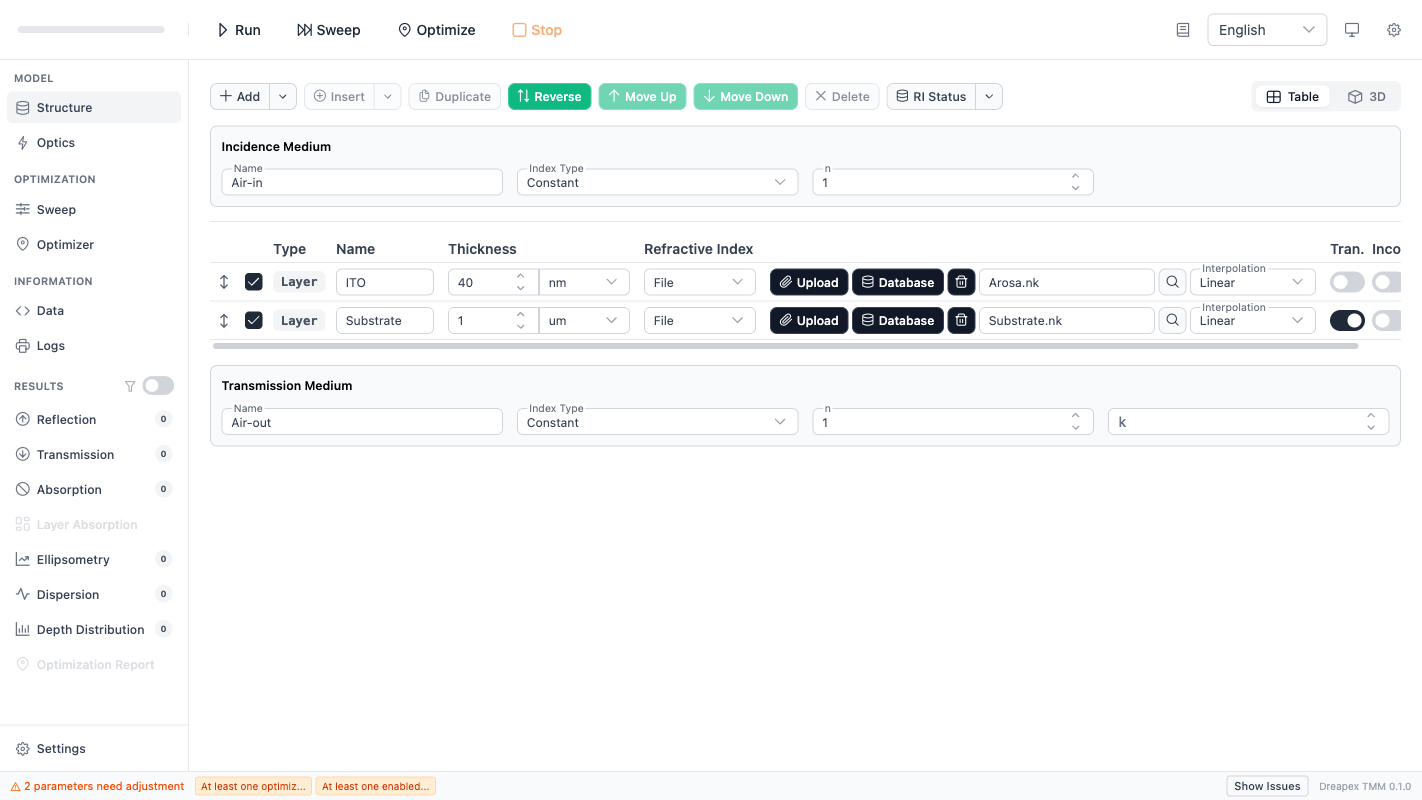
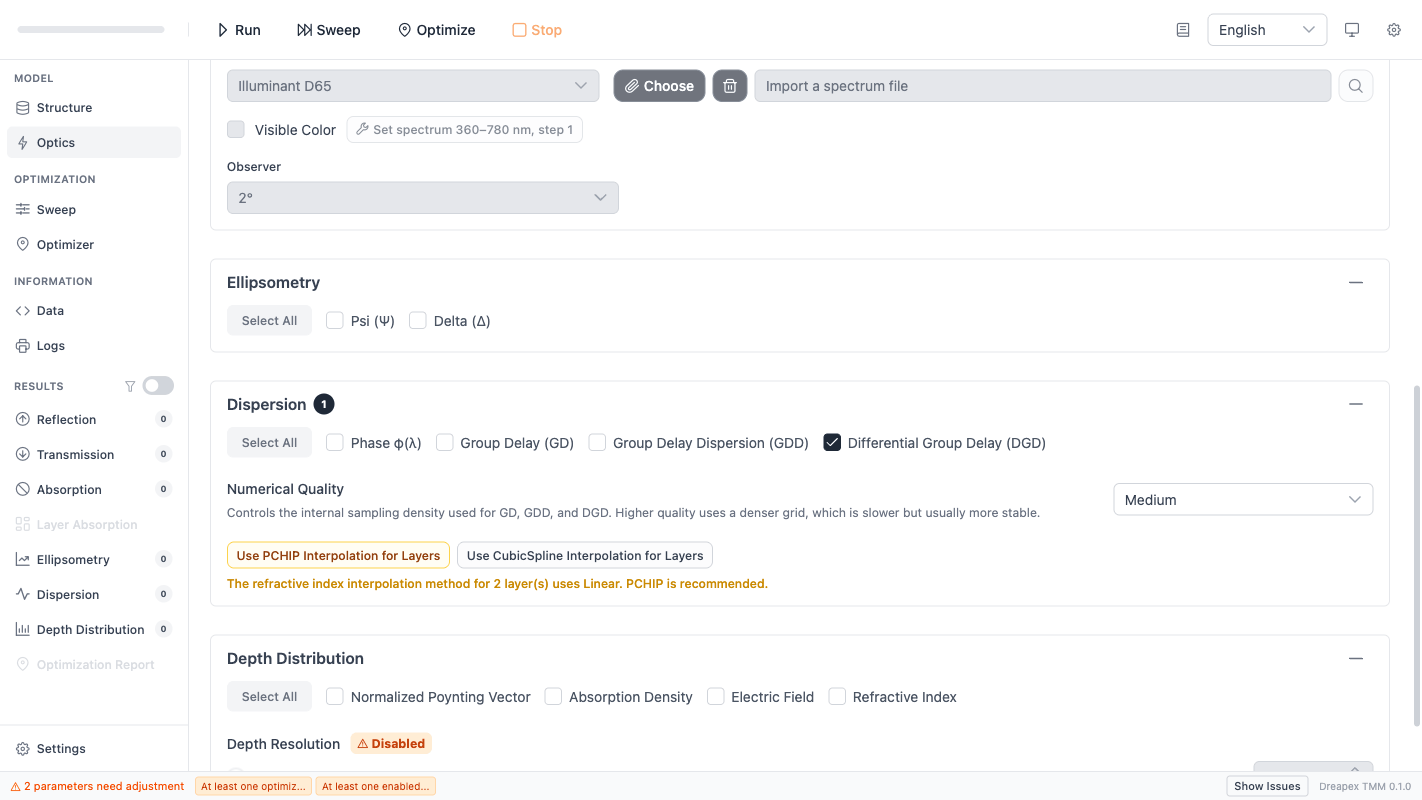
The following screenshots show the structure and optics configuration used for dispersion analysis:
Prerequisites
| Condition | Current requirement |
|---|---|
| Detector activation | Enable one or more of Phase, GD, GDD, DGD in Optics > Dispersion |
| Wavelength mode | Sweep mode required; Single and Average modes do not produce dispersion spectra |
| Structural coherence | Fully coherent stack recommended; incoherent layers may degrade the physical meaning of phase-based quantities |
| Cone Angle | Not supported for dispersion detectors |
| Analysis entry | Run and Run Sweep |
| Optimization entry | No direct Phase / GD / GDD / DGD target is currently available |
Physical Definitions
| Detector | Definition | Unit |
|---|---|---|
| Phase (φ) | Spectral phase of the transmitted or reflected complex amplitude | rad |
| GD | Group Delay: first derivative of phase with respect to angular frequency, GD = −dφ/dω | fs or ps |
| GDD | Group Delay Dispersion: second derivative of phase, GDD = d²φ/dω² | fs² or ps² |
| DGD | Differential Group Delay: difference in group delay between s- and p-polarization components | fs or ps |
GD describes the delay experienced by a pulse envelope. GDD describes how different frequency components experience different delays, leading to pulse broadening. DGD quantifies polarization-dependent delay differences relevant to PMD.
Application Scope
| Scenario | Main question | Recommended detectors | Recommended sweeps |
|---|---|---|---|
| Pulse broadening in ultrafast optics | Does the coating introduce excessive GDD that broadens femtosecond pulses? | GDD, Phase | structure layer thickness, wavelength range |
| GDD compensation coating design | Can the layer thicknesses be tuned to produce a target GDD profile? | GDD, GD | structure layer thickness |
| PMD evaluation in telecom coatings | Is the DGD within acceptable bounds across the operating band? | DGD, GD | optics/incidentAngle, structure layer thickness |
| Chromatic dispersion budget | What is the total GDD contribution of this coating in the system? | GDD, Phase | wavelength range extension |
| Phase ripple analysis | Are there rapid phase oscillations that degrade pulse fidelity? | Phase, GD | wavelength step refinement |
Common Problems and Diagnostics
| Problem | Symptom | Recommended action |
|---|---|---|
| Excessive GDD | Pulse broadening beyond tolerance in the target band | Sweep layer thicknesses to find a GDD minimum; verify with Phase continuity |
| Uncontrolled DGD | Polarization-dependent pulse distortion | Sweep incidentAngle and pRatio to isolate the angular sensitivity; check at normal incidence first |
| Phase ripple | Rapid oscillations in Phase or GD spectra | Reduce wavelength step for finer sampling; check whether ripple correlates with thin-layer interference |
| Low confidence at spectral edges | GD and GDD values show large fluctuations near the wavelength range boundaries | Extend the wavelength range beyond the region of interest; edge artifacts from numerical differentiation are expected |
| GDD sign ambiguity | Confusion between positive and negative chirp | Verify the sign convention by comparing with a known dispersive substrate |
Recommended Sweep Strategy
| Goal | Sweep parameter | Expected output |
|---|---|---|
| GDD sensitivity to layer thickness | structure/{layer}/thickness | GDD spectrum family; identify thickness values that flatten or invert GDD |
| Phase continuity check | Wavelength step refinement (decrease step size) | Smoother Phase curve; confirm absence of phase jumps |
| Angular dependence of DGD | optics/incidentAngle | DGD vs. angle; identify the angular range with minimal PMD |
| Multi-layer GDD optimization preparation | Multiple layer thicknesses | Parameter sensitivity map for downstream manual or R/T/A-based optimization |
Result Review Order
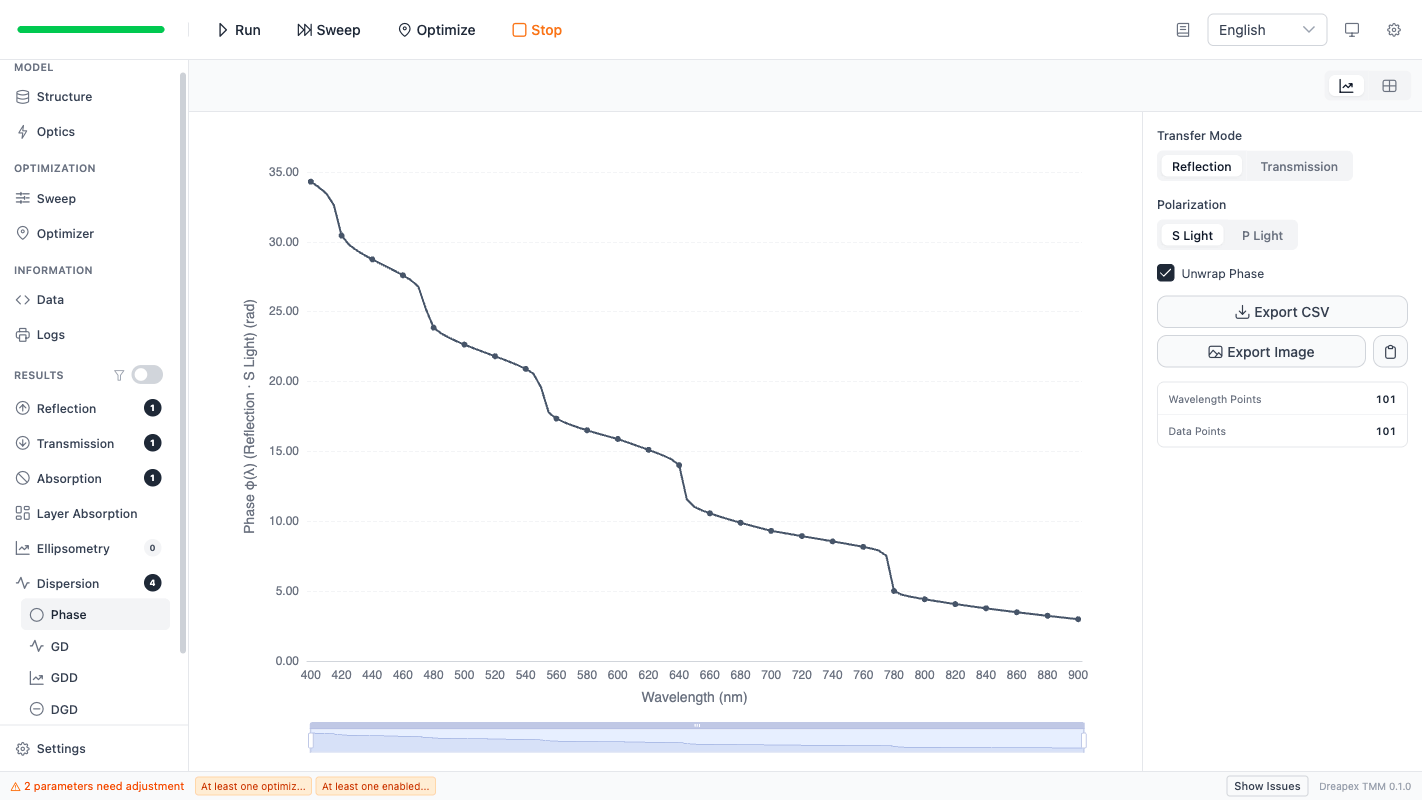
Start by checking the Phase page to verify phase continuity:
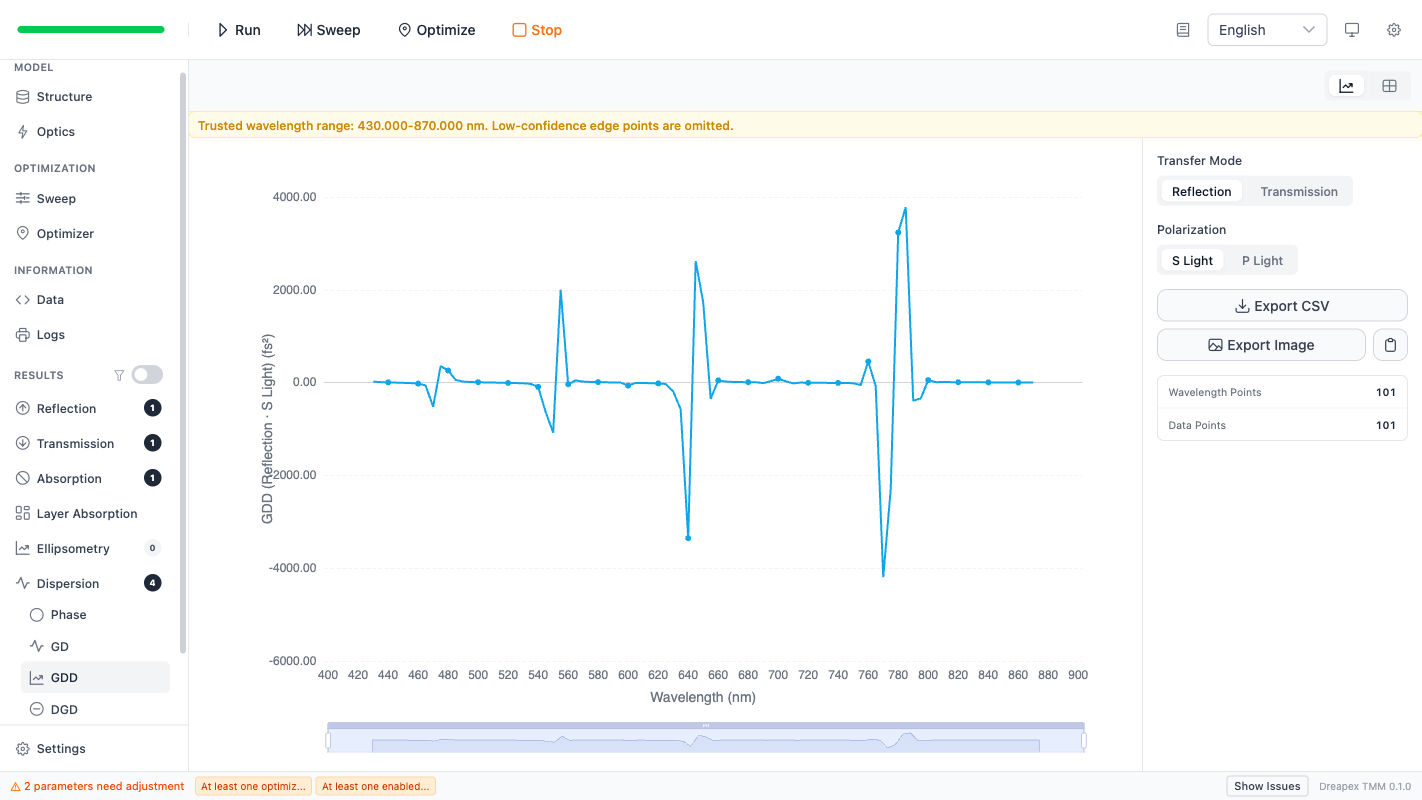
Then focus on the GDD page to quantify the pulse broadening contribution:
| Step | Detector | Purpose |
|---|---|---|
| 1 | Phase | Verify phase continuity; identify spectral regions with smooth vs. rapid phase variation |
| 2 | GD | Confirm group delay profile; identify delay peaks and flat regions |
| 3 | GDD | Quantify pulse broadening contribution; locate GDD zero-crossings and sign changes |
| 4 | DGD | Evaluate polarization mode dispersion; confirm acceptable DGD across the operating band |
| 5 | Reflectance / Transmittance | Back-check energy performance; confirm that dispersion optimization does not degrade spectral targets |
Relation to the Optimizer
| Item | Current status |
|---|---|
Direct Phase / GD / GDD / DGD optimization | Not supported |
| Indirect approach | Use Sweep to identify parameter sensitivity, then optimize R / T / A with Curve Fit or Scalar goals to achieve the spectral profile that corresponds to acceptable dispersion |
optics variables as optimization variables | Not exposed in the current UI |
R / T / A back-check | Recommended after any dispersion-driven parameter adjustment |
Conclusion Boundaries
- The current software supports
Phase,GD,GDD, andDGDprediction and sweep-based parameter sensitivity analysis. - The current software does not support direct optimization toward a target GDD or DGD value.
- Dispersion results require wavelength
Sweepmode; they are not produced inSingleorAveragemode. - Cone Angle averaging is not applied to dispersion detectors.
Case Study Entry
For full structures and workflows, see Case Studies. Future cases will cover GDD compensation for ultrafast mirror coatings, PMD evaluation for telecom filter stacks, and chirped mirror design.
Next Step
If the problem involves system-level reflectance or transmittance targets, return to RTA and Layer Absorption Analysis. For full application workflows, proceed to Case Studies.