Ellipsometry Analysis
This guide combines Psi and Delta with Sweep to analyze how thickness, refractive index, and incidence angle affect polarization response. Use it with R/T/A results to compare ellipsometric changes and structural differences.
Prerequisites
| Condition | Current requirement |
|---|---|
| Detector activation | Enable Psi (Ψ) and Delta (Δ) in Optics > Ellipsometry |
| Structural coherence | Fully coherent stack; results are invalid when incoherent layers are present |
| Incident angle | Oblique incidence is usually required; the sensitive angle range depends on the structure |
| Analysis entry | Run and Run Sweep |
| Optimization entry | No direct Psi / Delta target is currently available |
Application Scope
| Scenario | Main question | Recommended sweeps |
|---|---|---|
| Thickness sensitivity | Whether thickness changes are cleanly distinguishable | thickness |
Material n / k sensitivity | Whether real or imaginary refractive-index changes are distinguishable | n, k |
| Birefringent-film response | Whether nExt / kExt changes produce clear response changes | nExt, kExt |
| Angle selection | Which angle range gives stronger parameter sensitivity | incidentAngle |
| Absorbing and conductive films | Whether amplitude and phase responses are strong enough | thickness, k, incidentAngle |
| Multi-parameter separability | Whether two variables produce mixed or separable responses | thickness + incidentAngle, thickness + k |
Baseline Model
Structure
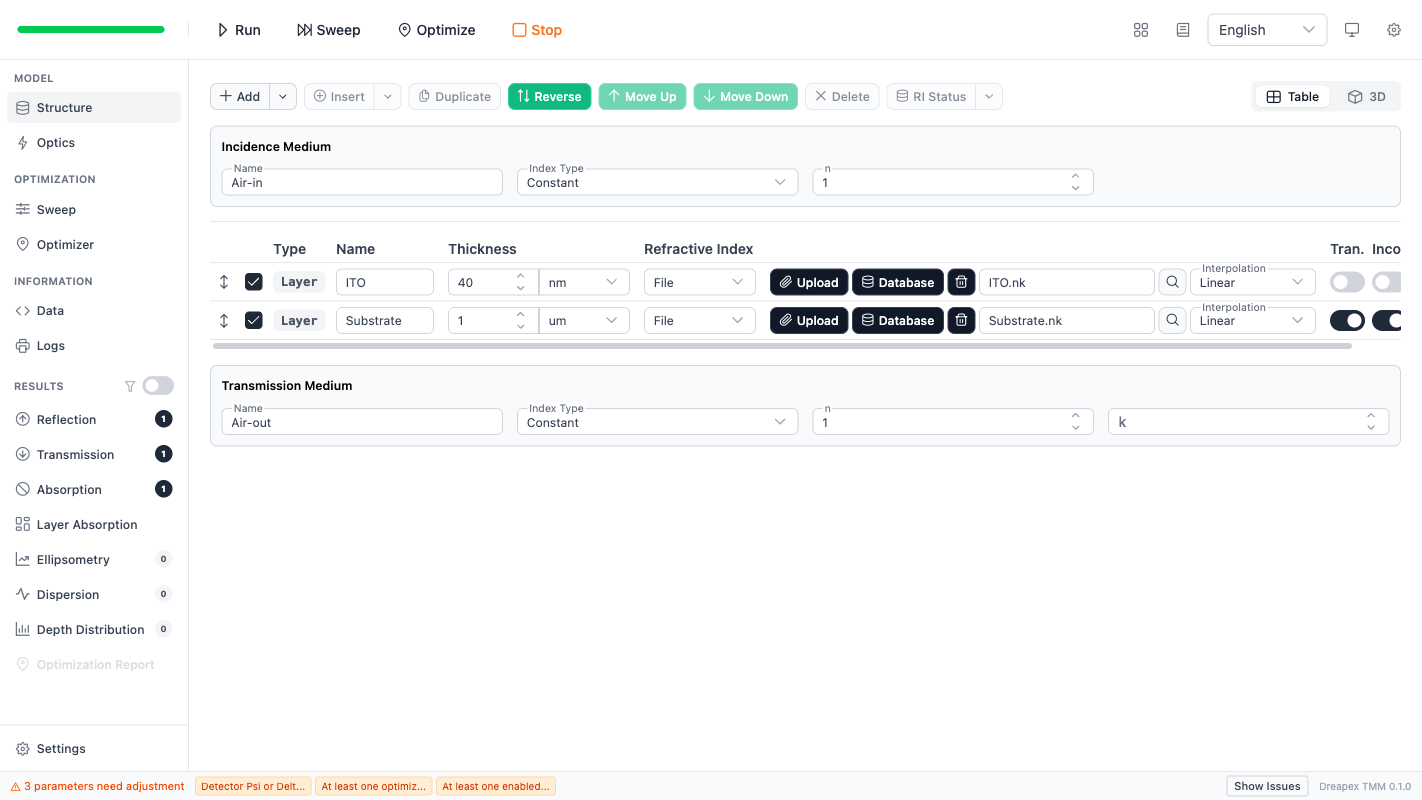
This example keeps the ITO + Substrate baseline and preserves coherence across the full stack. The purpose is to compare the effect of ITO thickness and incident angle on Psi / Delta.
Optical Parameters
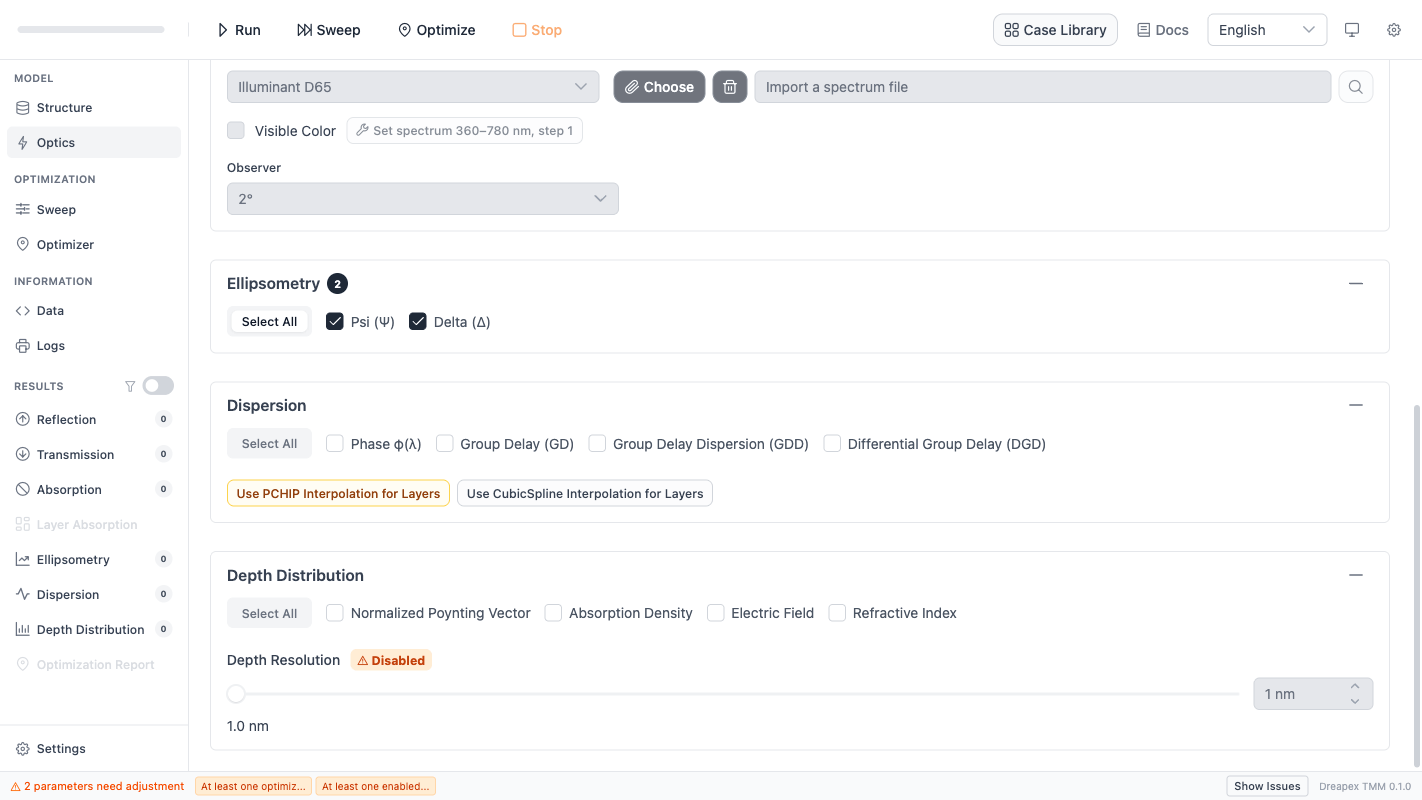
| Item | Setting |
|---|---|
| Wavelength Sampling | Sweep |
| Wavelength range | 400-900 nm |
| Step | 10 nm |
| Incident Angle | 65° |
| pRatio | 0.5 |
| Detectors | Reflectance, Psi, Delta |
This setup is used to establish one stable Psi / Delta spectrum. 65° is the starting angle for this example only. It is not a universal optimum.
One-Parameter Sweep
Sweep Setup
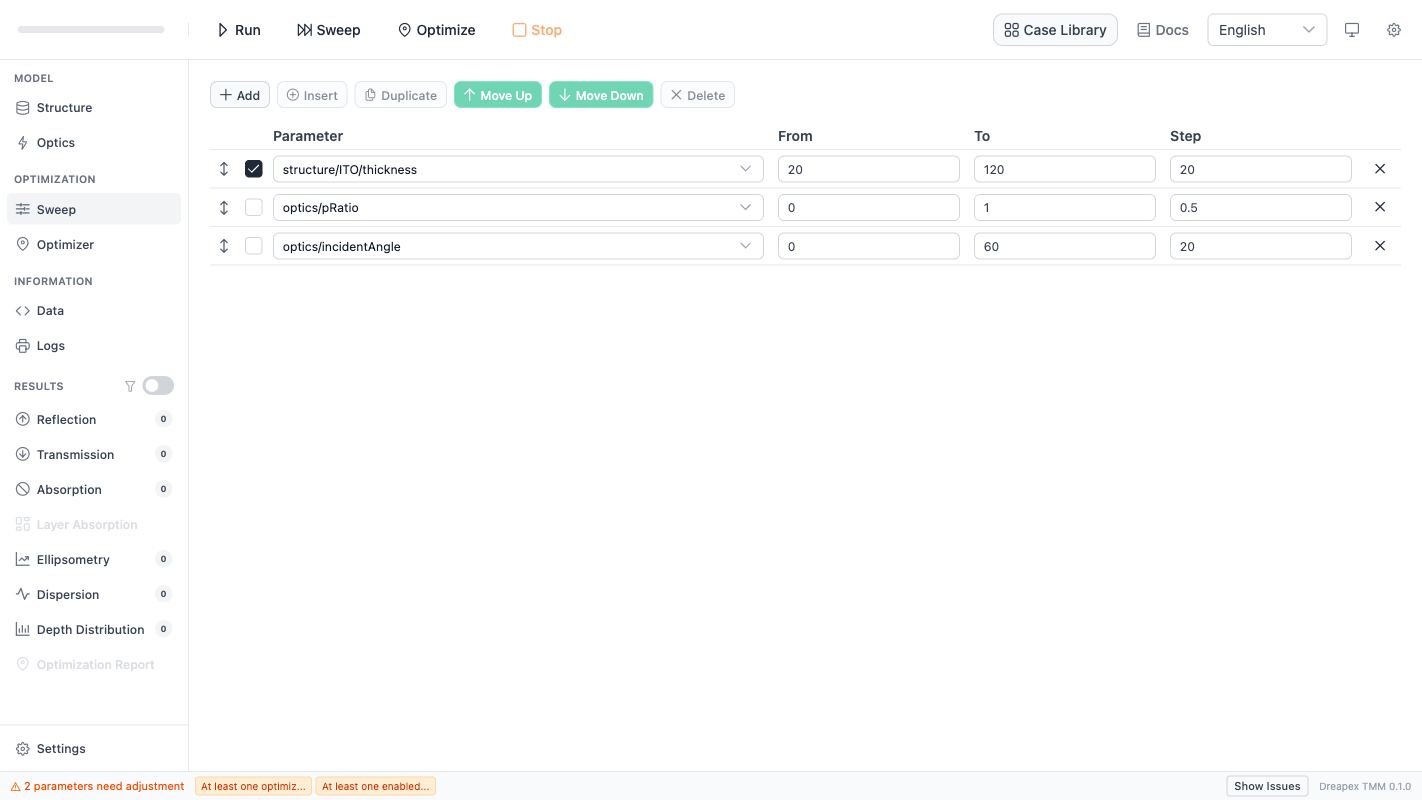
| Parameter | From | To | Step |
|---|---|---|---|
structure/ITO/thickness | 20 | 120 | 20 |
Psi Line Chart
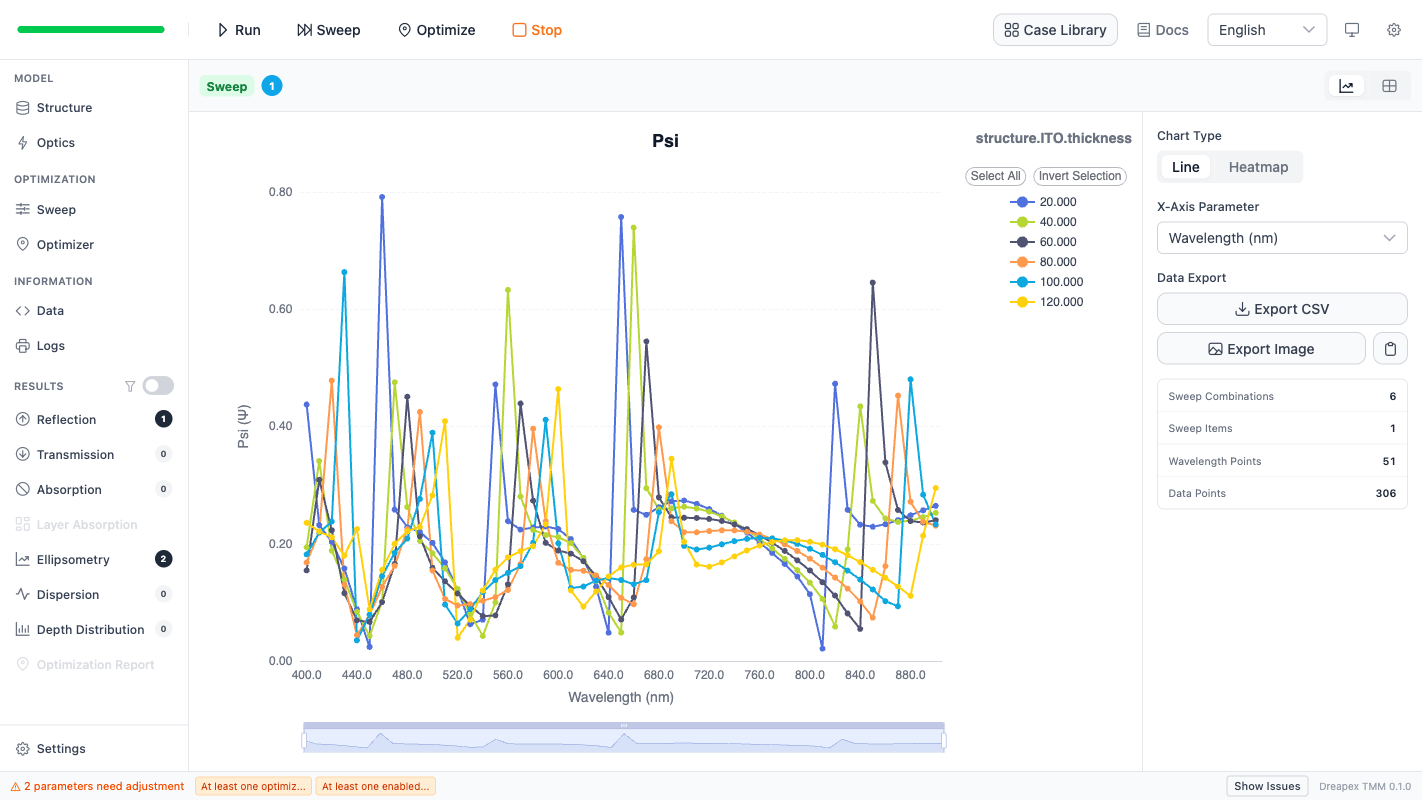
This chart keeps the full wavelength axis. Different thickness values produce clear peak shifts and local spikes in Psi. It is used to read:
- whether peak and valley positions move with thickness
- which spectral regions are most sensitive
- whether the response changes as a global shift or as local deformation
If curves from different thickness values nearly overlap, the variable does not provide sufficient sensitivity in Psi.
Psi Heatmap
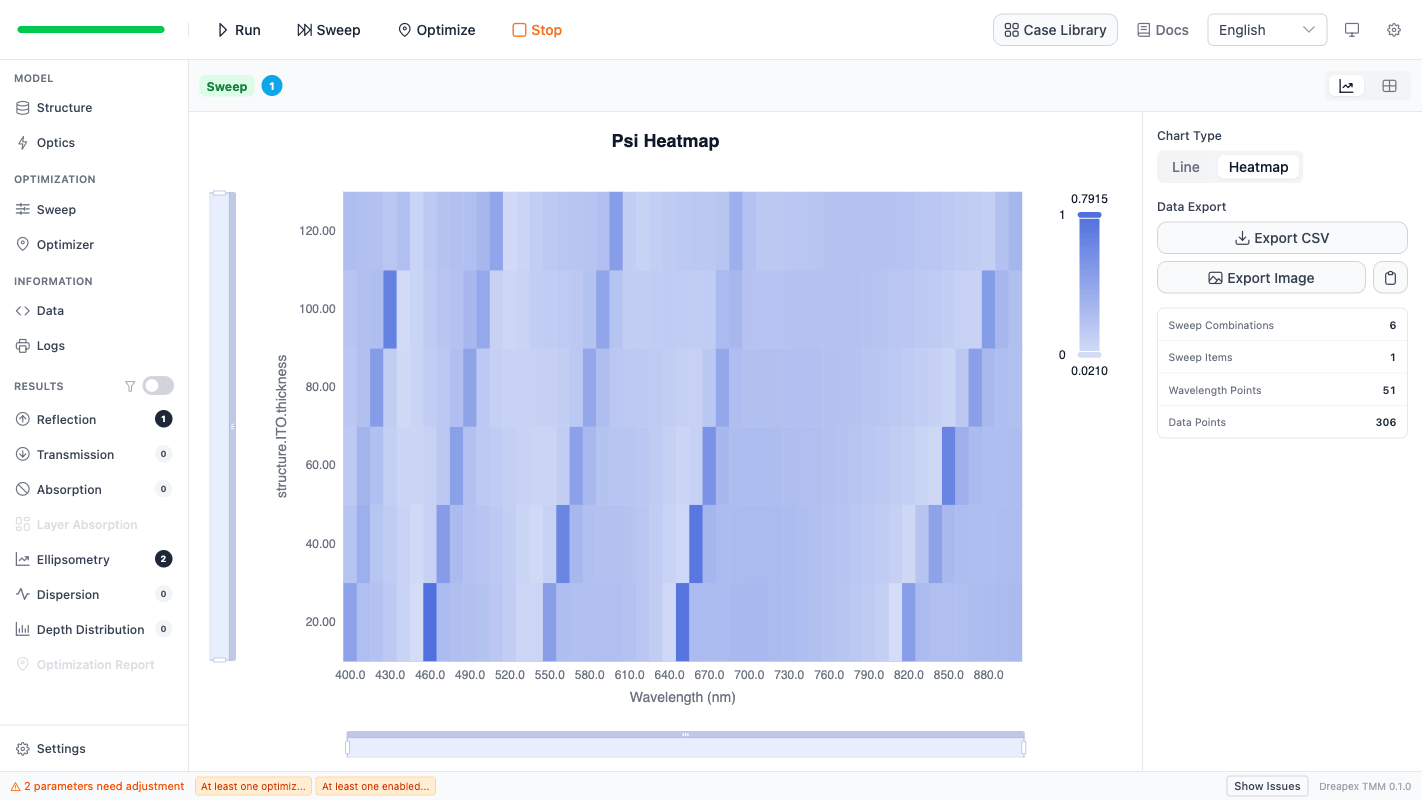
The heatmap maps wavelength and ITO thickness onto a two-dimensional plane. It is used to read:
- sensitive spectral bands
- continuity of response trajectories
- thickness ranges with smoother or sharper response variation
The heatmap is the primary view for locating sensitivity windows. Return to the line chart for detailed inspection at a few working wavelengths.
Two-Parameter Sweep
Sweep Setup
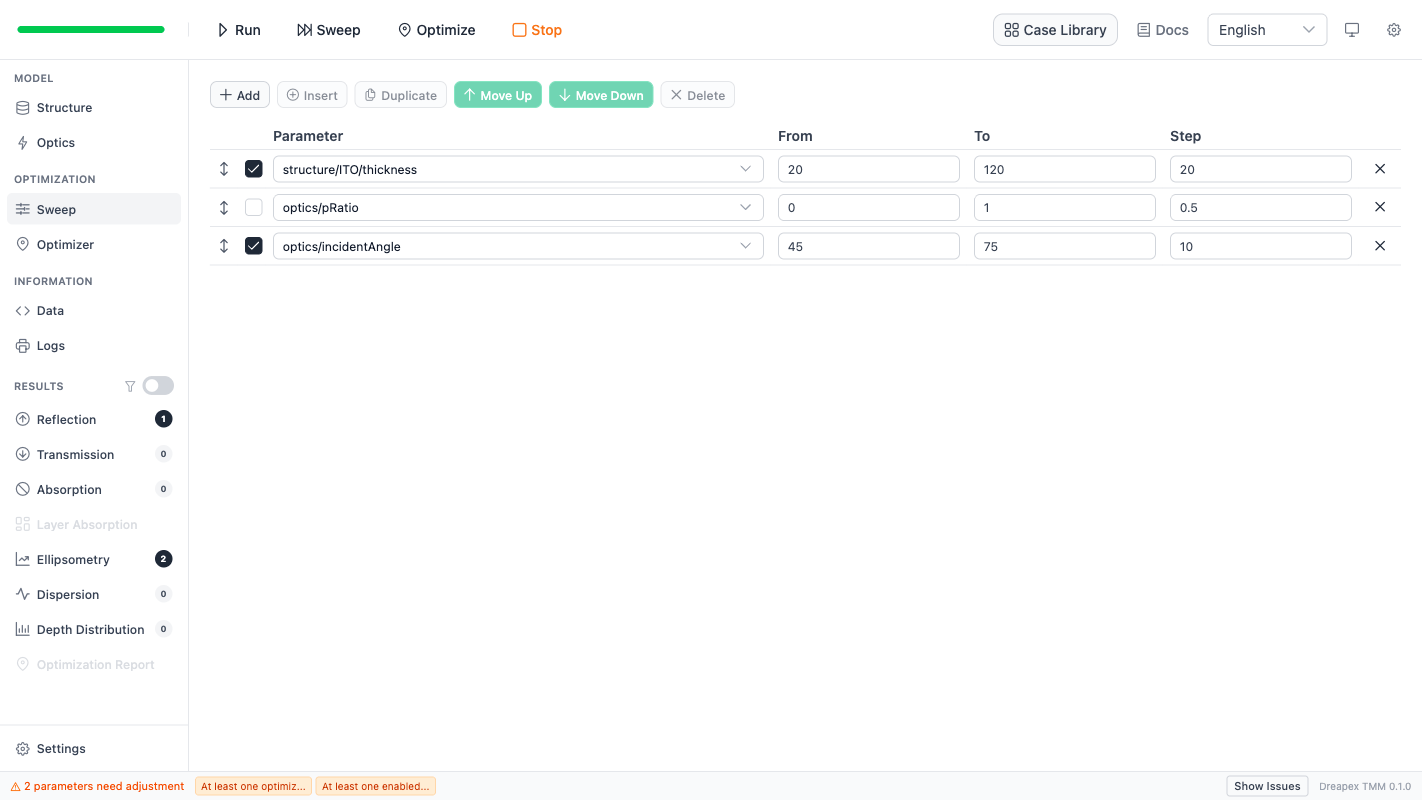
| Parameter | From | To | Step |
|---|---|---|---|
structure/ITO/thickness | 20 | 120 | 20 |
optics/incidentAngle | 45 | 75 | 10 |
Delta Heatmap
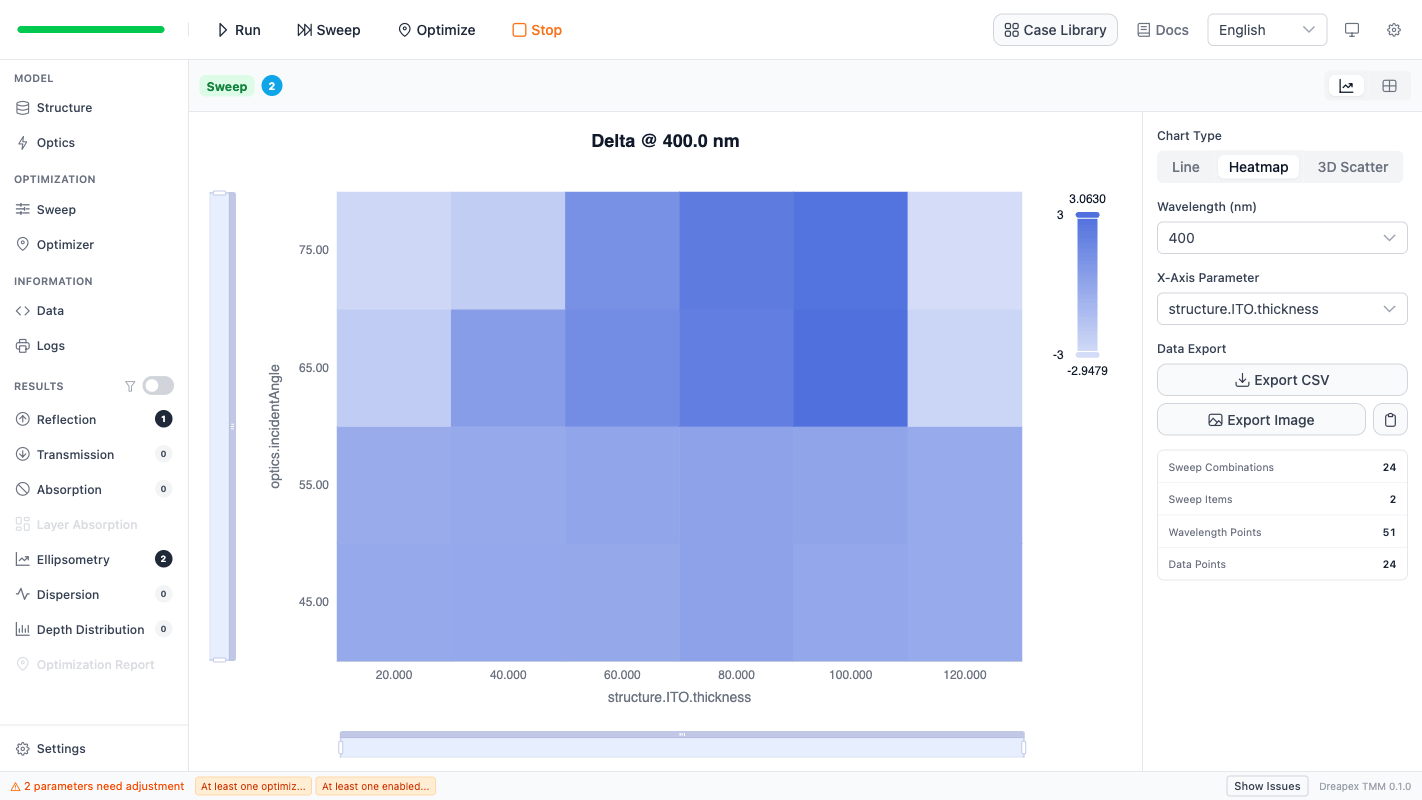
This chart is fixed at 550 nm. The horizontal axis is ITO thickness and the vertical axis is incidentAngle. It is used to read:
- whether
Deltaenters a stronger sensitivity region at higher angles - whether thickness and angle act in the same or opposite direction
- whether there is a stable operating window for parameter discrimination
In this example, the 65-75° region is more sensitive in Delta, while the lower-angle region is flatter. The practical role of angle sweeps is to find higher-discrimination working points.
Reading Psi and Delta
| Result quantity | Main reading focus | Typical use |
|---|---|---|
Psi | amplitude-ratio change, peak/valley drift, local rise or drop | thickness sensitivity, amplitude-response analysis |
Delta | phase-difference change, turning points, local jumps | angle selection, phase-sensitive window identification |
Psi and Delta should be interpreted together. Reading only one of them increases the chance of mixing different parameter effects.
Recommended Sweep Order
| Goal | Recommended order |
|---|---|
| Thickness sensitivity | Psi line chart → Psi heatmap → Delta check |
| Angle selection | Delta two-parameter heatmap → Psi line chart → Reflectance back-check |
n / k sensitivity | one-parameter sweep in n or k → compare Psi / Delta response strength |
| Multi-parameter separability | separate one-parameter sweeps first → then a two-parameter sweep for overlap inspection |
Relation to RTA and the Optimizer
| Item | Current status |
|---|---|
direct Psi / Delta optimization | Not supported |
optics variables as optimization variables | Not exposed in the current UI |
R / T / A back-check | Recommended |
After ellipsometry analysis, return to Basic Optical Results and check whether the same parameter change also produces a system-level change in R / T / A.
Conclusion Boundaries
- The current software supports
Psi / Deltaprediction, angle-sensitivity analysis, and parameter-separability analysis. - The current software must not be described as an automatic fitting platform for measured ellipsometry data.
Psi / Deltashould not be interpreted when incoherent layers are present.
Case Study Entry
For full structures and workflows, see Case Studies. Future cases will cover thickness sensitivity, conductive-film ellipsometry response, absorbing-film parameter separability, and birefringent-film response.
Next Step
If the problem moves to local energy flow, local absorption, or field-enhancement position, continue with Depth Detector Analysis.