Purcell Effect
Changing only the distance from an emissive layer to a metal electrode can change the emission lifetime even when material composition, concentration, and intrinsic quantum yield remain identical. The field reflected back to the emitter changes the electromagnetic states available to it and therefore its total decay rate.
This optical-environment control of spontaneous emission is the Purcell effect. It shares the same layered electromagnetic environment as microcavity interference: the microcavity article treats the spectrum and direction of outcoupled light, while this article treats the emitter decay dynamics.
Optical Environment and Decay Rate
In a homogeneous reference environment, the total decay rate is
Here, is the intrinsic decay rate into electromagnetic channels, is the internal material nonradiative rate, is the intrinsic total rate, is the intrinsic lifetime, and is the intrinsic quantum efficiency.
The layered environment multiplies the electromagnetic decay rate by the Purcell factor while approximately leaving the material nonradiative rate unchanged:
The electromagnetic channels here include external outcoupling, substrate, waveguide, absorption, and evanescent coupling. Near a metal, an increased can predominantly feed absorption or SPPs and does not necessarily produce more far-field photons.
Effective Quantum Efficiency and Lifetime
Eliminating the two intrinsic rate components using gives
where is the decay-rate ratio between the layered and reference environments. The effective lifetime and effective quantum efficiency are
Here, is the lifetime in the optical environment and is the fraction entering any electromagnetic channel. All three expressions use the same , so decay rate, lifetime, and effective quantum efficiency cannot be adjusted independently.
| Condition | Lifetime | Effective quantum efficiency | Efficiency interpretation |
|---|---|---|---|
| and | Shorter | Higher | Check whether the enhancement reaches outcoupling or a loss channel |
| and | Longer | Lower | One orientation or loss channel may be suppressed, but total electromagnetic decay is weaker |
| Changes with | Remains 1 | Purcell modulation changes lifetime and channel allocation but cannot raise 100% further | |
| Very large together with large EVA/ABS | Usually much shorter | Can be higher | EQE can still fall because the enhancement mainly feeds metal loss |
Maximizing is therefore not an OLED optical-design objective. A useful design increases the target outcoupling fraction while controlling guided, absorptive, and evanescent loss.
Wavevector Meaning of the Purcell Factor
The Purcell factor is the integral of normalized dissipated power across all in-plane wavevectors:
Here, is the in-plane wavevector normalized to the EML wavenumber, is normalized dissipated power per unit , is wavelength, is dipole position in the EML, and denotes dipole orientation. The integral contains propagating, guided, and evanescent regions, making sensitive to wavelength, position, and orientation.
Horizontal and vertical dipoles see different reflected fields and generally have different factors and . Even if the input orientation ratio is isotropic, the environment reweights their emission contributions through and . A strong microcavity can enhance horizontal dipoles and suppress vertical dipoles, pulling the total outcoupling toward the high-LEE horizontal component.
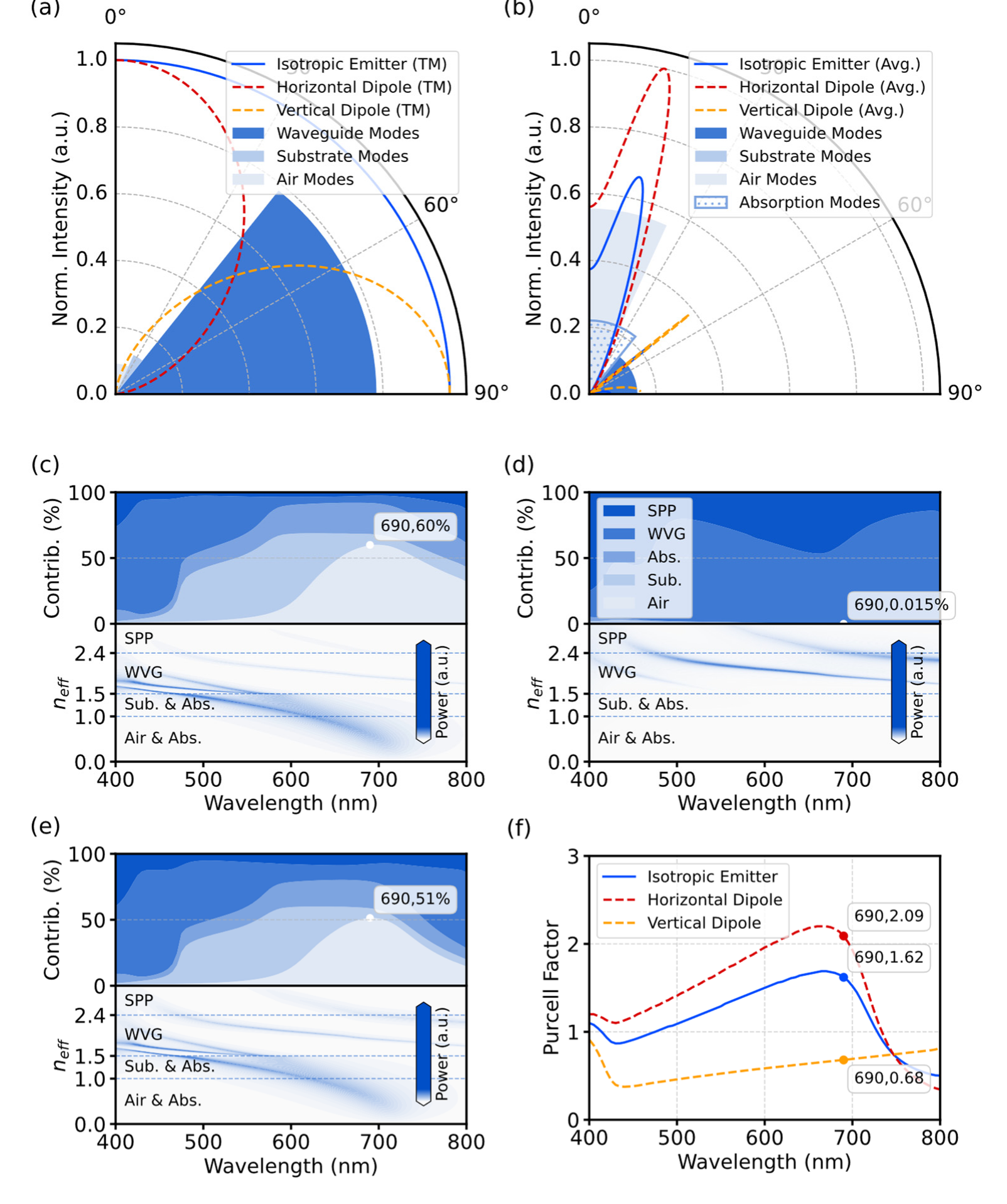
Broadband-Emitter Average
The Purcell factor varies with wavelength. For an emitter with photon-number weight , first calculate
where and bound the calculated spectrum, is the photon-number spectral weight, and is the spectrum-averaged Purcell factor. The overall , , and then follow by substituting into the rate equations above.
Both and are nonlinear. Directly averaging wavelength-resolved quantum efficiencies or lifetimes gives a different statistic. When comparing simulation with time-resolved measurements, confirm whether the reported lifetime is derived from the overall rate or is an arithmetic mean of wavelength-resolved lifetimes.
Interpreting the Results
| Quantity | Direct meaning | Read together with |
|---|---|---|
| Enhancement or suppression of electromagnetic decay relative to the reference | Dissipated-power spectrum and every Mode fraction | |
| Total decay-rate ratio | and | |
| Fraction of excitons entering any electromagnetic channel | NRA and outcoupling fractions | |
| Lifetime after optical-environment modulation | Intrinsic lifetime and the experimental time-resolved definition | |
| TOC/BOC | Fractions that actually cross an external boundary | Conversion efficiency is still needed to obtain device EQE |
Next Step
Read Emission Structure to turn the EML, emitter, spectrum, and detector quantities from these five principle articles into a runnable model.
Reference
- Purcell, E. M. Spontaneous Emission Probabilities at Radio Frequencies. In Confined Electrons and Photons; Springer, 1995; p 839.
- Chance, R. R.; Prock, A.; Silbey, R. Molecular Fluorescence and Energy Transfer near Interfaces. Adv. Chem. Phys. 1978, 37, 1–65.
- Wasey, J. A. E.; Barnes, W. L. Efficiency of Spontaneous Emission from Planar Microcavities. J. Mod. Opt. 2000, 47, 725–741.
- Cho, H.; Chung, J.; Song, J.; et al. Importance of Purcell Factor for Optimizing Structure of Organic Light-Emitting Diodes. Opt. Express 2019, 27, 11057.
- Meerheim, R.; Furno, M.; Hofmann, S.; Lüssem, B.; Leo, K. Quantification of Energy Loss Mechanisms in Organic Light-Emitting Diodes. Appl. Phys. Lett. 2010, 97, 275.