Emission Physics
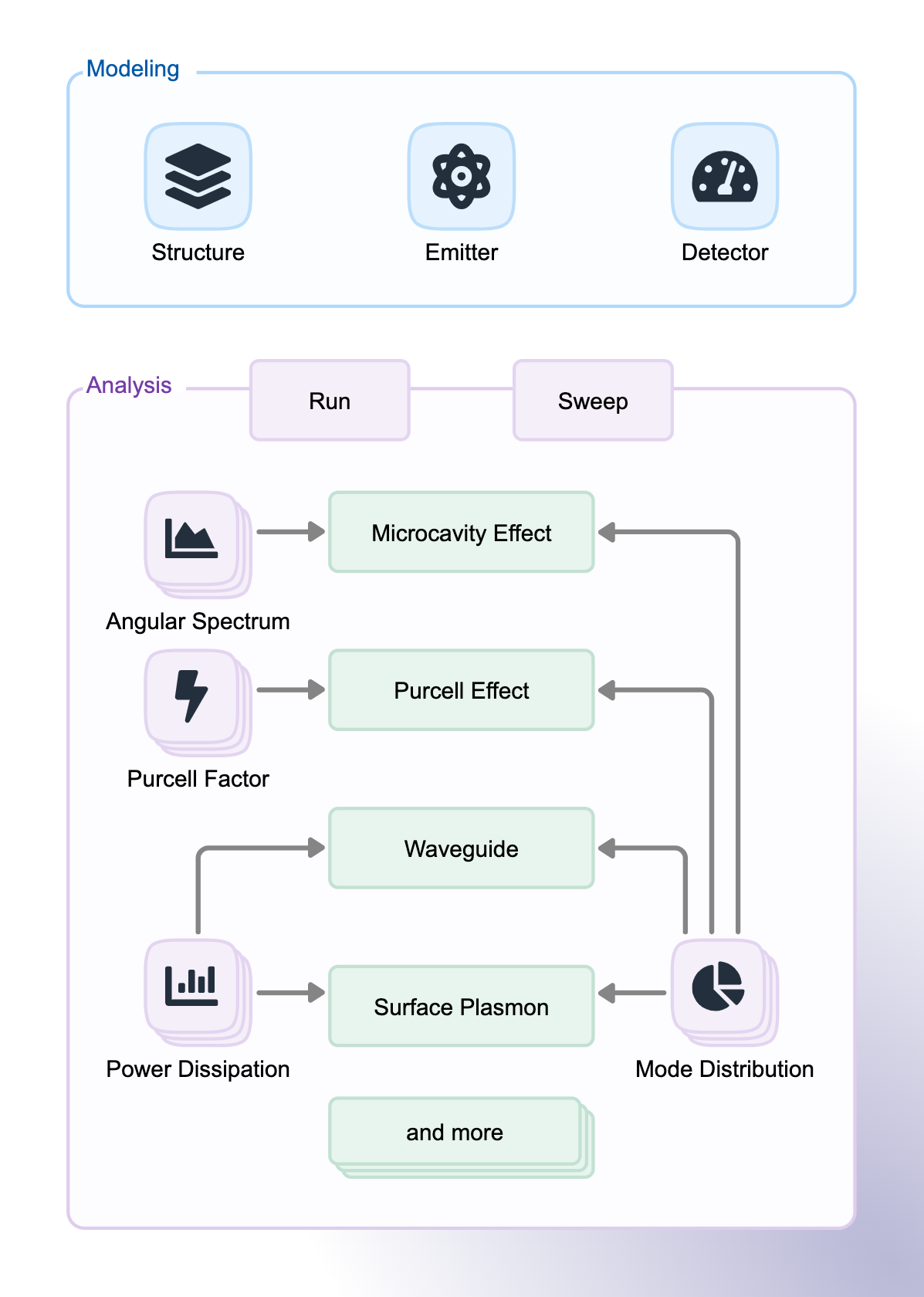
This chapter introduces dipole emission, microcavity interference, waveguides, surface plasmon polaritons (SPPs), and power dissipation in layered devices, and maps these quantities to the emission result pages. These results can be used to analyze emission efficiency, outcoupling direction, and loss pathways.
Chapter Scope
An external plane wave enters the stack from the surrounding medium; by contrast, emission simulation models the exciton as a radiating point dipole inside the stack. The point-dipole multilayer model applies when each layer is a flat thin film and the device lateral area is much larger than the functional-layer thickness (high width-to-height ratio); edge effects of small-area, thick devices are not captured.
| Physical object | Model description | Simulation consequence |
|---|---|---|
| Emission source | Radiating point dipole inside the stack | Internal source, as opposed to external plane-wave excitation |
| Spectrum | Intensity vs wavelength (measurable) | Forward emission spectrum |
| Angular distribution | Intensity vs angle (measurable) | Forward angular intensity |
| Power dissipation | Dissipated power vs in-plane wave vector (not directly measurable) | Dispersion basis for separating loss channels |
| Optical mode | Loss-channel share distribution (not measurable) | Outcoupling, waveguide, evanescent, absorption, and nonradiative shares |
| Purcell factor | Spontaneous-emission property affecting IQE (hard to measure) | Structural modulation of the spontaneous-emission rate |
Together these quantities are used to investigate microcavity, Purcell, planar-waveguide, optical-tunneling, and surface-plasmon-polariton (SPP) effects.
Dipole Emission and Orientation
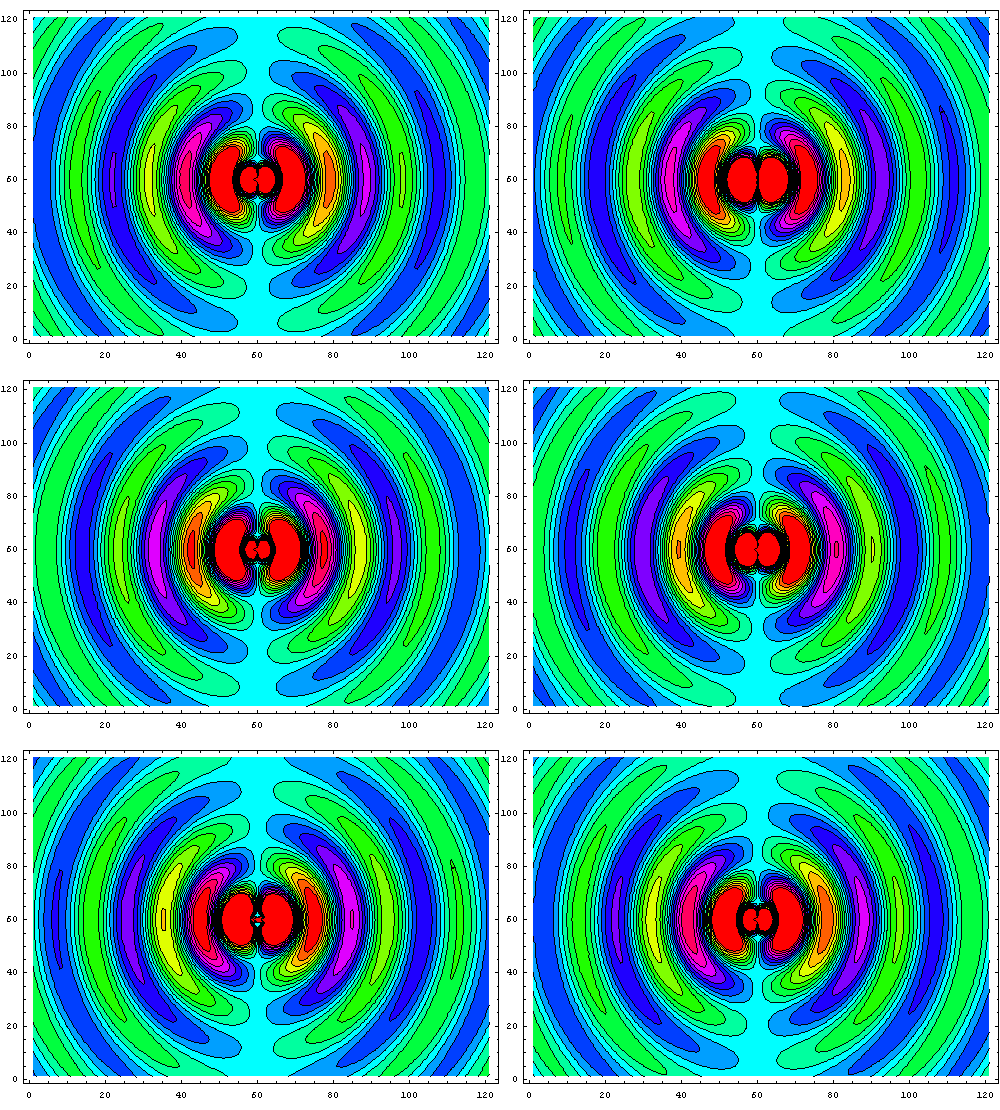
Unoriented emitters radiate isotropically; isotropic emission is the weighted sum of vertical (z) and horizontal (x,y) dipole radiated-power densities,
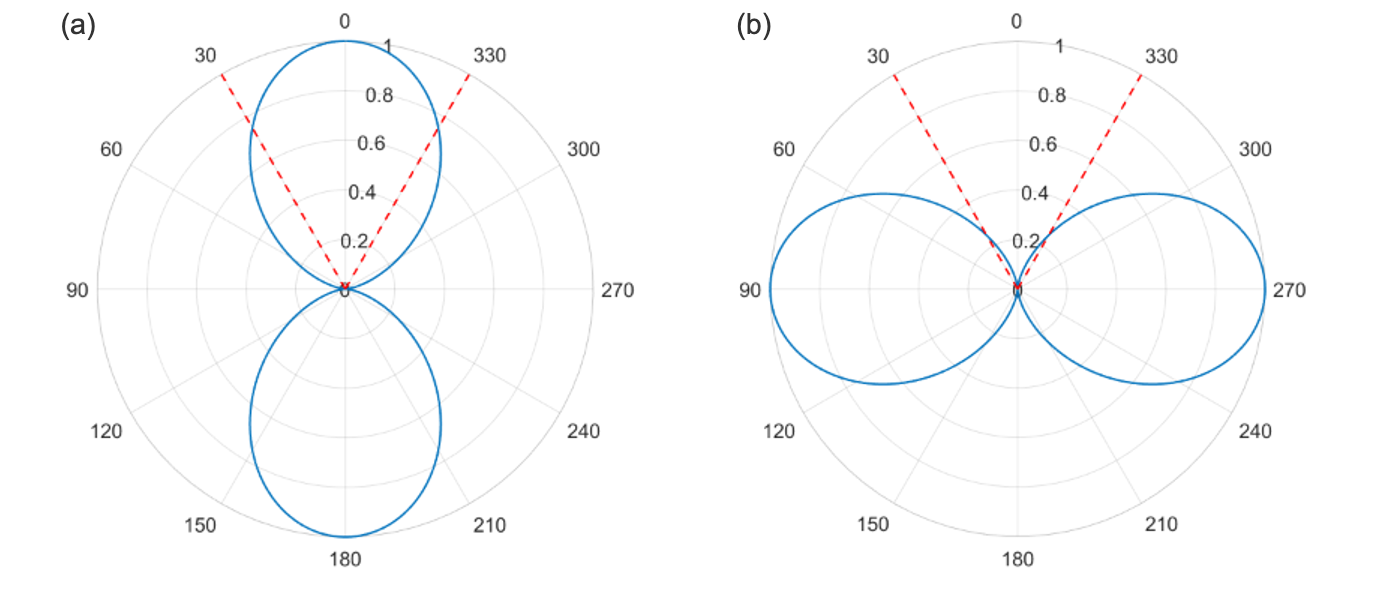
where iso is isotropic, v is vertical (z), and h is horizontal (x,y). A vertical dipole radiates its far field mainly in-plane (no far-field radiation along z); a horizontal dipole radiates mainly along z (out of plane).
Because the emission layer (EML) index exceeds air, light beyond the critical angle is totally internally reflected at the interface and cannot escape, forming the escape cone. Horizontal dipoles place more power inside the escape cone, so they yield substantially higher light extraction efficiency (LEE) than vertical dipoles, whose energy largely becomes loss.
Quantum Efficiency, Purcell, and EQE
The external quantum efficiency (EQE) of an OLED decomposes into the internal quantum efficiency (IQE) times the light extraction efficiency (LEE):
where is the charge-carrier balance factor, is the spin formation ratio ( for purely random singlet/triplet formation), is the effective quantum efficiency, and is the light extraction efficiency. QLED/PeLED have no spin-statistics bottleneck, so drops out:
LEE is defined as the ratio of photons entering the surrounding medium to photons emitted by the EML, also called outcoupling efficiency. For a Lambertian emitter, geometric optics gives the limit
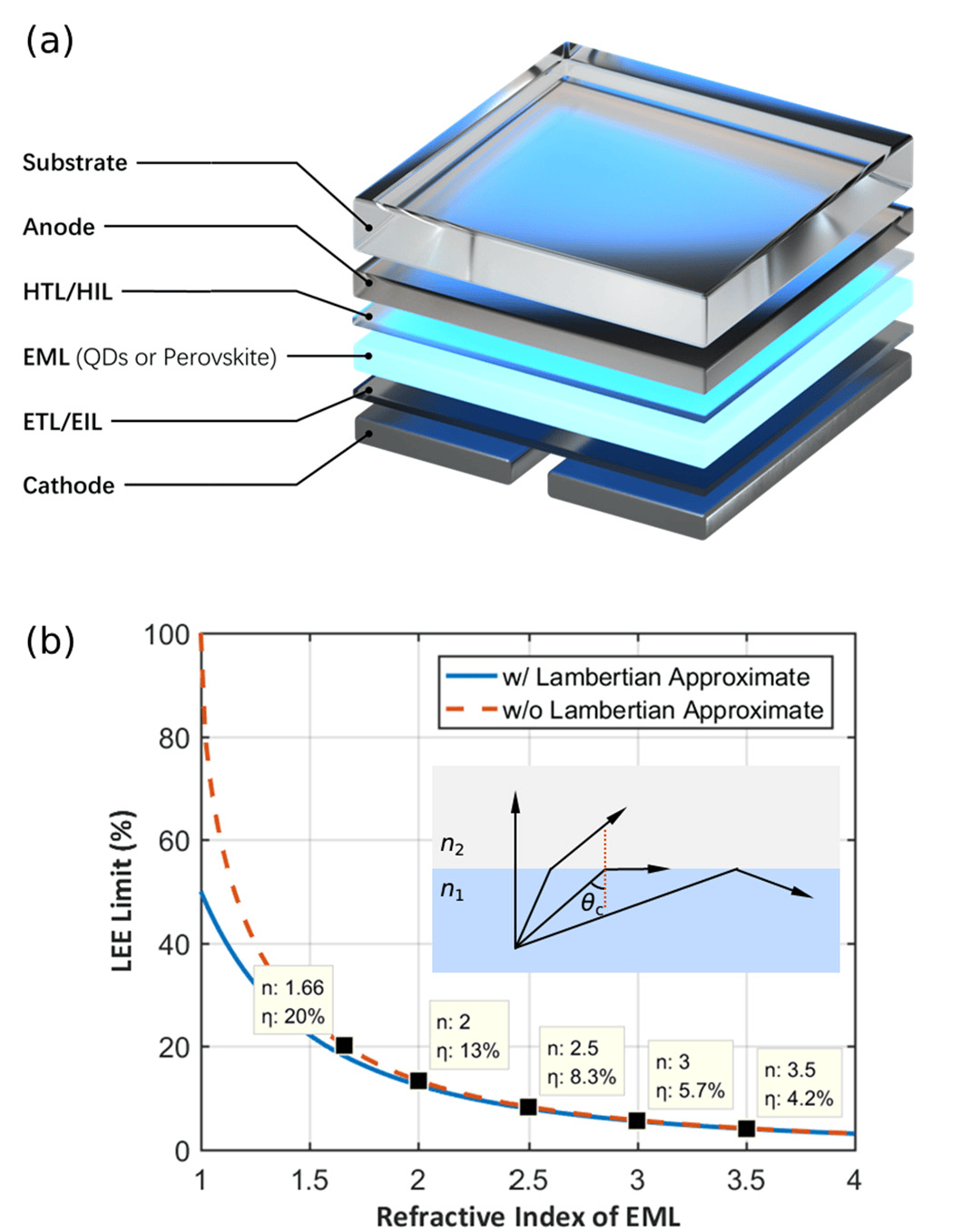
so higher-index emission layers (such as QLED/PeLED) have lower geometric LEE. This is only an approximation: because device layers are sub-wavelength, microcavity, Purcell, waveguide, and SPP effects coexist, Snell-based geometric optics cannot resolve the loss budget, and a wave-optics (CPS-type) model is required.
Spontaneous emission is not an intrinsic material property; the optical environment (device structure) modifies it, so quantum efficiency can be engineered structurally. The environment-modified radiative decay rate is
where is the environment-modified decay rate, the intrinsic decay rate, the intrinsic quantum efficiency, and the Purcell factor; when , . The Purcell factor gives the effective quantum efficiency
and the lifetime ratio
Different dipole orientations have different ; enhancing horizontal and suppressing vertical dipoles via the microcavity raises LEE and cuts waveguide/SPP loss. also varies with wavelength. The Purcell factor can be written as an in-plane-wave-vector integral
where the integrand is the dissipated-power spectrum; integrating it gives .
Two units for an emission spectrum
An emission spectrum can be expressed as photon number or radiant power per unit wavelength. The two forms are related by the energy of one photon:
Here, is the energy of one photon at wavelength , is the Planck constant, and is the speed of light in vacuum. is the photon-number spectral density, while is the radiant-power spectral density. Cross-wavelength Mode averages use because LEE and EQE are photon-number ratios. Power Dissipation, Intensity, and CIE chromaticity use because they describe radiant power or are integrated from a power spectrum.
At a fixed wavelength, , , lifetime, and mode boundaries depend only on the structure and dipole conditions at that wavelength, not on Spectrum Unit. A cross-wavelength average must first convert the input spectrum to the required weighting convention.
Conversion efficiency and the loss budget
Emission can be separated into "charge recombination into excitons -> radiative or non-radiative exciton decay -> photon allocation among optical channels." The charge-balance factor and spin-formation ratio form the Conversion Efficiency
Here, is the probability that a recombination event forms an emitting exciton, is the charge-balance factor, and is the spin-statistical fraction that forms the target emitting state. acts before exciton decay and is not modified by the Purcell effect. The intrinsic quantum efficiency is mapped to the effective quantum efficiency by the Purcell effect; the intrinsic lifetime is modified by the optical environment in the same way.
Using one recombination event as the normalized reference, conversion loss, exciton non-radiative loss, and the yield into optical channel are
Here, is the fraction that does not form an emitting exciton, is the fraction that forms an exciton and then decays non-radiatively, and is the photon yield into optical channel . The factor is the conditional fraction of radiated photons entering that channel, and the values over all optical channels sum to 1. NRA on the Mode page represents only the post-formation exciton non-radiative branch; it does not include conversion loss.
Microcavity, Waveguide, and SPP
The OLED layer stack forms a micro-cavity with planar reflective interfaces at the micro/nano scale, producing wavelength-scale interference that splits into wide-angle and multiple-beam types. Wide-angle interference arises between directly emitted and bottom-reflected light, set mainly by the emitter-to-bottom-mirror distance :
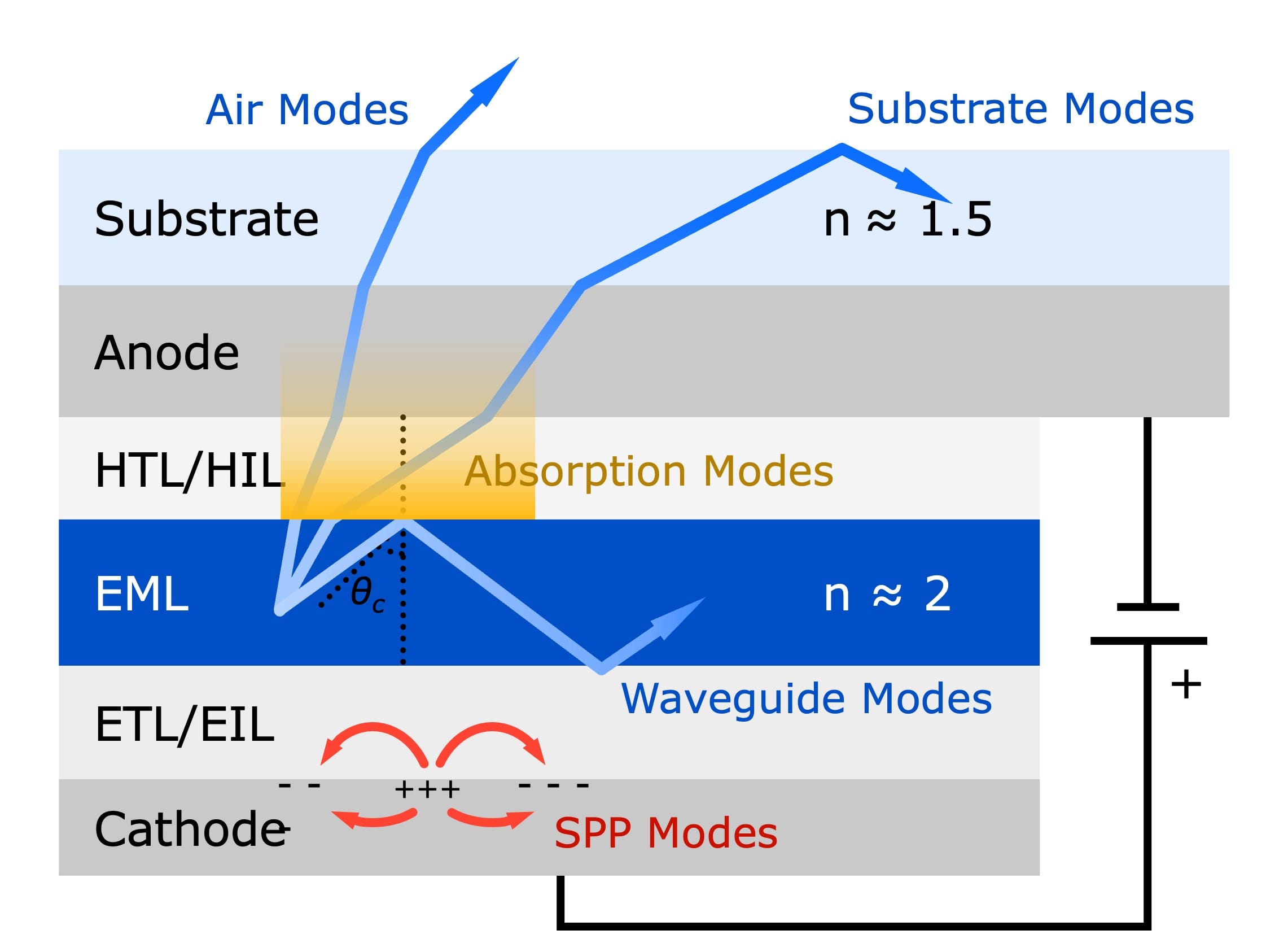
Multiple-beam interference arises from repeated round trips, set by the total cavity length :
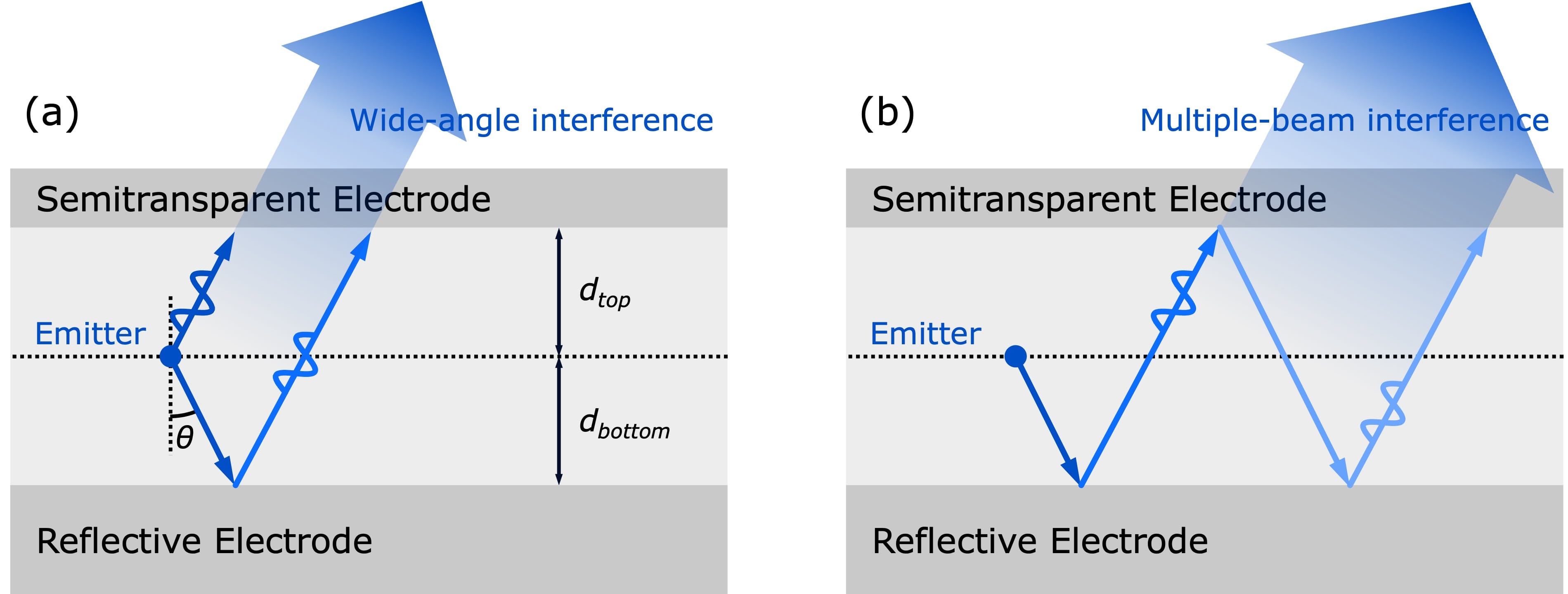
A single metal electrode forms a weak microcavity; adding a semitransparent metal electrode (or DBR) forms a strong microcavity with stronger interference. Microcavity tuning is via the emitter-reflector distance and cavity length (HTL/ETL/EML thickness, dipole position).
Totally internally reflected light forms interference-supported waveguide modes that ultimately become thermal loss. Waveguide losses are typically 30%-70% of total losses (device-dependent), so suppressing them is key to LEE. The waveguide (transverse-resonance) condition is
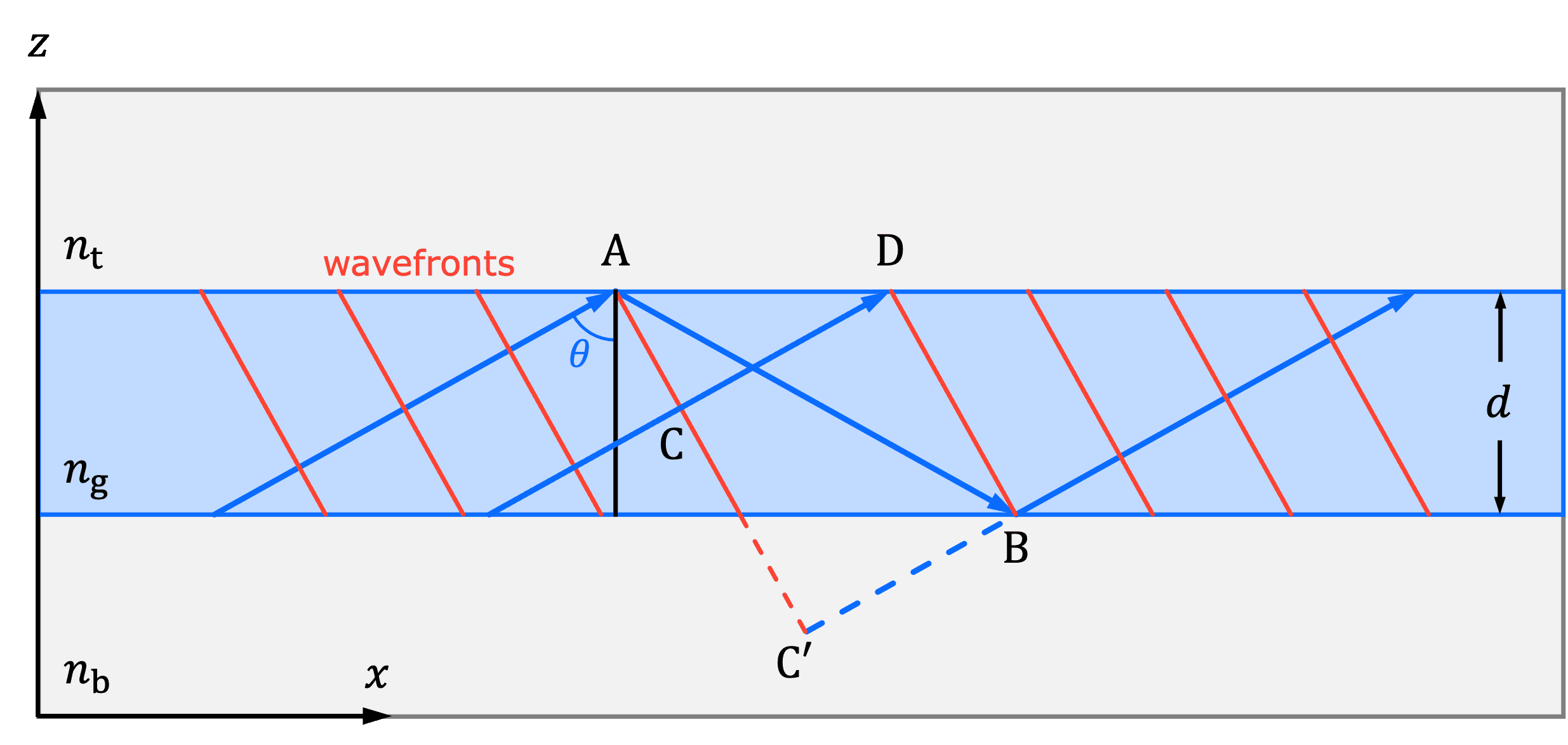
Waveguide formation depends on cavity length , index , angle , wavelength , and polarization; longer cavities admit more integer (more modes), so thinner devices are easier to control.
Near a metal-dielectric interface, the emitter couples energy into surface plasmon polaritons (SPP) through the near field, producing non-radiative loss and shortening the fluorescence lifetime (toward zero at close range). By the Drude model, the SPP resonance frequency depends on the metal and dielectric indices; for fixed materials, wavelength, dipole-metal distance, and dipole orientation control SPP loss. TM polarization is required to excite SPPs, and vertical-dipole emission is entirely TM-polarized, so vertical dipoles are the dominant SPP source.
Power Dissipation and In-Plane Wave Vector
The in-plane wave vector is the projection of the wave vector onto the interface plane:
Introducing and :
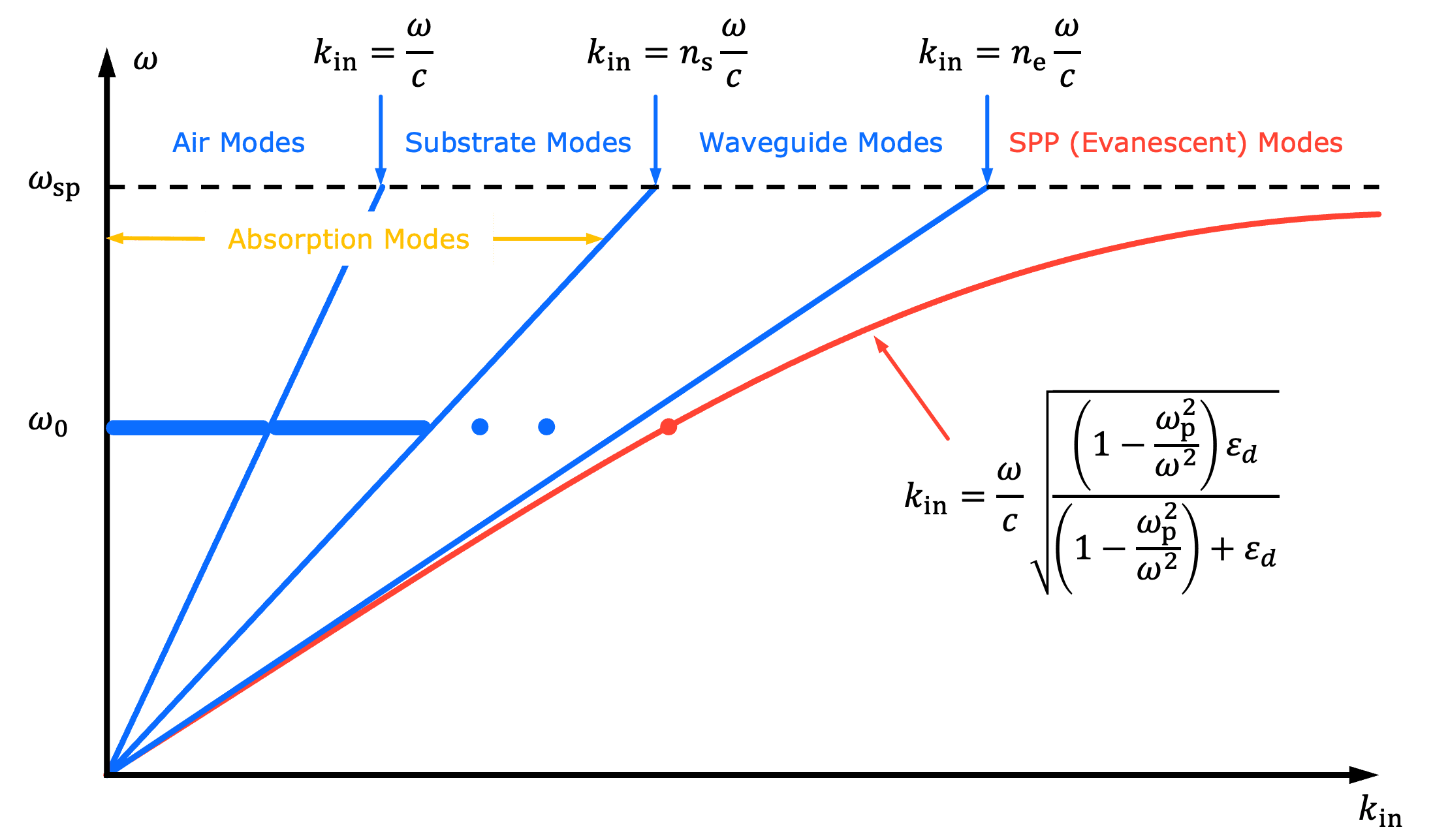
The relation of and to is wavelength-independent, so they divide modes intuitively; at (or ), , i.e. light propagates parallel to the interface inside the EML. When
then and becomes complex, corresponding to an evanescent wave, the condition for exciting SPPs.
Under microcavity/waveguide effects, the emitted energy is distributed over (different power in different directions), unlike isotropic vacuum radiation; constructive interference appears as sharp features (such as waveguide peaks), and SPP excitation appears as a distinct feature at high .
Optical Modes
Mode Boundaries and Intervals
Emitted energy is assigned to optical modes by in-plane-wave-vector interval. The light-line boundaries are
Here, and are the light-line boundaries of the top and bottom external media, is the substrate light line when a finite incoherent substrate is present in the top propagation direction, and is the EML light line. The quantities , , , and are the corresponding refractive indices, is angular frequency, and is the speed of light in vacuum. The outer boundary of the propagating channels is
Here, is the largest light-line boundary among the TOC, BOC, and SUB escape channels that are actually present; a channel absent from the structure is omitted from the maximum.
| Mode (in app) | Scientific name | Direction and range | Common description (not a definition) |
|---|---|---|---|
| TOC | — | top direction, | top-outcoupled |
| BOC | — | bottom direction, ; present for a transparent bottom boundary | bottom-outcoupled |
| TOC (top external medium is air) | Air Mode | top direction, | light extraction efficiency / outcoupling efficiency |
| SUB | Substrate Mode | top direction, ; used with an incoherent substrate | light confined in the substrate by reflection at the substrate-top medium interface |
| ABS | Absorption Mode | absorption residual in the top and bottom directions over | absorption before light reaches a TOC, SUB, or BOC escape boundary |
| WVG | Waveguide Mode | waveguide loss from total internal reflection plus interference | |
| EVA | Evanescent Mode | evanescent-wave loss, generally SPP loss | |
| NRA | Nonradiative Mode | not partitioned by a interval | exciton non-radiative loss when quantum efficiency is below 100% |
Using the same normalized exciton budget as the Mode output, let denote the total power share in the propagating in-plane-wave-vector region. Absorption Mode is defined as
Here, is the total top- and bottom-direction power share over , while , , and are the shares that have entered their respective escape channels. A channel absent from the structure contributes 0. Absorption along the bottom propagation path therefore contributes to ABS, whereas power that escapes through the bottom boundary contributes to BOC and is not counted again as ABS.
Outcoupling Efficiency and the Non-radiative Share
For one emitter with air as the top medium, the TOC fraction shown on the Mode page is
Here, is the top-outcoupled share of the normalized exciton budget, is the effective quantum efficiency, and is the light extraction efficiency LEE. Device external quantum efficiency is
Here, is the device external quantum efficiency and is Conversion Efficiency. TOC equals LEE when ; TOC equals EQE when . Air Mode is also called Outcoupled / Leaky Mode, and Evanescent Mode is also called SPP Mode.
The non-radiative share on the Mode page is
Here, is the non-radiative share after exciton formation. It is not and does not include the conversion loss ; is the intrinsic quantum efficiency. All efficiencies and shares above are dimensionless.
Mode Partition Conditions
Mapping to App Outputs
| Output / detector | Physical origin | Interpretation focus |
|---|---|---|
Power Dissipation | Dissipated power vs (or , ) | Per-channel dispersion, waveguide peaks, and SPP features |
Intensity | Dipole emission intensity exiting the stack | Forward emission intensity vs angle/wavelength |
Mode | Energy shares partitioned by interval | TOC/BOC/SUB/ABS/WVG/EVA/NRA shares and EQE, LEE |
Intensity Color | Color representation of exit intensity | Intensity color distribution vs wavelength |
Normalized Spectrum | Intensity vs wavelength (normalized) | Forward emission spectral shape |
Normalized Angular Distribution | Intensity vs angle (normalized) | Forward angular intensity distribution |
Emission | Combined output of Purcell factor , effective quantum efficiency, etc. | Structural modulation of spontaneous emission (including the wavelength dependence of ) |
Next
Continue with Emission Modeling and Emission Detectors.